Morocco: Imperial Cities and the Sahara
When to go
March to May and October to November. In July and August the desert stretch between Merzouga and Ouarzazate passes forty-five degrees by noon and the dunes are unbearable before evening. In winter the Atlas passes — Ifrane, Midelt and the Tizi n’Tichka on the way to Marrakesh — can close for snow, and Ifrane holds the record for the coldest temperature ever measured in Morocco. Check the dates of Ramadan: the roads are empty, but in the countryside most cafés stay closed until sunset.
The stops
Interactive map of the route on our site ›
- Casablancaone night
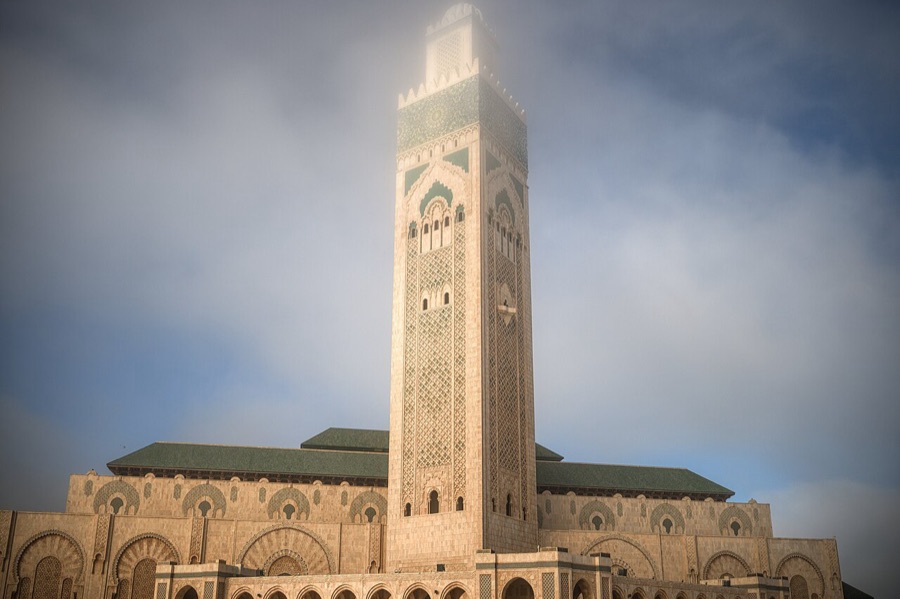
On the edge of the city stands the Museum of Moroccan Judaism, opened in 1997 and for many years the only Jewish museum in the Arab world. A few kilometres away, the minaret of the Hassan II Mosque rises two hundred and ten metres over the Atlantic, built partly on the sea itself.
- Rabatone night
The Hassan Tower is the stump of what was meant to be the largest mosque in the world, begun in 1195. When its builder, the sultan Yaqub al-Mansur, died four years later the work stopped, and the tower and some three hundred and fifty columns have stood unfinished ever since.
- Moulay Bousselhamone night
A fishing village on the Atlantic beside the Merja Zerga, a tidal lagoon protected under the Ramsar convention on wetlands, where flamingos and tens of thousands of other water birds spend the winter. Fishermen take visitors out on the lagoon in rowing boats at dawn.
- Lixusstop on the way
A Phoenician and then Roman town on a hill above the Loukkos river, which ancient writers placed beside the Garden of the Hesperides and its golden apples. Below the hill lie the vats of one of the largest fish-salting works in the Roman west.
- Laracheone night
A port at the mouth of the Loukkos that was Spanish from 1911 to 1956, which left it whitewashed houses with blue shutters and a round plaza. The French writer Jean Genet asked to be buried here, and lies since 1986 in the old Spanish cemetery above the sea.
- Ksar el-Kebirstop on the way
Near here, in August 1578, was fought the Battle of the Three Kings, in which King Sebastian of Portugal, the sultan Abd al-Malik and the deposed sultan he had come to restore all died. The Jews of Morocco, who feared a Portuguese conquest, kept a day of thanksgiving for the victory, the Purim of the Christians.
- Chefchaouen2 nights
A mountain town founded in 1471 and closed to Christians until the Spanish arrived in 1920. Its walls are washed in blue; the most common explanation credits the Jewish families who came here from Spain and painted with the blue of the sky.
- Asjenstop on the way
Above the village lies the tomb of Rabbi Amram ben Diwan, an emissary from Hebron who died here in the late eighteenth century. Every Lag BaOmer thousands of Jews from Israel, France and Morocco gather for the hillula, with candles, music and meat roasted on the hillside.
- Ouezzaneone night
A holy town of the Rif foothills that grew up around the zawiya, the Sufi lodge, of the sharifs of Ouezzane, founded by Moulay Abdallah Sherif, whose order spread across North Africa. It is the nearest town to the tomb of Rabbi Amram ben Diwan at Asjen, and on Lag BaOmer its hotels fill with pilgrims.
- Volubilisstop on the way
The ruins of a Roman city at the far edge of the empire, with mosaic floors still in place in the houses, among them Orpheus charming the animals. Much of it was shaken down not by invaders but by the Lisbon earthquake of 1755.
- Moulay Idrissstop on the way
A white town on two hills facing Volubilis, built around the tomb of Idris I, who arrived here in 789 and founded the first Muslim dynasty of Morocco. It is the holiest town in the country, and until 2005 non-Muslims were not allowed to stay the night.
- Meknesone night
The imperial city of Moulay Ismail, who ruled Morocco from 1672 to 1727 and surrounded it with some forty kilometres of walls. Its great gate, Bab Mansour, is named after its architect, a Christian convert, and the royal granaries and stables were said to hold twelve thousand horses.
- Fes2 nights
The mellah of Fes, beside the royal palace, was the first Jewish quarter in Morocco, created in 1438, and gave its name to every Jewish quarter in the country. Maimonides lived in Fes for some years in the 1160s, before leaving for Egypt; the restored Ibn Danan synagogue in the mellah dates from the seventeenth century.
- Sefroustop on the way
A small walled town under the Middle Atlas whose Jewish community was so large and so learned that it was called the little Jerusalem of Morocco; for centuries Jews were close to half its people. Every June it holds a cherry festival, inscribed by UNESCO in 2012 as intangible heritage.
- Ifraneone night
A town built by the French in the 1920s as a mountain resort, with pitched roofs and gardens like a village in the Alps. In 1935 it recorded minus twenty-four degrees, the coldest temperature ever measured in Morocco.
- Cedar forest of Azroustop on the way
The Middle Atlas holds the largest forests of Atlas cedar in the world. In them live Barbary macaques, the only macaques found outside Asia and an endangered species, which wait for visitors at the clearing of the Gouraud cedar; do not feed them.
- Mideltone night
A high plateau town between the Middle and High Atlas, famous for its apples, where roadside stalls sell fossils, crystals and geodes dug from the old mines of the area.
- Hassan Addakhil Damstop on the way
The dam on the Ziz river above Errachidia, whose water feeds the palm groves of the Tafilalet downstream. It is named after al-Hassan ad-Dakhil, the ancestor of the Alaouite kings, who came from Arabia to the Tafilalet in the thirteenth century.
- Errachidiaone night
The capital of the Tafilalet, built by the French as a garrison town called Ksar es-Souk. It was renamed after Moulay al-Rashid, the seventeenth-century sultan who founded the Alaouite state, and it is the last real town before the desert.
- Meski Blue Springstop on the way
A spring that rises in a palm grove under the ruined ksar of Meski, collected into a swimming pool by the French Foreign Legion. Local families come here to swim and picnic, and the Ziz valley below is one long ribbon of palms.
- Erfoudstop on the way
A town of date palms and fossils. Each autumn, after the harvest, it holds a date festival, and its workshops cut and polish the black local stone, full of fossil sea creatures hundreds of millions of years old, into tables and basins.
- Merzouga2 nights
The village at the foot of Erg Chebbi, a sea of dunes up to about a hundred and fifty metres high. In nearby Khamlia live the Gnawa, descendants of people brought across the desert as slaves, whose drum music is now known worldwide.
- Rissanistop on the way
Beside the town lie the ruins of Sijilmasa, founded in 757, the northern port of the caravans that crossed the Sahara with gold, salt and slaves. The Alaouite dynasty, which still rules Morocco, came from here.
- Tinghirone night
The oasis town had a large Jewish community, whose families left for Israel in the 1950s and 60s. A Moroccan filmmaker born here, Kamal Hachkar, traced them to Israel in the 2012 film Tinghir–Jerusalem; the empty mellah still stands among the palms.
- Todra Gorgestop on the way
A river canyon whose rock walls rise about three hundred metres and close in at the narrowest point to barely ten metres apart, with the road squeezed between them and the stream.
- Dades Gorgestop on the way
A valley of rock formations nicknamed the monkey fingers, and higher up a road that climbs the canyon wall in a tight stack of hairpin bends, one of the most photographed roads in Africa.
- Boumalne Dadesone night
A town on a bluff where the Dades gorge opens onto the valley. Twenty-four kilometres west lies Kelaat M’Gouna, the valley of roses, where Damask roses are grown for rose water and the harvest is celebrated every May with a festival.
- Skourastop on the way
A palm oasis of mud-brick kasbahs; one of them, the Kasbah Amridil, is the building printed on the Moroccan fifty-dirham note.
- Ouarzazatestop on the way
The Hollywood of Morocco: its film studios, opened in 1983, have stood in for Egypt, Rome and Jerusalem. Outside the town lies Noor, one of the largest concentrated solar power plants in the world.
- Ait Benhaddouone night
A fortified village of mud brick on the old caravan road over the Atlas, a World Heritage site since 1987, which has appeared in films from Lawrence of Arabia to Gladiator.
- Tizi n’Tichkastop on the way
The pass at about 2,260 metres that carries the road from the Sahara side of the High Atlas to Marrakesh, the highest major road pass in Morocco. The road over it was built by the French in the 1930s along the old caravan route; it is often closed by snow in winter.
- Marrakesh3 nights
In the mellah stands the Slat al-Azama synagogue, said to have been founded by Jews expelled from Spain in 1492 and still in use. Nearby, the square of Jemaa el-Fna, with its storytellers and musicians, was among the first places UNESCO recognised in 2001 as intangible heritage.
- Ounaghastop on the way
The heart of argan country. The argan tree grows wild almost nowhere but south-western Morocco, and the region was made a UNESCO biosphere reserve in 1998; along this road the women’s cooperatives crack the nuts by hand for oil, and goats climb into the branches to eat the fruit.
- Essaouira2 nights
In the nineteenth century, when the town was called Mogador, Jews made up close to half its population and ran much of its trade with Europe. In 2020 the King of Morocco opened Bayt Dakira, the house of memory, a museum of that shared history beside a restored synagogue.

What it costs
Eighty dollars a night is the room. The car, the fuel and the tolls are yours: the motorway from Casablanca to Fes is tolled in cash or by card, and the roads south of the Atlas are free. Fuel is cheaper than in Europe and stations thin out after Midelt — fill up whenever you see one. The cost nobody budgets for is the parking guardian: in every town a man in a vest watches your car for a few dirhams, day and night, and he is worth it. The hotels in the old medinas of Fes, Marrakesh and Chefchaouen cannot be reached by car; you park outside the walls and a porter with a handcart carries your bags in.
What to know
Three things. One: the police checkpoints. They stand at the entrance to almost every town, the speed limit drops sharply just before them and radar is common; fines are paid on the spot, so carry cash, your passport, the rental contract and an international driving permit. Two: do not drive after dark outside the cities — unlit carts, donkeys, cyclists and people walking on the road are the real danger here. Three: the two long days. The crossing of the High Atlas from Ait Benhaddou to Marrakesh, over the Tizi n’Tichka, and the road from Marrakesh to Essaouira are each some hundred and seventy to hundred and eighty-five kilometres with little to stop for; leave in the morning and keep them for driving. For Israeli passport holders: entry rules and security advice change — check them, and the Israeli travel advisory, before booking.
Roads, tolls and rules
Morocco drives on the right. The motorways in the north are modern and tolled; south of the Atlas the national roads are good tarmac but narrow, and the N13 from Midelt to Errachidia and the N10 through the gorges carry heavy lorries. The pace is slow on purpose: a night in every town on the way, so most days are a hundred to a hundred and fifty kilometres, and the desert stretch from Fes to Marrakesh, which most tours drive in three days, takes eight here. Rental cars are usually small and manual; an automatic must be booked well ahead. Speed limits are 120 on motorways, 100 on main roads and 60 in towns, and they are enforced. Fuel is diesel and petrol everywhere, but there are long empty stretches in the desert. Driving into the medinas is impossible, and in Merzouga the last kilometres to the dunes are sand: leave the car at the hotel and go by camel or four-by-four.

Travel Morocco: Imperial Cities and the Sahara
The route on our site, with a room up to $80 every night.