Uzbekistan: The Silk Road by car
When to go
April to early June, and September to October. In those months the days are warm and the evenings cool, and the gardens of Samarkand are green. In July and August Bukhara and the steppe pass forty degrees, and the tiled courtyards hold the heat into the night. In winter the nights fall below zero, snow can close the Takhtakaracha Pass between Samarkand and Shahrisabz, and the days are short for the long drives.
The stops
Interactive map of the route on our site ›
- Tashkentone night
On 26 April 1966 an earthquake destroyed much of the old city, and the Tashkent you see was rebuilt by the Soviets around wide avenues; its metro, opened in 1977, was the first in Central Asia. In the Second World War tens of thousands of Jewish refugees from the west of the Soviet Union found shelter here.
- Khast Imamstop on the way
On the way out through the old city. The library of this religious complex keeps a Quran written on parchment in the first centuries of Islam, which tradition links to the Caliph Uthman; the Russians took it to Saint Petersburg in 1869, and it came back to Tashkent only in the 1920s. Chorsu Bazaar, under its great green dome, is a few minutes away.
- Chinazstop on the way
Here the road crosses the Syr Darya, the river the Greeks called the Jaxartes; upstream, near Khujand, Alexander the Great fought the Scythians on its banks in 329 BCE. It runs more than two thousand kilometres to the Aral Sea, and so much of its water is taken for cotton that little of it arrives.
- Gulistanone night
The capital of the Hungry Steppe, a plain so dry that caravans crossed it as fast as they could. Grand Duke Nicholas Konstantinovich, a grandson of Tsar Nicholas I exiled to Tashkent, dug the first canals here before the First World War, and from the 1950s the Soviets turned the steppe into cotton fields; the regional museum in the centre tells the story.
- Zominstop on the way
A small town at the foot of the Turkestan range, the gateway to Zaamin National Park, created in 1976 as the first national park in Uzbekistan, with old juniper forests on the slopes above. The local museum is in the centre; the road then turns west along the foothills to Jizzakh.
- Jizzakhone night
The town of the poet Hamid Olimjon, born here in 1909, and the museum in the centre is shared with his wife, the poet Zulfiya. In July 1916, when the Tsar ordered the men of Central Asia to dig trenches behind the front, Jizzakh rose in the bloodiest revolt in Uzbekistan, and the Russian army crushed it.
- Tamerlane’s Gatestop on the way
Amir Temur Darvoza: a narrow gorge where the road and the river squeeze between two walls of rock, the natural gate on the way to Samarkand. Ulugh Beg had an inscription carved on the rock in 1425 to mark the passage of his army against the Moghuls.
- Ulugh Beg Observatorystop on the way
On the way into Samarkand. Timur’s grandson Ulugh Beg built a three-storey observatory here in the 1420s, and his catalogue of about a thousand stars was the greatest since Ptolemy. It was destroyed after his murder in 1449; in 1908 the archaeologist Vasily Vyatkin found the underground arc of its giant sextant, which is what you see.
- Samarkand3 nights
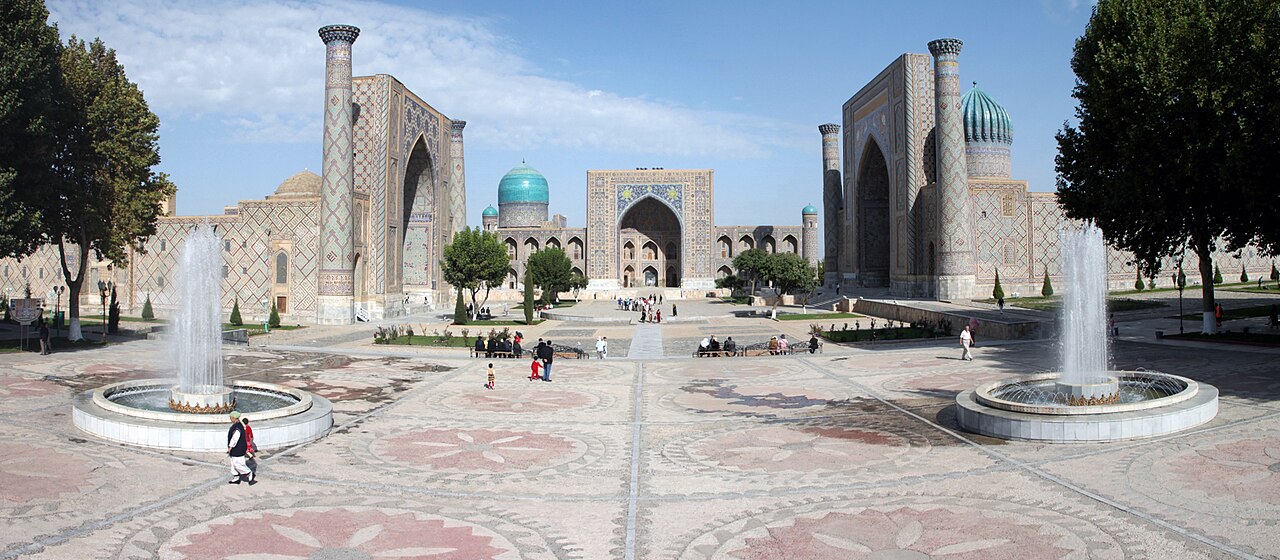
Timur’s capital, and the Registan is its heart: the madrasa of Ulugh Beg of 1417 to 1420, the Sher-Dor, finished in 1636, whose façade shows tigers chasing deer with a human sun on their backs despite the Islamic ban on images, and the gilded Tilla-Kari between them. A few minutes north stands Bibi-Khanym, the great mosque Timur built after his campaign in India in 1399.
- Gur-e Amirstop on the way
The tomb of Timur, who died in 1405, under a ribbed turquoise dome. In June 1941 the Soviet anthropologist Mikhail Gerasimov opened the grave despite a legend that it would unleash war; two days later Germany invaded the Soviet Union, and Timur was reburied with Islamic rites in 1942.
- Shah-i-Zindastop on the way
An avenue of tiled mausoleums climbing a hill, built from the eleventh to the nineteenth centuries, many of them for the women and generals of Timur’s family. Its name means the Living King, after Qusam ibn Abbas, a cousin of the Prophet, who according to legend never died and still lives below.
- Gumbaz Synagoguestop on the way
In the old Jewish quarter east of Bibi-Khanym stands the Gumbaz Synagogue, built in 1891 and named for its dome, still open for prayer. The Bukharan Jews lived in Samarkand for centuries and spoke their own dialect of Persian, written in Hebrew letters; most left for Israel and America after 1991.
- Takhtakaracha Passstop on the way
The road to Shahrisabz climbs in hairpins over the Zarafshan range to about 1,700 metres, with stalls of dried fruit and views back over the Samarkand valley. When snow closes it, the traffic goes round by a much longer road to the west.
- Kitabstop on the way
A quiet town with an unusual place in science: since 1930 it has had one of the international latitude stations, a chain of observatories on the same parallel, 39°08′ north, in Japan, Italy and the United States, that measured the slow wobble of the Earth’s poles.
- Shahrisabzone night
Timur was born near here in 1336, and in 1380 he began the Ak-Saray, the White Palace, of which only the stumps of the gate, still almost forty metres high, survive; the inscription said: if you doubt our power, look at our buildings. He had a crypt built for himself in the town, but he died in winter in 1405, snow blocked the passes, and he was buried in Samarkand.
- Dorut Tilavatstop on the way
On the way out of town, a short walk south of the palace: the Kok Gumbaz, the blue-domed Friday mosque that Ulugh Beg built in 1435 in memory of his father, Shah Rukh, and the mausoleums of Timur’s ancestors beside it. In 2016 UNESCO put Shahrisabz on its list of World Heritage in Danger after a renovation cleared much of the old town around them.
- Odina Mosquestop on the way
At the edge of the old town of Karshi, a sixteenth-century mosque and madrasa of the Shaybanid era. Karshi was Nasaf, or Nakhshab, in the early Islamic centuries, where according to legend the rebel prophet al-Muqanna, the Veiled One, made an artificial moon rise every night from a well in the eighth century.
- Karshione night
The capital of Kashkadarya, a working city off the tourist trail. Its name means palace in Mongolian, after the palace that the Chagatai khan Kebek built here in the fourteenth century; the blue dome of the Kok Gumbaz, the sixteenth-century Friday mosque, still rises over the old town.
- Kaganstop on the way
New Bukhara, founded in 1888 when the Russian railway passed twelve kilometres from the old city, which did not want it. Here the Emir of Bukhara built a palace in Russian and Oriental style to receive the officials of the Tsar; it is now a museum.
- Bukhara2 nights
The Kalyan Minaret, built in 1127, so impressed Genghis Khan in 1220 that he spared it while burning the city; in front of the Ark fortress the Emir beheaded two British officers, Stoddart and Conolly, in 1842. Beside the Lyab-i Hauz pool lies the old Jewish quarter, where the Bukharan Jews still keep a working synagogue.
- Sitorai Mohi Khosastop on the way
The summer palace of the last Emir of Bukhara, Alim Khan, built from 1912 to 1918 with the help of Russian engineers; the name means the Palace of the Moon and Stars. Two years after it was finished the Red Army took Bukhara and the Emir fled to Afghanistan.
- Bahauddin Naqshbandstop on the way
The shrine of Bahauddin Naqshband, who died in 1389 and founded the Naqshbandi order, one of the largest Sufi orders in the Muslim world. Pilgrims come from Turkey to Indonesia, and it is the holiest place in Bukhara.
- Chor-Bakrstop on the way
A city of the dead west of Bukhara, built in the sixteenth century around the grave of a tenth-century descendant of the family of Abu Bakr, with lanes, courtyards and family tombs of the Juybari sheikhs, who were richer and more powerful than many khans.

What it costs
Eighty dollars a night is the room. The car and the fuel are yours, and fuel in Uzbekistan is cheap by European standards. The real extras are two. First, the rental: self-drive hire is still young here, the companies are few and mostly in Tashkent, and leaving the car in Bukhara is a one-way drop that has to be arranged and paid for in advance. Second, the tickets: the Registan, Gur-e Amir, Shah-i-Zinda, the Ark of Bukhara and almost every madrasa charge their own entry, and a photo ticket is sometimes extra. Parking is mostly free; the old centre of Bukhara is closed to cars.
What to know
Three things. One: police posts. At the borders between regions the road passes fixed police checkpoints, where cars slow down and are sometimes stopped; keep your passport, your licence with an international driving permit, and the rental papers within reach, and keep to the speed limits, which are watched by many cameras. Two: fuel. Most cars in Uzbekistan run on methane or propane, and many stations sell only gas; stations with petrol are fewer, and the higher octane is not always on sale, so fill up whenever you see one, and ask the rental company which fuel the car takes. Three: the dark. Outside the cities the roads have potholes, carts, cattle and unlit trucks, so plan every leg to arrive before sunset. Hotels must register foreign guests with the authorities; keep the small registration slips they give you until you leave the country.
Roads, tolls and rules
Uzbekistan drives on the right. The route follows the old caravan road south-west from Tashkent, first across the irrigated cotton country of the Hungry Steppe, then over the Turkestan foothills to Samarkand, across the Zarafshan range to Shahrisabz, and through the steppe of Kashkadarya to Bukhara; the drives are short, but the roads are slower than the map suggests. The longest day is the last, from Karshi to Bukhara, about two and a half hours over open steppe with one stop. Beyond Bukhara the road to Khiva crosses about 450 kilometres of the Kyzylkum desert with no town worth a night on the way, so this route ends in Bukhara: Khiva is reached by train, most of a day across the desert, and the fast Afrosiyob train runs from Bukhara back to Tashkent in about four hours.

Travel Uzbekistan: The Silk Road by car
The route on our site, with a room up to $80 every night.