Crete: From Heraklion to Chania
When to go
May to June and September to October. In July and August Heraklion and the south coast pass thirty-three degrees, the beaches of Balos and Elafonisi are packed by mid-morning, and the meltemi, the strong north wind of the Aegean summer, can cancel the boats. The sea stays warm enough to swim until the end of October. In winter the White Mountains and Mount Ida are under snow, and many hotels on the south coast close from November to April.
The stops
Interactive map of the route on our site ›
- Agios Nikolaos2 nights
A harbour town on the Gulf of Mirabello built around Lake Voulismeni, a deep round pool that was joined to the sea by a channel cut in the 1870s; by legend it has no bottom. Elounda and Plaka, where the boats leave for Spinalonga, are a short drive north along the gulf.
- Spinalongastop on the way
An islet fortified by the Venetians in 1579, which held out against the Ottomans until 1715, long after the rest of Crete had fallen. From 1903 to 1957 it was a colony for people with leprosy, among the last in Europe; Victoria Hislop’s novel The Island is set here. Boats cross from Agios Nikolaos, Elounda and Plaka.
- Panagia Kera, Kritsastop on the way
A small whitewashed church below the hill village of Kritsa, with three aisles painted inside with frescoes of the thirteenth and fourteenth centuries, among the finest Byzantine paintings on Crete. Above the village are the ruins of Lato, a Dorian city on a saddle between two peaks.
- Malia Palacestop on the way
The third-largest Minoan palace on Crete, on the flat shore east of the resort of Malia, left without the concrete rebuilding of Knossos. In the cemetery nearby was found the gold pendant of two bees holding a drop of honey, of about 1700 before the common era, now in the museum in Heraklion.
- Knossosstop on the way
The largest Minoan palace, the seat, in the Greek myth, of King Minos and the labyrinth of the Minotaur. Arthur Evans dug here from 1900 and rebuilt parts of it in reinforced concrete, with the red columns and painted copies of frescoes that visitors see today; the originals are in Heraklion.
- Creteone night
Heraklion, the capital of Crete, ringed by Venetian walls more than four kilometres long. Its Archaeological Museum holds the Minoan treasures, among them the Phaistos Disc. On the Martinengo bastion lies Nikos Kazantzakis, who was born here, under his epitaph: I hope for nothing, I fear nothing, I am free.
- Gortynastop on the way
The Roman capital of Crete and of Cyrenaica, on the Messara plain. Its Law Code, of the fifth century before the common era, is carved on the wall of a round building in lines that run alternately left to right and right to left, and is the longest legal inscription in ancient Greek; beside it stands the ruined basilica of Saint Titus, Paul’s companion and the first bishop of Crete.
- Phaistosstop on the way
A Minoan palace on a ridge above the Messara plain, with Mount Ida behind it. In 1908 the Italian archaeologist Luigi Pernier found here a disc of fired clay stamped on both sides with a spiral of signs; more than a century later no one has read it.
- Matalaone night
A bay on the Libyan Sea under a sandstone cliff full of tombs carved in Roman times. In the 1960s hippies from across Europe and America lived in the caves, until the church and the police drove them out; Joni Mitchell wrote of the place in her song Carey.
- Spilistop on the way
A mountain village on the road between the two coasts, with a long Venetian fountain in its square where spring water pours from a row of carved stone lion heads. The cafés around it are a usual stop on the way to the south.
- Preveli Monasterystop on the way
A monastery on a terrace high above the Libyan Sea. After the Battle of Crete in 1941 its monks hid British, Australian and New Zealand soldiers and helped them escape by submarine from the beaches below, and the Germans looted the monastery in reprisal. Below it, a palm grove lines the mouth of the Megalopotamos river at Preveli beach.
- Rethymnoone night
A Venetian and Ottoman old town of lanes, wooden balconies and minarets. After the Ottoman corsair Uluç Ali sacked the town in 1571, the Venetians built the Fortezza on the hill above it; the Rimondi Fountain of 1626 still runs in the old town.
- Arkadi Monasterystop on the way
In November 1866, during the Cretan revolt against Ottoman rule, hundreds of rebels, women and children were besieged here; when the walls were breached they blew up the powder store, killing themselves and many of the attackers. The explosion turned opinion in Europe toward the Cretan cause, and Arkadi became the national shrine of the island.
- Lake Kournasstop on the way
The only natural freshwater lake on Crete, fed by springs at the foot of the White Mountains, a few kilometres inland from Georgioupoli. Its colour changes from green to blue with the light; pedal boats go out on it, and freshwater turtles live along the shore.
- Chania2 nights
The Venetian harbour, with its lighthouse and the domed Küçük Hasan mosque of the seventeenth century, is the face of the old capital of Crete. In the old Jewish quarter stands the Etz Hayyim synagogue, restored and reopened in 1999. In May 1944 the Germans rounded up the Jews of Chania; the ship Tanais, carrying them toward the mainland, was sunk by a British submarine on 9 June, and all on board were lost.
- Elafonisistop on the way
An islet joined to the south-west tip of Crete by a sandbar and shallow water you can wade across, with sand tinted pink by crushed shells. It is a protected nature area; on Easter Day 1824 Ottoman soldiers massacred hundreds of Cretan refugees who had hidden on the island, and a memorial stands on its hill.
- Chrysoskalitissa Monasterystop on the way
A white monastery perched on a rock above the sea, its name meaning Our Lady of the Golden Step. By tradition one of the stairs that climb to it is of gold, but only those without sin can see it.
- Kissamos2 nights
A quiet farming town on its own gulf, once the port of the ancient city of Polyrrhenia in the hills behind it. The archaeological museum, in the old Venetian governor’s house, shows Roman floor mosaics found under the town, and from the port of Kavonisi the boats leave for Gramvousa and Balos.
- Balos and Gramvousastop on the way
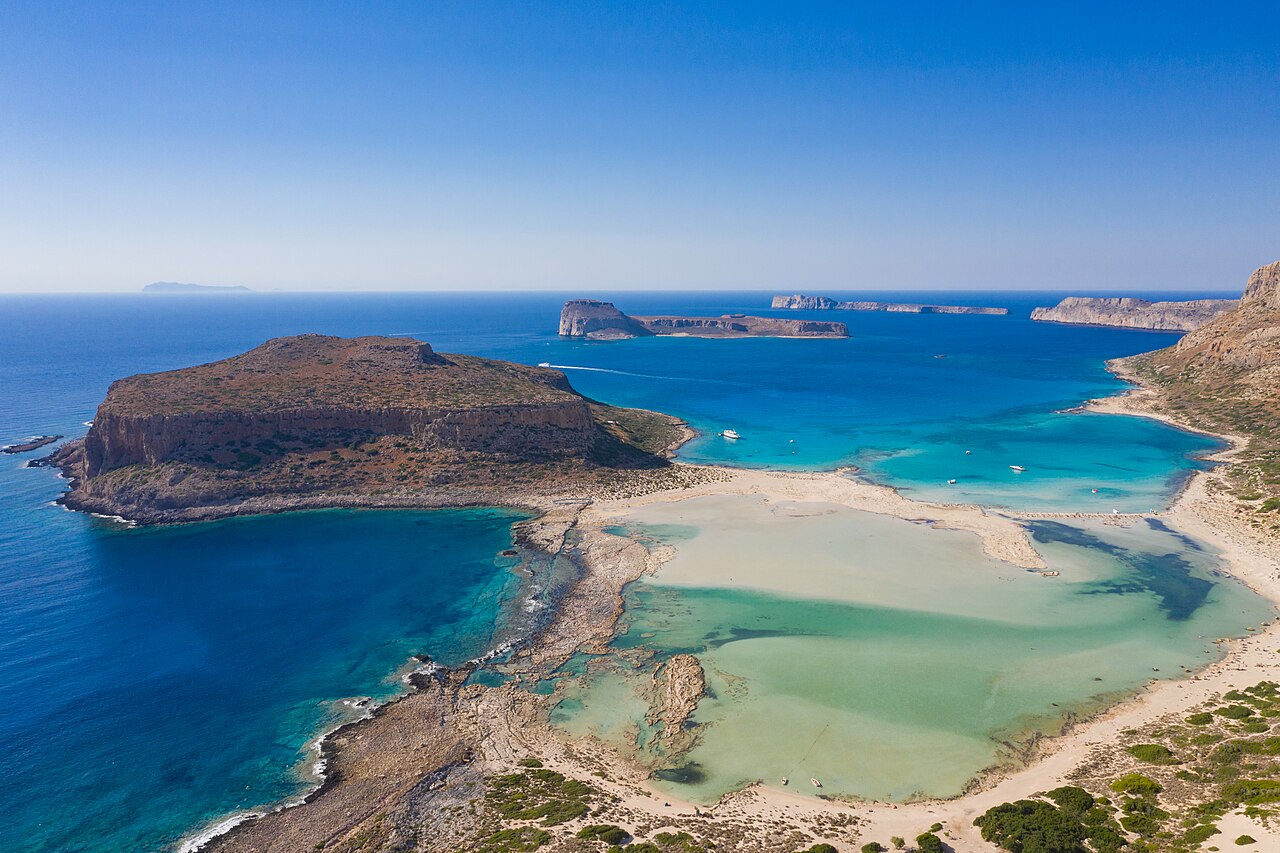
A shallow lagoon of white sand and turquoise water at the tip of the Gramvousa peninsula. The boats from Kissamos stop first at the islet of Imeri Gramvousa, where a Venetian fortress on the summit became a base of Cretan rebels and pirates in the 1820s.
- Falasarnastop on the way
A long sandy beach on the west coast, the place on Crete to watch the sun set. Beside it lie the ruins of a Hellenistic port whose harbour now stands on dry land, some hundred metres from the sea, because an earthquake in 365 lifted western Crete by several metres.

What it costs
Eighty dollars a night is the room. The car and the fuel are yours, and the north road of Crete has no toll booths, so there are no tolls to add. Parking in the old towns of Chania and Rethymno is paid and hard to find; leave the car in a lot outside the walls. The extras worth budgeting are the boat to Spinalonga, the tickets to Knossos and Phaistos, the boat from Kissamos to Balos and Gramvousa, and the paid car park at Elafonisi.
What to know
Three things. One: the north road, the VOAK, carries most of the island’s traffic and has one of the worst accident records in Greece; it has no barrier between the lanes along much of its length, and slower drivers move half onto the hard shoulder to let you pass, and expect you to do the same. Two: the mountain roads to the south coast are narrow and steep, goats stand on the asphalt, and the bends hide buses; sound the horn before a blind corner and drive in daylight. Three: the road to Balos is a dirt track, and most rental contracts do not cover damage on unpaved roads; this track takes the boat from Kissamos instead.
Roads, tolls and rules
Greece drives on the right. The track runs west along the north coast, with a crossing over the mountains to the Messara plain and the Libyan Sea at Matala and Preveli, then back to the north at Rethymno. The days are short, none longer than about 120 kilometres, but the mountain sections are slow. The first day is the hour from Heraklion airport east to Agios Nikolaos, and the last morning is about fifty kilometres from Kissamos to Chania airport; flying home from Heraklion instead adds some 175 kilometres of the north road.

Travel Crete: From Heraklion to Chania
The route on our site, with a room up to $80 every night.