The Garden Route: From Cape Town to Plettenberg Bay
When to go
October to April, the summer of the southern hemisphere, when the Cape is dry and sunny; January and February are the busiest and hottest, and in the Klein Karoo around Oudtshoorn the days pass thirty-five degrees. Cape Town gets its rain in winter, from June to August. The southern right whales come into the bays from June to November, best in September and October, and the Swartberg Pass can close after heavy rain or snow.
The stops
Interactive map of the route on our site ›
- Cape Town2 nights
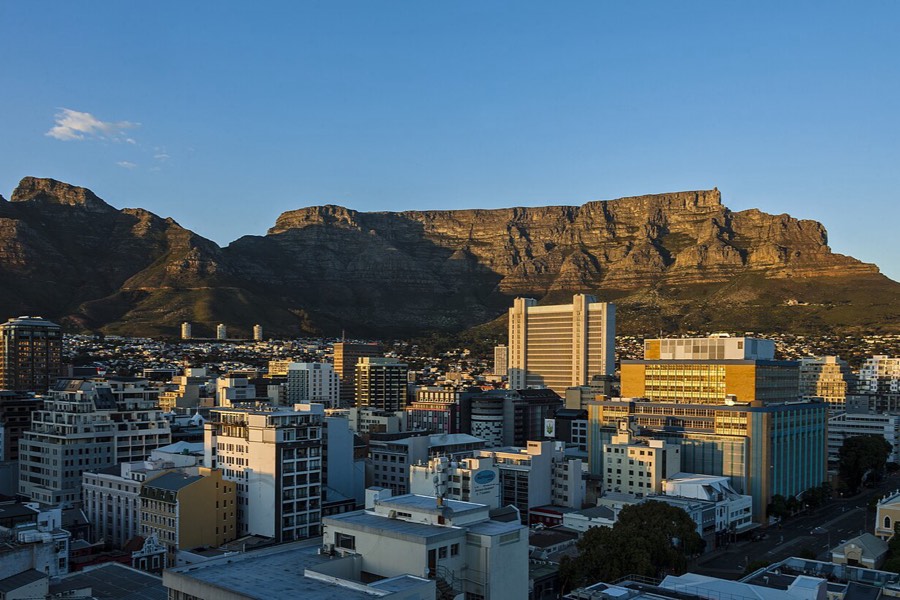
The Dutch East India Company planted the Company’s Garden in 1652 to feed its ships, and it is still a park in the city centre. Beside it stands the Old Synagogue of 1863, the first built in South Africa, and with it the South African Jewish Museum, opened by Nelson Mandela in 2000.
- Franschhoekone night
The French Corner, settled from 1688 by Huguenots, French Protestants who fled persecution after the Edict of Nantes was revoked. They brought vines with them, and many wine estates in the valley still carry French names; the Huguenot Monument stands at the end of the main street.
- Hermanusone night
In whale season the southern right whales come into Walker Bay to calve, close enough to watch from the cliff path in town. Hermanus has a whale crier, who walks the streets and blows a horn of dried kelp to tell people where the whales are.
- Swellendamone night
The third-oldest town in South Africa, after Cape Town and Stellenbosch, founded in 1743 and named after the governor Hendrik Swellengrebel and his wife Helena ten Damme. The Drostdy, the seat of the magistrate built in 1747, is now a museum, and in 1795 the burghers of Swellendam briefly declared a republic of their own.
- Barrydalestop on the way
A small town on Route 62 at the northern end of the Tradouw Pass, a road through a river gorge built by Thomas Bain, the great road builder of the Cape, and opened in 1873. Here the green of the wine country gives way to the dry Klein Karoo.
- Ladismithone night
A Karoo town at the foot of the Klein Swartberg, named, like Ladysmith in Natal, after Juana, the Spanish wife of the Cape governor Sir Harry Smith; the spelling was later changed to tell the two apart. Above the town rises Towerkop, a peak split in two at the summit.
- Calitzdorpstop on the way
A Karoo village that calls itself the port capital of South Africa. Its hot, dry summers suit the Portuguese grapes of port, and several cellars in and around the village are open for tasting.
- Oudtshoorn2 nights
Before the First World War ostrich feathers were among South Africa’s great exports, and the feather barons of Oudtshoorn built sandstone mansions called feather palaces, until the trade collapsed in 1914. Jews from Lithuania were at the heart of that trade, so many that the town was called the Jerusalem of Africa; Max Rose, the ostrich feather king, was one of them, and the C.P. Nel Museum keeps a section on the town’s Jewish history.
- Cango Cavesstop on the way
A chain of limestone halls hung with stalactites, explored by a local farmer in 1780 and shown to visitors ever since. Besides the ordinary tour there is an adventure tour that crawls through narrow squeezes and up a chimney; it is not for the claustrophobic.
- Swartberg Passstop on the way
A gravel road over the Swartberg mountains, built by Thomas Bain with convict labour and opened in 1888, with dry-stone walls that still hold it to the cliffs. It climbs in hairpins to more than fifteen hundred metres and down to Prince Albert on the other side.
- Wildernessstop on the way
A village of long beaches and lakes where the N2 comes down from the mountains to the coast. From the Map of Africa viewpoint above it, the Kaaimans River curves around a forested hill shaped like the African continent.
- Knysna2 nights
A town on a lagoon that opens to the sea through the Heads, two sandstone cliffs with a narrow and dangerous channel between them. The lagoon is home to the Knysna seahorse, found in only a few estuaries on this coast; in June 2017 wildfires burned hundreds of houses in and around the town.
- Plettenberg Bay2 nights
The Portuguese sailors who passed in the sixteenth century called it Bahia Formosa, the beautiful bay. The trail around the Robberg peninsula passes a colony of Cape fur seals, and dolphins are often seen from the beaches.
- Storms River Mouthstop on the way
A suspension bridge of seventy-seven metres hangs over the mouth of the river where it meets the sea, inside the Tsitsikamma section of the national park, whose marine reserve, declared in 1964, is among the oldest in Africa. On the way, the Bloukrans Bridge carries one of the highest bungee jumps in the world.

What it costs
Eighty dollars a night is the room. The car, the fuel and the tolls are yours; the only toll on this route is the Tsitsikamma toll plaza on the N2 on the way to Storms River, and fuel is cheaper than in Europe. The extras worth budgeting are the cableway up Table Mountain, the tour of the Cango Caves, the conservation fee at Tsitsikamma, and a few rand for the car guards wherever you park.
What to know
Three things. One: the left. South Africa drives on the left, traffic lights are called robots, and at a four-way stop every car stops and the first to arrive is the first to go. Minibus taxis stop wherever a passenger waves and pull out without warning; give them room. Two: safety. Keep bags, phones and anything of value out of sight, in the boot, even while you drive; lock the doors at the lights; do not stop in the townships after dark, and keep to daylight on the long stretches. Three: the car guards. In almost every car park a man in a bright vest will watch your car, and he lives on what drivers give him; a few rand when you leave is the custom.
Roads, tolls and rules
South Africa drives on the left. The route is driven slowly, with a night every hundred to a hundred and fifty kilometres: it leaves Cape Town for Franschhoek in the wine country and Hermanus on the coast, turns inland at Swellendam and follows Route 62 through the Klein Karoo, a dry land of mountain passes and small towns, with a night in Ladismith, then comes down to the green coast of the Garden Route on the N2. The roads are good and mostly empty, but the distances between fuel stations in the Karoo are long, so fill up in every town. The Swartberg Pass is gravel and steep; drive it slowly, in good weather. On the last day, George airport is about an hour and three quarters from Plettenberg Bay.

Travel The Garden Route: From Cape Town to Plettenberg Bay
The route on our site, with a room up to $80 every night.