Vietnam: From Hanoi to Hoi An
When to go
February to April is the best window for the whole route. The north and the centre have different weather: Hanoi is cool and grey from December to February and hot and humid from May to August, while the central coast from Hue to Hoi An takes its heavy rain and its typhoons from September to December, when the old town of Hoi An floods almost every year. From May to August the centre is dry and very hot. Around Tet, the lunar new year in late January or February, the roads fill, prices rise and many places close for several days.
The stops
Interactive map of the route on our site ›
- Hanoi2 nights
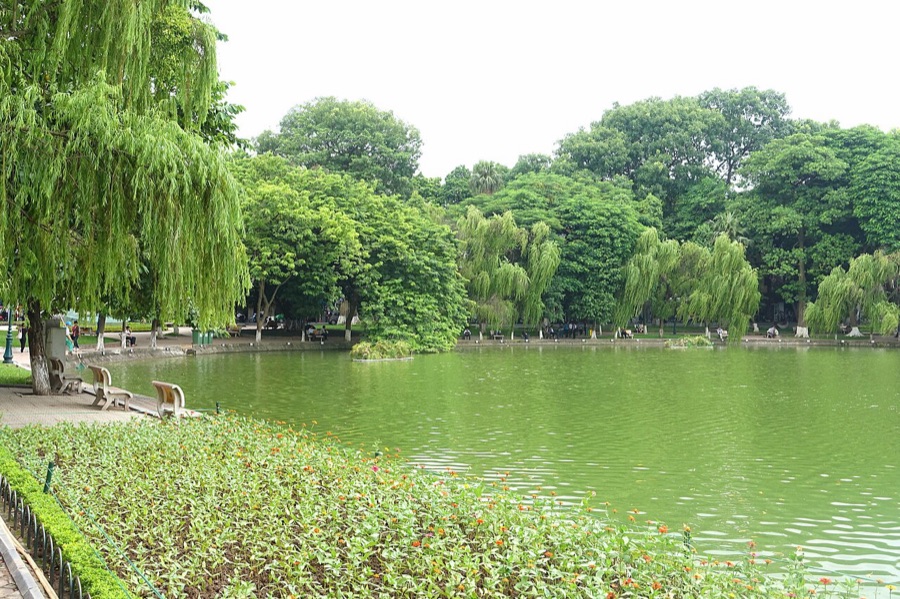
The name of Hoan Kiem, the Lake of the Returned Sword, comes from the legend of Le Loi, who in the fifteenth century gave back to a golden turtle of the lake the sword that had driven out the Chinese. The lake really did hold giant softshell turtles; the last of them died in January 2016.
- Bai Dinh Pagodastop on the way
A temple complex built on the hills from 2003 around an old cave pagoda, among the largest in Vietnam. A covered corridor of some five hundred stone arhats, each with a different face, climbs to the halls of the great bronze Buddhas.
- Hoa Lustop on the way
In a valley closed by limestone walls, Hoa Lu was the capital of Vietnam from 968 until 1010, when the court moved to Thang Long, today’s Hanoi. The temples of the Dinh and early Le kings stand on the site of the old palace.
- Ninh Binh2 nights
Limestone towers rise straight out of the rice fields, and Tam Coc is called Ha Long Bay on land. On its river the boatmen and boatwomen often row with their feet, leaving their hands free.
- Trang Anstop on the way
A rowing boat takes you for two or three hours along the rivers between the karst towers and through caves so low you bend your head. Trang An became Vietnam’s first mixed natural and cultural World Heritage site in 2014, and Kong: Skull Island was filmed here.
- Phat Diem Cathedralstop on the way
A Catholic cathedral built from 1875 to 1899 under the priest Tran Luc in the form of a Vietnamese temple, of stone blocks and ironwood columns, with a bell tower like a pagoda gate. It faces a lake, with smaller stone chapels around it.
- Ho Citadelstop on the way
Ho Quy Ly built this citadel in 1397 of huge cut stone blocks, some weighing over ten tonnes, in only a few months; his dynasty lasted barely seven years before the Ming invaded. It has been a World Heritage site since 2011.
- Sam Sonone night
The beach of Thanh Hoa, turned into a seaside resort by the French at the start of the twentieth century and still the summer beach of the north. On the rocky hill at its southern end stands the temple of Doc Cuoc, the one-legged giant who, the legend says, split himself in two to fight a sea monster.
- Den Con Templestop on the way
A temple among old trees at the mouth of the Con estuary, one of the most visited in Nghe An. It honours four holy mothers, and the legend links them to a Song empress who fled the Mongols by sea in the thirteenth century and whose body washed ashore here.
- Cua Lostop on the way
The beach of Vinh, a quarter of an hour from the city, where Nghe An goes to swim and to eat seafood on the sand. The two green islands of Hon Ngu lie offshore.
- Vinhone night
The capital of Nghe An province was bombed almost flat in the war and rebuilt in the 1970s with the help of East Germany, whose concrete housing blocks still stand in the Quang Trung quarter. The moat and the stone gates of the old citadel, from the early nineteenth century, still ring the centre.
- Kim Lienstop on the way
The villages where Ho Chi Minh was born in 1890, in his mother’s village of Hoang Tru, and grew up in his father’s village of Sen nearby. Both thatched houses are kept as they were, and the site is one of the most visited in the country.
- Dong Loc Junctionstop on the way
A crossroads of the Ho Chi Minh Trail that American planes bombed again and again. On 24 July 1968 a bomb killed ten young women of the volunteer youth who filled the craters so the lorries could pass; their graves and a memorial stand at the junction.
- Thien Camone night
A quiet beach in Ha Tinh under a green hill, with little more than a few hotels and seafood restaurants. Its name means heavenly lute, after the legend that a king passing here heard the wind over the hills as music.
- Deo Ngang Passstop on the way
The Transverse Pass, where a spur of the mountains runs into the sea, was for centuries a border, first with Champa and later between provinces. A poem about crossing it by the nineteenth-century poet Ba Huyen Thanh Quan is learned by every Vietnamese schoolchild.
- Grave of Vo Nguyen Giapstop on the way
General Vo Nguyen Giap, who defeated the French at Dien Bien Phu in 1954, died in 2013 at the age of 102 and was buried by his wish on this hill at Vung Chua, looking out over the islet of Yen, in his home province of Quang Binh.
- Phong Nha2 nights
The village at the gate of Phong Nha-Ke Bang, a World Heritage site since 2003, a limestone massif riddled with caves. Son Doong, the largest cave passage in the world, was found by a local man, Ho Khanh, in the early 1990s and explored by British cavers only in 2009.
- Phong Nha Cavestop on the way
The boat leaves from the village and goes up the Son river and straight into the mountain, on the underground river that runs out of the cave. In the war the cave sheltered people and supplies from the bombing of the nearby Ho Chi Minh Trail.
- Paradise Cavestop on the way
Found by a local man in 2005 and explored by British cavers, it runs some thirty-one kilometres into the mountain. Visitors walk about one kilometre of it on a wooden boardwalk among stalagmites many metres high.
- Quang Binh Gatestop on the way
The old gate of Dong Hoi, from the defensive line the Nguyen lords built in the seventeenth century against their rivals in the north. Dong Hoi was bombed almost flat in the war; the gate survived, and the bare bell tower of the Tam Toa church nearby is kept as it was left.
- Hien Luong Bridgestop on the way
The bridge over the Ben Hai river, on the 17th parallel that split Vietnam in two from 1954 to 1975. The two sides painted their halves of the bridge in different colours and raised ever taller flagpoles at each end. The Vinh Moc tunnels, where whole families lived underground through the bombing, are a short way east.
- Dong Haone night
The town of the demilitarized zone, where Highway 9 leaves the coast for Khe Sanh and the border with Laos; in the war it was a base of the American marines. Today it is the starting point for the battlefields of the DMZ.
- Quang Tri Citadelstop on the way
In 1972 the citadel of Quang Tri was fought over for eighty-one days and nights, and almost nothing of it was left standing. Its grounds are now a memorial park inside the old moat.
- La Vangstop on the way
The national Marian shrine of Vietnam, on the place where, by tradition, the Virgin appeared in 1798 to Catholics hiding in the forest from persecution. Pilgrims come from all over the country, above all for the great pilgrimage in August.
- Hue2 nights
The capital of the Nguyen emperors from 1802 to 1945, with a walled Imperial City on the Perfume River, a World Heritage site since 1993. The last emperor, Bao Dai, abdicated at the Ngo Mon gate in August 1945, and much of the citadel was destroyed in the battle of Hue in 1968.
- Tomb of Minh Mangstop on the way
The most formal of the royal tombs, laid out along a single axis of courtyards, pavilions and lakes in the hills south of Hue. Work began in 1840, Minh Mang died the next year, and his son Thieu Tri finished it.
- Lang Costop on the way
A long sandbar between the sea and the Lap An lagoon at the foot of the Hai Van Pass, with fishing boats and oyster beds on the lagoon side. Stop for seafood before the climb.
- Hai Van Passstop on the way
The Pass of the Ocean Clouds climbs to about 500 metres over the sea, and was once the border between Dai Viet and the kingdom of Champa; the gate on top dates from the reign of Minh Mang. Since the tunnel under it opened in 2005 the old road is left to cars and motorbikes that come for the view, and Top Gear called it a ribbon of perfection.
- Marble Mountainsstop on the way
Five marble and limestone hills on the coast south of Da Nang, named after the five elements — metal, water, wood, fire and earth — with pagodas and Buddhist grottoes inside them. The stone carvers of the village at their foot still work the stone, though most of it now comes from elsewhere.
- Hoi An2 nights
A trading port of the sixteenth to eighteenth centuries where Chinese and Japanese merchants settled, kept almost whole because the river silted up and the trade moved to Da Nang; a World Heritage site since 1999. The covered Japanese Bridge, from the 1590s, is printed on the 20,000-dong note.
- My Sonstop on the way
The holy valley of the kings of Champa, where Hindu temples of brick were built from the fourth century to the thirteenth, a World Heritage site since 1999. American bombing in 1969 destroyed many of them; go early, before the heat and the tour buses.

What it costs
Eighty dollars a night is the room. The car and the driver are yours: on this route almost every visitor hires a car with a driver for the whole journey or for each leg, priced by the day or by the route, and the price usually includes the fuel, the tolls and the driver’s food and lodging; agree in writing before you start what is included. The boats at Trang An and at Phong Nha are paid separately, per boat or per ticket, and so are the entrance tickets to the caves, the Imperial City in Hue, the tombs and My Son.
What to know
Three things. One, and above all: take a driver. Vietnam does not accept a foreign licence on its own, and in practice a visitor needs a Vietnamese licence to drive; self-drive car rental for tourists barely exists, and a car with a driver is the norm and costs little more. Two: the traffic. Motorbikes are the great majority of the traffic, they come from every side and fill every gap, and the horn here means only I am here; a driver who knows the roads reads all of it for you. Do not ride a motorbike yourself without a licence — travel insurance will not cover the accident. Three: the expressways. The new north–south expressway is fast, but where it is tolled the toll is taken electronically, with no cash lanes, and a car needs the tag; this is one more reason the driver and his company handle the road.
Roads, tolls and rules
Vietnam drives on the right. This route keeps to short days: no day drives more than about 160 kilometres, with two or three stops on the way, so the long road down the coast from Ninh Binh to Phong Nha takes four days, with nights at the beach of Sam Son, in Vinh and at the beach of Thien Cam. The expressway runs fast, but the driver will take the old coast road and Highway 1 to reach the stops, and fifty kilometres an hour is a good average; the last leg, from Hue over the Hai Van Pass to Hoi An, is slow on purpose. Ha Long Bay is three hours or more each way from Hanoi, so a day there means six hours in the car for a few hours on the water; this route leaves it out. Da Nang, half an hour from Hoi An, is easy to add for an evening: the Dragon Bridge breathes fire at nine on weekend nights.

Travel Vietnam: From Hanoi to Hoi An
The route on our site, with a room up to $80 every night.