Portugal, North to South
When to go
April to June and September to October. July and August are not impossible but the Algarve is at capacity, the coastal road is slow and a room costs what it costs in August. Winter is mild — fifteen to seventeen degrees in the Algarve — and the Douro is at its best in late September and October, when the harvest is on and the terraces turn.
The stops
Interactive map of the route on our site ›
- Porto2 nights
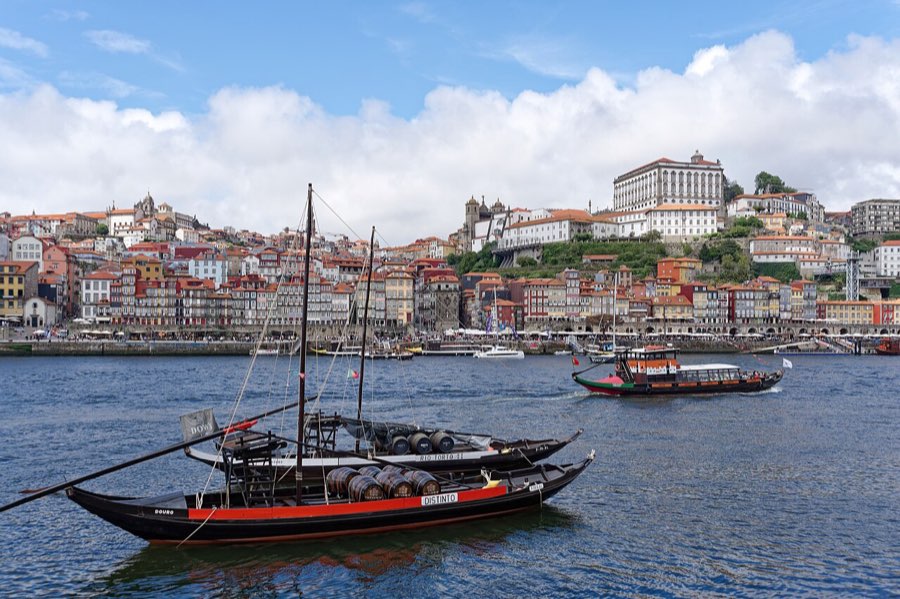
The country is named after this city. The Roman settlement on the two banks of the Douro was Portus Cale — the port of Cale — and the name of the port became the name of the county, then of the kingdom, then of the country. A city gave its name to a nation, which is rare, and then lost the capital to Lisbon.
- Amarantestop on the way
In the spring of 1809 Portuguese troops held the granite bridge of São Gonçalo against Napoleon's army for about two weeks before it was forced. The church beside it belongs to São Gonçalo, the matchmaking saint, and people still come to touch his tomb in the hope of a marriage.
- Peso da Reguastop on the way
In 1756 the Marquis of Pombal drew a boundary round this valley and created the Douro wine region, which Portugal counts as the first demarcated and regulated wine region in the world. The border was marked with carved granite pillars, and some of them are still standing in the vineyards where they were set.
- Pinhaoone night
The road between Regua and here, the N222, was voted the best driving road in the world in 2015 — twenty-seven kilometres of bends above the river with terraced vineyards on both sides. And the little railway station at the end of it is tiled with twenty-four azulejo panels from 1937 showing the grape harvest, which is the whole valley explained on a platform wall.
- Lamegostop on the way
A baroque stairway of 686 steps climbs from the town to the sanctuary of Nossa Senhora dos Remédios, past fountains and landings lined with azulejos. Lamego also gives its name to the bola de Lamego, a bread baked with ham and sausage inside.
- Ucanhastop on the way
A medieval bridge over the Varosa with a tower at one end, raised in the fifteenth century by the abbots of the nearby monastery of Salzedas to collect a toll from everyone who crossed. It is one of the very few fortified bridges of its kind left in Portugal.
- Viseuone night
The city of Vasco Fernandes, called Grão Vasco, the great painter of the Portuguese Renaissance, whose panels hang in the museum beside the cathedral. King Duarte was born here in 1391, and the huge eight-sided earthwork on the north side of town carries the name of Viriathus, the shepherd who fought Rome.
- Caramulostop on the way
A mountain village that grew in the 1920s around sanatoriums for tuberculosis, where patients came for the clean air at about 800 metres. The museum founded by the Lacerda brothers in the 1950s keeps paintings upstairs and a collection of classic cars and motorcycles below.
- Bucacostop on the way
Discalced Carmelite monks walled this forest in the seventeenth century, and in the middle stands a neo-Manueline palace built at the end of the nineteenth century for the last kings, now a hotel. On 27 September 1810 Wellington's Anglo-Portuguese army beat Masséna's French on this ridge.
- Coimbraone night
The university was founded in 1290, in Lisbon, and settled here for good in 1537, in the old royal palace on the hill. Its baroque library has a problem no other library has solved the same way: a colony of bats lives behind the shelves and eats the insects that would eat the books, and the tables are covered in leather every night, for the obvious reason.
- Conimbrigastop on the way
The best-preserved Roman town in Portugal, with mosaic floors still in the houses and a wall thrown up in haste across the middle of the town in the late empire. In 468 the Suebi sacked it, and in time its bishop moved to Aeminium on the Mondego, which took the old town's name and became Coimbra.
- Batalhastop on the way
King João I vowed this monastery before the battle of Aljubarrota in 1385 and began it the next year; he lies in the Founder's Chapel beside his English queen, Philippa of Lancaster, the two stone figures holding hands. The Unfinished Chapels behind the church were never roofed and still stand open to the sky.
- Alcobacastop on the way
In the church, facing each other across the transept, are the carved tombs of King Pedro I and Inês de Castro, placed so that at the resurrection the first thing each sees will be the other. The Cistercian abbey was founded in 1153 and is a World Heritage site.
- Nazareone night
The largest waves ever surfed were ridden here, and the reason is under the water: the Nazare Canyon, a submarine gorge five kilometres deep that runs straight at the beach and squeezes an Atlantic swell into one place. The fishing village above it had known about that water for centuries before anyone thought to surf it.
- Obidosstop on the way
In 1282 King Dinis gave this walled town to his queen, Isabel, as a wedding present, and for centuries afterwards it belonged to the queens of Portugal. That is why it was never developed and never knocked about: it belonged to someone who had no reason to change it.
- Mafrastop on the way
King João V paid for this palace, convent and basilica with the gold of Brazil, beginning in 1717, and it is one of the largest buildings in Portugal. Its library holds some 36,000 books, and, as at Coimbra, a colony of bats keeps the insects off them at night.
- Sintra2 nights
Behind one of the estates here is an inverted tower: a well twenty-seven metres deep with nine spiral landings, cut downwards into the rock in the early twentieth century. It was never a well. It was built for initiation ceremonies, the nine landings are deliberate, and you walk down it and come out through a tunnel at the bottom.
- Cabo da Rocastop on the way
The westernmost point of mainland Europe, and the inscription on the stone here is a line of Camoes: where the land ends and the sea begins. For most of Portuguese history that was not poetry but a statement of fact about the edge of the known world.
- Boca do Infernostop on the way
A collapsed sea cave in the cliffs west of Cascais, where the waves boom through a rock arch. In 1930 the occultist Aleister Crowley staged his own suicide here with the help of the poet Fernando Pessoa, leaving a note under a cigarette case, and turned up alive in Berlin a few weeks later.
- Lisbon3 nights
On All Saints morning in 1755 an earthquake, a fire and a tsunami destroyed most of the city within hours. The Marquis of Pombal rebuilt the centre on a grid with something new inside the walls: the gaiola, a timber cage designed to flex instead of collapse. Before building it they made a model and marched troops around it to simulate a quake — the first recorded earthquake engineering test.
- Serra da Arrabidastop on the way
The N379-1 along this ridge is the one road in Portugal that gets called the Portuguese Pacific Coast Highway, and the water below it is turquoise for a reason: the mountain is limestone, the seabed under the bays is white rock and not dark sand, and the light comes back up through the water instead of being absorbed.
- Sesimbrastop on the way
A fishing town squeezed between the ridge and the sea with a Moorish castle on the hill above it, and the fleet here still lands swordfish and black scabbardfish — the deep-water fish that gets eaten in Lisbon and is caught from this coast at eight hundred metres down.
- Montemor-o-Novostop on the way
The ruined castle on the hill above the town looks out over the plain of the Alentejo. John of God, who founded the Brothers Hospitallers, was born here in 1495, and the order he started still runs hospitals around the world.
- Almendres Cromlechstop on the way
About ninety-five standing stones on a slope among the cork oaks, raised in stages from around the sixth millennium BCE, which makes this one of the oldest and largest stone circles in Europe. A few of the stones carry faint carved circles and lines.
- Evora2 nights
Inside a church here is a chapel built out of the bones of about five thousand people. Franciscan monks assembled it in the sixteenth century because the city had more graveyards than it had room for, and they wrote over the door: we bones that are here, for yours await. It was not meant to shock. It was meant as an argument.
- Monsarazstop on the way
A walled village on a hill above the Alqueva, the largest artificial lake in western Europe, which flooded a whole valley in 2002. And because there is almost no light for fifty kilometres in any direction, the area around it was certified as the world’s first Starlight Tourism Destination.
- Alcacovasstop on the way
In 1479 the Treaty of Alcáçovas, signed here, ended the war between Portugal and Castile and divided the Atlantic: the Canaries went to Castile, and the coast of Africa and the islands to the south to Portugal. The village still makes cowbells by hand, a craft UNESCO listed for urgent safeguarding in 2015.
- Mirobrigastop on the way
Roman ruins on a hill outside Santiago do Cacém, with a temple, two bath houses and a hippodrome, one of the very few Roman racecourses known in Portugal. The castle of Santiago do Cacém stands on the next hill.
- Vila Nova de Milfontesone night
Milfontes sits where the Mira meets the sea, with calm river beaches on one side of the point and the open Atlantic on the other. The little fort over the river mouth was built in the early seventeenth century against the North African corsairs who raided this coast, and the village is a stage on the Rota Vicentina, the walking route along this whole shore.
- Zambujeira do Marstop on the way
On the sea stacks off this stretch of cliff, white storks build their nests on bare rock above the Atlantic. It is the only place in the world where white storks nest on coastal cliffs rather than on roofs, chimneys and poles, and they come back to the same stacks every year.
- Odeceixestop on the way
The beach lies at the mouth of the Seixe, the river that is the border between the Alentejo and the Algarve, so it has fresh water on one side of the sand and the Atlantic on the other. The village sits a few kilometres inland on a hill, where villages on this coast were always built, out of sight of anyone arriving by sea.
- Lagos2 nights
The first market in Europe for the sale of enslaved Africans opened on this square in 1444, when Portuguese ships began landing captives taken on the West African coast. The building is still standing and it is now a museum that says so plainly. The cliffs south of the town are what people come for; this is what happened here.
- Ponta da Piedadestop on the way
Golden limestone stacks, arches and grottoes cut by the sea at the point south of Lagos. A stairway runs down the cliff from the lighthouse to the water, and small boats and kayaks from the town go into the caves that cannot be reached on foot.
- Sagresstop on the way
The south-western corner of Europe, and in the fort there is a stone compass rose forty-three metres across, uncovered in 1919. The tradition that Henry the Navigator ran a school of navigation here is disputed by historians and there is no document for it — what is certain is that the voyages were organised from this coast and that the compass is in the ground.
- Silvesstop on the way
Under Islamic rule this was Xelb, the capital of the Algarve, and its red sandstone castle is the best-preserved Moorish castle in Portugal. In 1189 King Sancho I took the town with the help of crusaders sailing to the Holy Land.
- Benagilstop on the way
The sea cave at Benagil has a round hole in its roof that drops a shaft of light onto the small beach inside, and it can be reached only from the water. Boat and kayak trips leave from the beach below the village; landing inside has been restricted in recent seasons, so check the current rules before you book.
- Faroone night
In 1596 an English fleet under the Earl of Essex sacked this town and carried off the bishop’s library. Those books were given to Oxford and became part of the founding collection of the Bodleian — so a library looted from a small Portuguese port is one of the foundations of one of the great libraries of the world. The first book printed in Portugal also came from Faro: a Pentateuch in Hebrew, printed here in 1487 by Samuel Gacon.

What it costs
Eighty dollars a night is the room. The car, the fuel and the tolls are yours, and the tolls are the thing to know about in Portugal: the motorways in the north and parts of the Algarve are electronic only, with no booth and nothing to pay at the roadside. The rental company fits a transponder or bills you later with a fee per day. Ask for the transponder at the desk — it is cheaper than the alternative.
What to know
Three things. One: the N222 above the Douro and the N379-1 over the Arrabida are the two roads this route exists for, and both are narrow, bent and slow — count on half the speed the map suggests and do them in daylight. Two: parking in Lisbon and Porto. Both old centres are hills with lanes a car should not enter; use a public garage and walk. Three: the rental deposit, six hundred to twelve hundred euros held on the card, plus the insurance excess, released weeks after you hand the car back.
Roads, tolls and rules
Portugal is the country where the toll is the thing to understand. Parts of the motorway network are electronic only: there is no booth, nothing to pay at the roadside, and a camera reads the plate. A hire car normally comes with a transponder, and if it does not, you have forty-eight hours to pay each passage manually — after that it becomes a fine of about twenty-five euros per passage. Ask at the desk and get it in writing. The pace of this route is the other thing: no driving day is longer than about 160 kilometres, each has two or three stops on the way, and the Arrábida, Monsaraz and Sagres are done as day trips from a base where you sleep two or three nights. The longest day is the crossing of the Alentejo from Évora to the coast, on quiet national roads. Fuel is plentiful on the A-roads and the national roads in the interior are long stretches between stations, so fill up before the Alentejo rather than in it. Charging is dense around Lisbon and Porto and thin in the south-west. The weather to plan around is wind and fog on the Atlantic coast, not heat.

Travel Portugal, North to South
The route on our site, with a room up to $80 every night.