Poland: From Warsaw to Kraków and the Tatras
When to go
May to September. Summer days are long and warm, and the Tatras are open for walking from June; July and August bring the crowds to Kraków and Zakopane, and the road into Zakopane jams on summer weekends. Winter is cold and dark, but the memorial sites are open all year, and Zakopane becomes a ski town with snow from December. Check the opening days before you plan each one: POLIN in Warsaw closes on Tuesdays, the Majdanek visitor centre closes on Mondays, and the synagogues of Kraków close on Shabbat.
The stops
Interactive map of the route on our site ›
- Warsaw2 nights
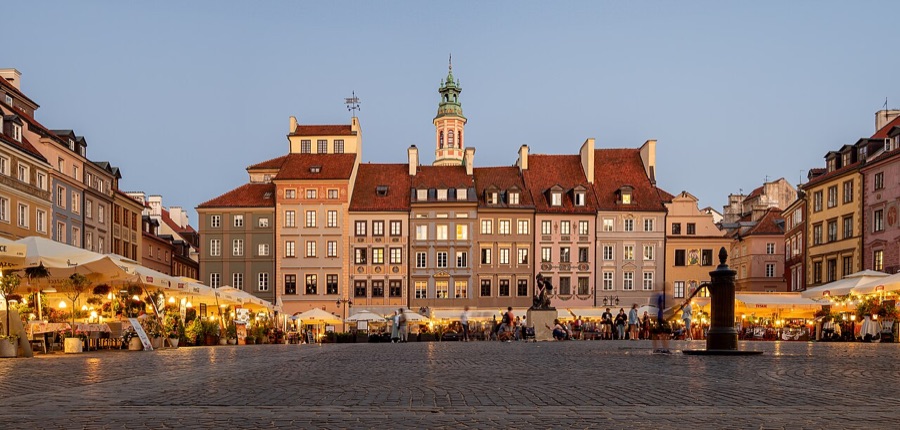
Before the war some 350,000 Jews lived in Warsaw, about a third of the city, the largest Jewish community in Europe. The Germans sealed them into the ghetto in November 1940; in April 1943 its last fighters rose against them, and the Old Town you see was rebuilt from ruins after 1945, which is why UNESCO listed it in 1980.
- POLIN Museumstop on the way
The museum of the history of Polish Jews tells a thousand years of life, not only the end, and stands where the ghetto stood, facing Nathan Rapoport’s Monument to the Ghetto Heroes of 1948. A short walk north is the Umschlagplatz, the railway yard from which, in the summer of 1942, the Germans sent some 300,000 Jews of the ghetto to Treblinka.
- Dęblinstop on the way
The Polish Air Force academy has trained its pilots here since 1927, and is still called the School of Eaglets. Its Air Force Museum shows dozens of aircraft in the open, from Soviet-era MiGs to helicopters, beside the nineteenth-century Russian fortress of Ivangorod.
- Puławystop on the way
The seat of the Czartoryski princes on the Vistula, with a landscape park over the river. In 1801 Princess Izabela Czartoryska opened the Temple of the Sibyl in the park as a museum of Polish memory, the first museum in Poland; its collection later went to Kraków, Lady with an Ermine among it.
- Kazimierz Dolnyone night
A Renaissance market town on the Vistula, with grain stores on the bank and painters at their easels in the square. Before the war about half its people were Jews; in 1936 the Yiddish film Yidl mitn Fidl was shot here, and on the road out of town a wall of broken tombstones, built in 1984 and split down the middle, stands for the community that was murdered.
- Nałęczówstop on the way
A small spa town in a park of ponds and old trees, where writers such as Bolesław Prus and Stefan Żeromski came to rest. The mineral water bottled under its name is sold all over Poland.
- Kozłówka Palacestop on the way
The eighteenth-century palace of the Zamoyski counts, kept with its furniture and paintings as they were. Its coach house holds something unexpected: the largest gallery of socialist realist art in Poland, the statues of Lenin and Bierut and the posters of the communist years.
- Lublinone night
Before the war Lublin was a third Jewish and was called the Jerusalem of the Kingdom of Poland. In 1930 Rabbi Meir Shapiro, who founded the Daf Yomi, the daily page of Talmud, opened Yeshivat Chachmei Lublin here, then the largest yeshiva building in the world; the Grodzka Gate, which led from the Christian town to the Jewish one, is now a centre of memory.
- Majdanekstop on the way
The German concentration and death camp on the edge of Lublin, where at least 78,000 people were murdered, most of them Jews; on 3 November 1943 the SS shot some 18,000 Jews here in a single day. The Red Army reached it in July 1944, so much of it stands as it was, and under the dome of the mausoleum lie the ashes of the victims.
- Kraśnikstop on the way
A market town on the road south where two synagogues still stand side by side, the larger built in the seventeenth century and the smaller, a house of study, added later. Before the war Jews were a large part of the town, and both buildings outlived the community that built them.
- Sandomierzone night
A royal town on a hill over the Vistula, with a Gothic gate and a sloping market square above a maze of medieval merchants’ cellars that you can walk through underground. The cathedral holds an eighteenth-century painting of the blood libel, the false charge that Jews murdered Christian children; since 2006 a plaque beside it says plainly that the accusation was a lie.
- Baranów Sandomierskistop on the way
A Renaissance castle of the late sixteenth century with corner towers and an arcaded courtyard, so like the royal castle in Kraków that it is called the little Wawel. It stands in a park by the Vistula, and you can walk through its rooms and courtyard.
- Zalipiestop on the way
The painted village: its women cover their cottages, inside and out, with bright flowers, and the wells, fences and dog kennels too. The custom began in the nineteenth century, when they painted over the soot from stoves without chimneys, and every year a contest called the Painted Cottage chooses the best.
- Tarnowone night
A Renaissance town hall in a square of arcaded houses, in a town that before the war was nearly half Jewish. Of the Old Synagogue, burned in 1939, only the brick bimah still stands, under a small roof in the open; and on 14 June 1940 the first transport of prisoners to Auschwitz, 728 men, most of them Polish political prisoners, left from Tarnów.
- Niepołomicestop on the way
King Casimir the Great built a hunting castle here in the fourteenth century, on the edge of the Niepołomice forest, and in the sixteenth century King Sigismund the Old rebuilt it as a Renaissance residence with an arcaded courtyard. The forest is still there, with a breeding enclosure of European bison.
- Wieliczka Salt Minestop on the way
Salt was mined here for some seven centuries, and the miners carved chapels, statues and chandeliers out of the rock salt; the Chapel of Saint Kinga lies about a hundred metres down. In 1978 the mine was on the first list of World Heritage sites ever drawn up.
- Krakow3 nights
The royal city that the war spared. Its Jewish quarter, Kazimierz, kept its synagogues: the Old Synagogue of the fifteenth century and the Remuh, of the sixteenth century, with the grave of Rabbi Moshe Isserles, the Rema, in the old cemetery beside it. Across the river in Podgórze was the ghetto, and Oskar Schindler’s enamel factory is now a museum of the city under occupation.
- Auschwitz-Birkenaustop on the way
At Oświęcim, about an hour and a quarter from Kraków, the Germans murdered some 1.1 million people, about a million of them Jews from all over Europe. Auschwitz I is the old camp with the museum in its blocks; Birkenau, three kilometres away, is the death camp of the gas chambers and the railway ramp. In the town, the Auschwitz Jewish Center keeps the one synagogue left of a town that was more than half Jewish before the war.
- Dębnostop on the way
The larch church of Saint Michael the Archangel was built in the late fifteenth century without a single nail, and inside every surface is painted with patterns of the time. It is one of the wooden churches of southern Lesser Poland on the World Heritage list since 2003.
- Chochołówstop on the way
A highland village near the Slovak border whose main street is lined with wooden houses of the nineteenth century, each built of whole fir logs and scrubbed pale. In 1846 its peasants rose against Austrian rule, and the Chochołów uprising is remembered in a small museum in one of the houses.
- Zakopane2 nights
The highland town under the Tatras, where at the end of the nineteenth century the painter Stanisław Witkiewicz invented a whole Zakopane style of wooden houses from the cottages of the górale, the mountain people. The cable car to Kasprowy Wierch, built in 1936, climbs to the Slovak border on the ridge.
- Morskie Okostop on the way
The largest lake in the Tatras, at about 1,400 metres under a wall of granite peaks. Cars stop at Palenica Białczańska, half an hour from Zakopane, and from there it is about nine kilometres on an asphalt road through the forest, on foot.
What it costs
Eighty dollars a night is the room. The car and the fuel are yours, paid in złoty. The expressways on this route are free; the only toll you may meet is the private A4 motorway between Kraków and Katowice, which the road to Oświęcim can avoid. Budget for paid parking in the centres of Warsaw, Lublin and Kraków, for the parking at Palenica Białczańska under Morskie Oko, which must be booked online, and for the Tatra National Park entry. Entry to the Auschwitz-Birkenau memorial is free, but a guided visit, which is the best way to see it, is paid.
What to know
Three things. One: in Poland the headlights are on day and night, all year, and the drink-drive limit is 0.2 per mille, close to nothing; do not drink at all if you drive. Two: Auschwitz-Birkenau. Entry is by a timed pass booked in advance on the memorial’s website, and from spring to autumn, during the middle of the day, individual visitors can enter Auschwitz I only with a guide; book the pass when you book the hotel. The visit takes at least three and a half hours, it is hard on children, and the memorial does not recommend it under fourteen. Three: the Tatras. Weather in the mountains changes fast, the paths are stone, and in the national park you stay on the marked trails.
Roads, tolls and rules
Poland drives on the right. Expressways now join most of the cities on this route, but the last part to every small town is a two-lane road through villages, with tractors and cyclists. The road from Kraków to Zakopane is the busiest in the south and slow at weekends; leave early. You can fly home from Kraków, about two hours from Zakopane.

Travel Poland: From Warsaw to Kraków and the Tatras
The route on our site, with a room up to $80 every night.