Yucatán: From Cancún to Tulum
When to go
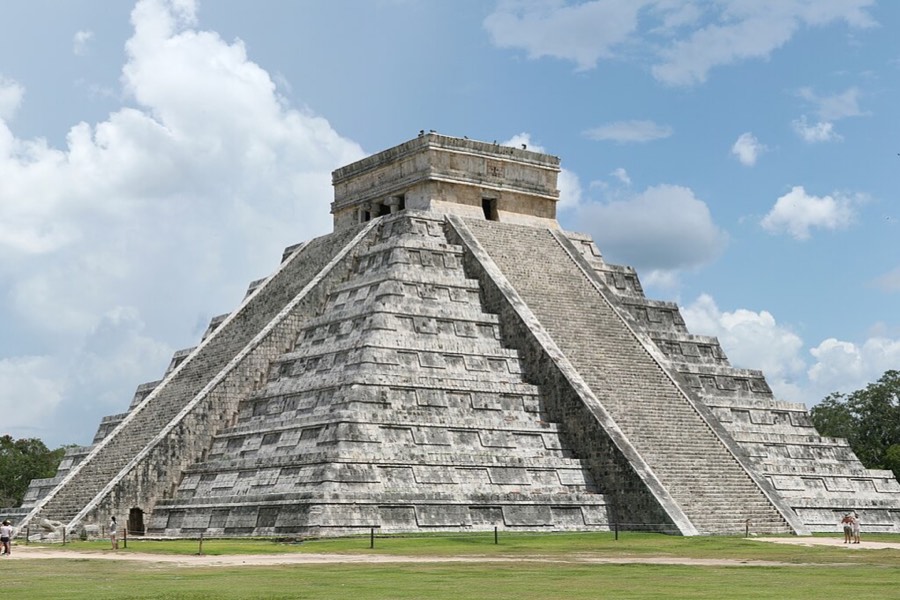
November to April. This is the dry season, with warm days and cooler nights inland. From May the peninsula grows very hot and humid, and the hurricane season runs from June to November, with the greatest risk from August to October. In spring and summer the sargassum seaweed can pile up on the Caribbean beaches; the cenotes and the inland towns are not touched by it. At the spring and autumn equinoxes the shadow of a serpent slides down the pyramid at Chichén Itzá, and the crowds come with it.
The stops
Interactive map of the route on our site ›
- Cancunone night
In the late 1960s the Mexican government picked this strip of sand, then almost empty, as the site for a planned resort, and building began in 1970. Off its shore lies MUSA, an underwater museum of hundreds of concrete statues by Jason deCaires Taylor that coral is slowly covering.
- Valladolid2 nights
Founded by the Spanish in 1543 and moved two years later onto the Maya town of Zací, whose cenote still opens in the middle of the city. The Caste War, the Maya uprising against Yucatán’s rulers, broke out in this region in 1847, and Valladolid was taken by the rebels in 1848.
- Ek Balamstop on the way
A Maya city whose name means black jaguar. High on the Acropolis, a doorway is framed as the open jaws of a monster, with stucco figures around it that have wings; the plaster survived so well because the Maya themselves walled it over.
- Cenote Suytúnstop on the way
A cave cenote under the ground, where a stone walkway leads out to a round platform in the middle of the water. Around midday a single beam of light falls through the hole in the roof onto the platform.
- Cenote X’Kekén, Dzitnupstop on the way
The cenotes are holes in the limestone where the roof of an underground river has fallen in, and for the Maya they were the only water and a door to the underworld. Here you climb down into a domed cave hung with stalactites, lit through one hole in the ceiling; its neighbour Samulá is across the road.
- Izamalone night
The yellow city, where nearly every building in the centre is painted the same egg-yolk yellow. The Franciscans built the convent of San Antonio de Padua in the sixteenth century on top of the platform of a Maya pyramid, and its atrium, ringed by arches, is among the largest in the world; Pope John Paul II came here in 1993.
- Merida3 nights
Founded in 1542 on the ruins of the Maya city of T’hó, whose stones went into the cathedral of San Ildefonso, among the oldest on the American mainland. Around 1900 henequen, the sisal fibre that the world made rope from, made Mérida one of the richest cities in Mexico, and the planters lined the Paseo de Montejo with their mansions.
- Uxmalstop on the way
The finest city of the Puuc style, with long façades covered in stone mosaics of masks of the rain god Chaac. The Pyramid of the Magician stands on an oval base, unusual among Maya pyramids, and a legend says a dwarf built it in a single night.
- Pisteone night
The village at the gate of Chichén Itzá, where a night lets you be at the site when it opens, hours before the coaches from Cancún and Mérida. Beside the ruins stands the Hacienda Chichén, home of the American consul Edward Thompson, who between 1904 and 1910 dredged the Sacred Cenote and sent its gold, jade and bones to the Peabody Museum at Harvard.
- Chichén Itzástop on the way
The pyramid of Kukulcán has ninety-one steps on each of its four sides, and with the platform at the top they add up to 365, the days of the year. The Great Ball Court is the largest known in Mesoamerica. Climbing the pyramid is no longer allowed; come at opening time, before the coaches from Cancún.
- Cenote Ik Kilstop on the way
A round, open cenote a few minutes from Chichén Itzá, with vines hanging down the walls to the water far below. It has hosted the Red Bull Cliff Diving World Series; stairs cut in the rock lead down to swim.
- Cobástop on the way
A Maya city spread through the jungle between lakes, crossed by raised white roads called sacbés; the longest ran some hundred kilometres west to Yaxuná. Visitors rent bicycles at the gate to ride between its groups of ruins, and Nohoch Mul, the great pyramid, rises above the trees.
- Tulum2 nights
A walled Maya port on a cliff over the Caribbean, one of the last cities the Maya built, and still lived in when Spanish ships sailed past in 1518. Its name means wall; its old name is thought to have been Zamá, the dawn, because it faces the sunrise.
- Akumalstop on the way
In Maya, the place of the turtles. Green sea turtles graze on the seagrass in the shallow bay, a few metres from the beach; swimming among them is allowed only in the marked areas, and touching them is forbidden.
- Cancunone night
Back for the flight. The hotel zone runs along a long, narrow island shaped like the number seven, with the Caribbean on one side and the Nichupté lagoon on the other; the beaches all along it are public by Mexican law.

What it costs
Eighty dollars a night is the room. The car, the fuel and the tolls are yours: the fast road from Cancún to Mérida, the 180D, is a toll motorway, and the free road beside it runs through every village. Parking in the old centres of Valladolid and Mérida is mostly on the street. The extras worth budgeting are the archaeological sites, where Chichén Itzá charges two separate tickets, one federal and one for the state of Yucatán, and the entry to each cenote.
What to know
Three things. One: the insurance. Mexican law requires third-party liability insurance from a Mexican insurer, and the cover of a foreign credit card does not replace it, so the cheap rate booked online often grows at the rental counter; read what is included before you book. Two: the road. Every village begins and ends with topes, speed bumps that are often unpainted and unmarked, and at speed they can break a car; slow down whenever houses appear. The army and the National Guard keep checkpoints on the main roads; stop, open the window, and answer calmly. Three: the fuel. Attendants fill the tank for you; get out, check that the pump shows zero before they start, say the amount clearly, and count the change, because the swapped note and the pump that was never reset are old tricks.
Roads, tolls and rules
Mexico drives on the right. The peninsula is flat limestone with no rivers on the surface, and the roads run straight through low jungle; the 180D toll road from Cancún to Mérida is fast and nearly empty, and the free roads are slower, through villages and over topes. Fill up in the towns, keep to daylight, because cattle, cyclists and unlit topes make the night roads dangerous, and keep cash in pesos for tolls and cenotes. The days are short: the longest is the first, about 160 kilometres on the toll road from Cancún to Valladolid, and on the way back east the route sleeps at Pisté, by Chichén Itzá, to be at the site when it opens.
Travel Yucatán: From Cancún to Tulum
The route on our site, with a room up to $80 every night.