Italy: The Dolomites
When to go
Mid-June to late September. The cable cars, the mountain huts and the toll road to the Tre Cime open around the middle of June and most close in late September or early October, and from then until the snow the valleys are quiet but the heights are shut. July and August are the high season, and around the middle of August all of Italy is on holiday in these valleys: the passes are full of cars, cyclists and motorcycles, and the rooms are at their dearest. Afternoon thunderstorms are common in summer, so go up early. From 15 November to 15 April winter tyres or chains are compulsory on the mountain roads.
The stops
Interactive map of the route on our site ›
- Veronaone night
The Arena was built around the year 30, and it is still a theatre: the summer opera festival began here in 1913 with Aida, for the hundredth birthday of Verdi. The airport at Villafranca is a quarter of an hour from the centre.
- Roveretostop on the way
Austrian until 1918, and close to the front of the First World War. On the hill above the town hangs the Campana dei Caduti, the Bell of the Fallen, cast in 1924 from the bronze of cannons of the nations that fought that war; every evening it rings a hundred strokes for the dead of all wars.
- Castel Besenostop on the way
The largest castle in Trentino, a ring of walls on a hill over the Adige. In the valley below, at Calliano, the army of Tyrol beat the Venetians in August 1487, and their commander, Roberto Sanseverino, drowned in the river.
- Trentoone night
The Council of Trent met here, on and off, from 1545 to 1563, and shaped the Catholic answer to the Reformation; the cathedral on Piazza Duomo hosted its sessions. In 1475, after a small boy named Simon was found dead at Easter, the Jews of Trent were accused of ritual murder, tortured and put to death; the Church venerated the boy until it abolished the cult in 1965.
- Bolzanostop on the way
In the archaeology museum lies Ötzi, the man of the ice, found on 19 September 1991 by two German hikers on the Austrian border at more than 3,200 metres. He died about 5,300 years ago, and an X-ray in 2001 found an arrowhead in his shoulder. Bolzano was Austrian until 1919 and still speaks German as well as Italian.
- Alpe di Siusistop on the way
The Seiser Alm, the largest high alpine meadow in Europe, about fifty square kilometres of grass under the Sciliar and the Sassolungo. The road up is closed to private cars during the day in season, so leave the car at Seis and take the cable car, about four kilometres, up to Compatsch.
- Ortisei2 nights
The main village of Val Gardena, where the old language is Ladin, a Romance tongue spoken only in a few valleys of the Dolomites, and every sign comes in three languages. The valley has carved wood since the seventeenth century, and the film-maker and climber Luis Trenker was born here in 1892.
- Secedastop on the way
A cable car from the centre of Ortisei climbs in two stages to about 2,500 metres, under the summit of Seceda, where a meadow ends in the sudden jagged wall of the Odle, the Geisler peaks, one of the most photographed views in the Alps.
- Sella Passstop on the way
At 2,244 metres, between the towers of the Sassolungo and the great block of the Sella. Around the Sella massif lie four valleys of Ladin speakers, Gardena, Badia, Fassa and Fodom, and in winter skiers circle all four in a day on the Sella Ronda.
- Pordoi Passstop on the way
At 2,239 metres, with the cable car to the Sass Pordoi at about 2,950 metres, the Terrace of the Dolomites, facing the glacier of the Marmolada. Just below the pass on the Arabba side stands the German war ossuary, built in 1959, with the remains of some 8,500 German and Austro-Hungarian soldiers of both world wars.
- Falzarego Passstop on the way
At 2,105 metres, on the front line of the First World War: the Austrians held the Lagazuoi above the pass, and the Italians dug tunnels into the mountain and blew mines under them. The cable car climbs to the top, and the tunnels are now an open-air museum; take a headlamp.
- Cortinaone night
Habsburg land from 1511 until 1918, and the queen of the Dolomites. It hosted the Winter Olympics of 1956, the first to be shown on television across Europe, and in February 2026 it shared the Winter Olympics with Milan. The bell tower of the basilica on the Corso Italia is the landmark of the town.
- Lake Misurinastop on the way
A round lake at 1,754 metres on the road to the Tre Cime, with the Sorapiss reflected in it; the dry, clean air here made it a place for children with asthma, and a clinic for them still stands on the shore.
- Tre Cime di Lavaredostop on the way
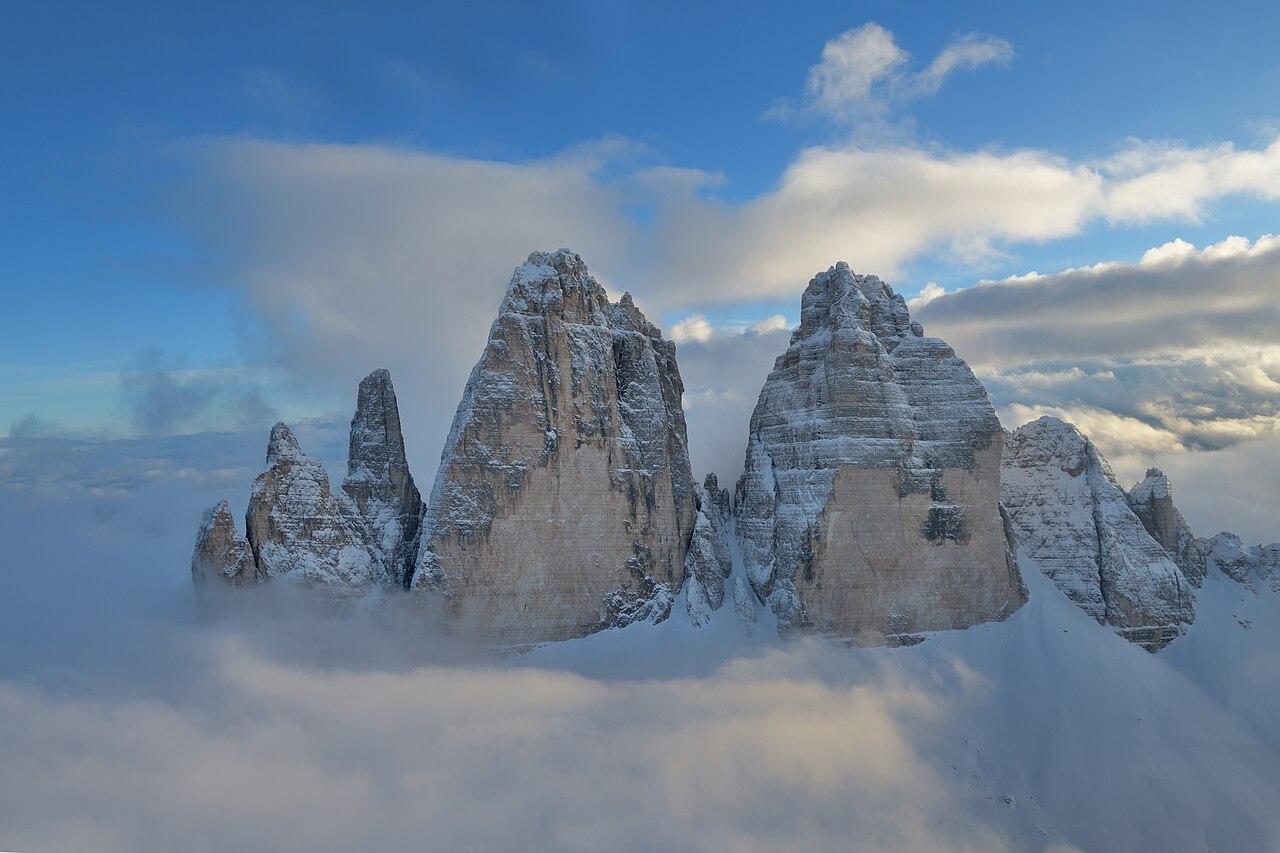
A private toll road climbs from Misurina to the Auronzo hut at 2,320 metres, under the three peaks; the walk around them takes about four hours, with the famous north faces at the Locatelli hut. The front of the First World War ran across them, and the Cima Grande was first climbed in 1869 by Paul Grohmann with two local guides.
- Dobbiaco2 nights
Toblach, on the watershed between the Adriatic and the Black Sea. Gustav Mahler, born to a Jewish family in Bohemia, spent his last three summers here, from 1908 to 1910, and in a small wooden hut outside the village he wrote Das Lied von der Erde and his Ninth Symphony; a music festival in his name is held every summer.
- Lake Braiesstop on the way
A green lake at about 1,500 metres under the cliffs of the Croda del Becco, a short drive from Dobbiaco; in high summer the road is closed to cars during the day unless the parking is booked online. In the hotel on its shore, at the start of May 1945, about 140 prominent prisoners of the SS, among them the former French prime minister Léon Blum, waited for the Americans after being freed nearby.
- Pieve di Cadorestop on the way
Titian was born here around 1490, and his birth house on the square is a small museum. Cadore is also the valley of Italian eyeglasses, made here since the nineteenth century, and the town has a museum of spectacles.
- Vajont Damstop on the way
On the night of 9 October 1963 a mountainside slid into the reservoir behind this dam, and a wave poured over the top and down onto Longarone in the valley below, killing almost two thousand people. The dam itself, more than 260 metres high, still stands, empty; guided visits walk along its crest.
- Bellunoone night
A small walled city above the Piave, at the foot of the Dolomites. Its main square, Piazza dei Martiri, is named after four partisans hanged there by the Germans in March 1945; the writer Dino Buzzati was born just outside the town in 1906.
- Vittorio Venetostop on the way
Two towns, Ceneda and Serravalle, joined in 1866 and named after King Vittorio Emanuele II; the battle fought here at the end of October 1918 was the last Italian offensive of the First World War. In Ceneda in 1749 was born Emanuele Conegliano, to a Jewish family; baptised as a boy, he took the name Lorenzo Da Ponte and wrote the libretti of Mozart’s Figaro, Don Giovanni and Così fan tutte.
- Coneglianostop on the way
The gateway to the hills of Prosecco between Conegliano and Valdobbiadene, a UNESCO World Heritage site since 2019. The town opened the first school of winemaking in Italy in 1876, and the painter Cima da Conegliano was born here.
- Trevisostop on the way
A city of canals inside walls that Venice built in the early sixteenth century; its fish market stands on an island in the middle of the Cagnan canal. On Good Friday, 7 April 1944, Allied bombers destroyed much of the centre, and it was rebuilt in its old form.
- Veniceone night
The car goes back at Piazzale Roma or at the airport; from here the city is on foot and by boat. In 1516 Venice confined its Jews to the island of the old foundry, the getto, and gave the word ghetto to the world; its synagogues still stand in Cannaregio. The rooms for eighty dollars are in Mestre, ten minutes away by tram.
What it costs
Eighty dollars a night is the room; in Ortisei and Cortina that is possible in June and September but hard in August, so book early. The car, the fuel and the tolls are yours: the Brenner motorway from Verona to Trento and the motorway down from Belluno to Venice are tolled, paid at the exit by card or cash. The real extras are up the mountain: every cable car, the Seiser Alm, Seceda, the Sass Pordoi and the Lagazuoi, charges its own return ticket, the private road to the Tre Cime charges a toll per car, and at Lake Braies in high summer the parking has to be booked and paid online. Parking in the mountain villages is mostly paid.
What to know
Three things. One: the ZTL. The old centres of Verona, Trento and Treviso are limited-traffic zones, and a camera at each entrance photographs every plate that drives in without a permit; there is no barrier, and each pass is a separate fine that reaches you months later through the rental company. Park outside and walk in, and if the hotel is inside a zone, ask it to register your plate. Two: the passes. The roads over the Sella, the Pordoi and the Falzarego are good but climb in dozens of hairpins, shared with buses, cyclists and fast motorcycles; go down in a low gear rather than on the brakes, and do not stop on the bends for photographs. The roads up to the Seiser Alm and to Lake Braies are closed to private cars during the day in season, so the car stays below and the cable car or the bus goes up. Three: two languages. South Tyrol, from Bolzano to Dobbiaco, speaks German as well as Italian, and every place has two names, Bozen and Bolzano, St. Ulrich and Ortisei, Toblach and Dobbiaco; the navigation may use either. Parking on blue lines is paid, on white lines free, and yellow lines are for residents.
Roads, tolls and rules
Italy drives on the right. The route climbs from Verona up the Adige valley on the Brenner motorway to Trento and Bolzano, then leaves the motorway for the mountains: from Ortisei over the Sella, Pordoi and Falzarego passes to Cortina, on to the Tre Cime and Dobbiaco, and down the valley of the Piave to Belluno and the plain of Venice. The distances are short, but on the passes the average speed is thirty or forty kilometres an hour, which is why no mountain day here is longer than about eighty kilometres. Rental cars are mostly small and manual, which suits the hairpins and the village car parks; at the end the car goes back at Piazzale Roma or at Venice airport.

Travel Italy: The Dolomites
The route on our site, with a room up to $80 every night.