Ireland, the west coast: From Dublin to Killarney
When to go
May to September. Ireland is never really hot and rain can come on any day of the year, so pack a waterproof whatever the month. In June the light lasts until after ten at night, which makes the long days on the coast easy. July and August bring the crowds to the Cliffs of Moher and the Ring of Kerry; in winter many places in the west close, and the wind off the Atlantic can shut the cliff paths.
The stops
Interactive map of the route on our site ›
- Dublin2 nights
Trinity College keeps the Book of Kells, a gospel book painted by monks around the year 800. In Portobello, the Irish Jewish Museum fills a former synagogue in two joined houses on Walworth Road, and it was opened in 1985 by Chaim Herzog, the president of Israel, who grew up in Dublin, where his father was chief rabbi of Ireland.
- Kilbeggan Distillerystop on the way
A whiskey distillery on the River Brosna that holds a licence from 1757, the oldest in Ireland. The Locke family ran it from 1843 until it closed in the 1950s, and its old water wheel still turns; whiskey has been distilled here again since 2007.
- Clonmacnoisestop on the way
A monastery founded by Saint Ciarán in the sixth century on a bend of the Shannon, which grew into one of the great centres of learning in Europe. Its carved high crosses now stand indoors, with copies outside in their place; Pope John Paul II came here in 1979.
- Athloneone night
A town on the Shannon at the very middle of Ireland, guarded by the castle the Normans built by the river crossing in about 1210. In 1691 the Williamite army took it after one of the heaviest bombardments in Irish history, and Sean’s Bar, behind the castle, claims to be the oldest pub in Ireland.
- Galway3 nights
The City of the Tribes, after the fourteen merchant families who ruled it in the Middle Ages and traded wine with Spain. The Spanish Arch of 1584 still stands by the river, and the Claddagh ring, two hands holding a crowned heart, takes its name from the fishing village across the water.
- Kylemore Abbeystop on the way
A castle on a lake under the mountains of Connemara, built from 1867 by the Manchester businessman Mitchell Henry for his wife Margaret. Benedictine nuns who had fled their abbey in Ypres during the First World War bought it in 1920, and they still live there.
- Poulnabrone Dolmenstop on the way
A portal tomb of great slabs standing on the bare limestone pavement of the Burren, older than the pyramids of Egypt. When it was excavated in 1986, the bones of more than thirty people were found under it. In the cracks of the Burren, Arctic-alpine and Mediterranean flowers grow side by side.
- Doolinone night
A village known for its traditional music, played in its pubs most evenings of the year. Ferries leave from its pier for the Aran Islands, and in summer also along the foot of the Cliffs of Moher.
- Cliffs of Moherstop on the way
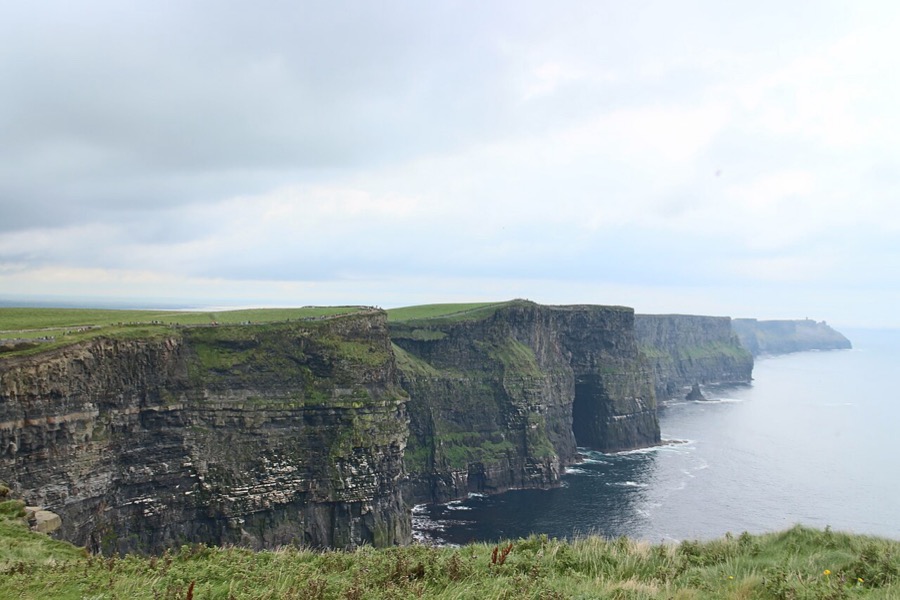
The cliffs run for some fourteen kilometres along the Atlantic and rise to more than two hundred metres. O’Brien’s Tower on the top was built in 1835 by Cornelius O’Brien as a viewing point for visitors; puffins nest on the ledges in early summer.
- Killimer–Tarbert Ferrystop on the way
A car ferry across the mouth of the Shannon, the longest river in Ireland, from County Clare to County Kerry in about twenty minutes. It saves the long drive round through Limerick; check the sailing times before you set out.
- Traleeone night
The county town of Kerry, known around the world for the Rose of Tralee, a festival held every August since 1959 that takes its name from a nineteenth-century ballad. The Kerry County Museum, in the Ashe Memorial Hall in the town centre, tells the story of the county from the Stone Age on.
- Conor Passstop on the way
The highest mountain pass in Ireland that a road crosses, over the spine of the peninsula from Brandon Bay down to Dingle, with views of lakes and of both sides of the peninsula from the top. Near the summit the road is one lane cut into the rock, and drivers have to back up to the pull-ins to let each other pass.
- Dingle2 nights
A fishing town in the Gaeltacht, where Irish is still the language of daily life and the road signs are in Irish only; the town’s official name is An Daingean. For more than thirty years, from 1983, a wild dolphin called Fungie lived in the harbour mouth and swam beside the boats.
- Slea Head Drivestop on the way
A loop around the tip of the peninsula past beehive huts of stone and the Gallarus Oratory, with the Blasket Islands offshore. The islanders were moved to the mainland in 1953, but they left a shelf of books in Irish about their life, among them Tomás Ó Criomhthain’s The Islandman; drive the loop clockwise, as the signs ask.
- Killarney2 nights
The town of lakes and mountains that Queen Victoria visited in 1861, after which it became a fashion. Killarney National Park, the first in Ireland, was created in 1932 when the family that owned the Muckross estate gave it to the state; its jaunting cars, horse carts with a driver, still wait for passengers in town.
- Gap of Dunloestop on the way
A narrow pass carved by ice between the MacGillycuddy’s Reeks, the highest mountains in Ireland, and Purple Mountain, past five small lakes joined by a stream. The way in is from Kate Kearney’s Cottage, a nineteenth-century coaching inn; the road through is so narrow that the best way is on foot, by bicycle or by jaunting car.
- Muckross Housestop on the way
A Victorian mansion of 1843 on the shore of Muckross Lake, inside the national park. Its owners spent a fortune preparing it for Queen Victoria’s visit in 1861, and the cost helped ruin the family.
- Cahir Castlestop on the way
One of the largest and best preserved castles in Ireland, built on a rocky island in the River Suir. The Earl of Essex took it in 1599 after a siege of three days, and in 1650 it surrendered to Cromwell without a fight.
- Cashelone night
A town under the Rock of Cashel, the seat of the kings of Munster on a limestone rock over the plain, where by tradition Saint Patrick baptised the king in the fifth century. In 1101 the king gave the rock to the Church, and Cormac’s Chapel, consecrated in 1134, keeps some of the oldest wall paintings in Ireland.
- Kilkennyone night
A medieval town on the River Nore, called the Marble City after the black limestone quarried nearby. Its castle, built by the Normans from 1195, was the seat of the Butler family from 1391, until in 1967 they sold it to the people of the town for fifty pounds.
- Glendaloughstop on the way
The glen of the two lakes in the Wicklow Mountains, where Saint Kevin founded a monastery in the sixth century. Its round tower, some thirty metres high, still stands among the ruined churches, and walking trails lead along the upper lake.
- Dublinone night
Back for the flight. In James Joyce’s Ulysses, all set in Dublin on the sixteenth of June 1904, the hero is Leopold Bloom, a Dubliner of Jewish descent, and every year on that date the city celebrates Bloomsday along the route of his walk.

What it costs
Eighty dollars a night is the room. The car, the fuel and the tolls are yours: a few motorway toll plazas paid at the barrier, the M50 around Dublin paid online, and the car ferry across the Shannon from Killimer to Tarbert. Fuel in Ireland is dear by European standards. The extras worth budgeting are the entry to the Cliffs of Moher, Kylemore Abbey and the Rock of Cashel, and a jaunting car through the Gap of Dunloe.
What to know
Three things. One: the left. Ireland drives on the left, and the first hours out of Dublin airport are the hardest; take the car out slowly, keep the driver to the middle of the road, and at roundabouts give way to the right and go clockwise. Two: the M50. The motorway around Dublin has a barrier-free toll between junctions 6 and 7, with no booth and no gate; a camera reads the plate, and you must pay online by eight in the evening of the next day, or the rental company will pass on the fine with its own fee. Three: the insurance. Many credit cards that cover rental cars elsewhere exclude Ireland, so the rental company will often insist you buy its own collision damage waiver, or bring a letter from your card issuer; check before you book, and look at the excess you would pay for a scratch.
Roads, tolls and rules
Ireland drives on the left, and distances are in kilometres. The route is driven at an easy pace, with a night every hundred kilometres or so, in Athlone on the Shannon, in Doolin, in Tralee, in Cashel and in Kilkenny, so no day is longer than about two and a half hours at the wheel. The motorways out of Dublin are fast; the rest of the west is a world of narrow roads between stone walls and hedges, with tractors, sheep and tour coaches, and on the Dingle Peninsula, over the Conor Pass and in the Gap of Dunloe a road can shrink to one lane with pull-ins. An hour on the map is often an hour and a half.

Travel Ireland, the west coast: From Dublin to Killarney
The route on our site, with a room up to $80 every night.