The Adriatic Highway
When to go
May, June and September. July and August on this coast are not a question of heat but of volume — the coastal road is one lane each way for most of its length, and in August it carries the traffic of every ferry and every campsite on it. Dubrovnik in August is a queue. In May the sea is cold and everything else is better.
The stops
Interactive map of the route on our site ›
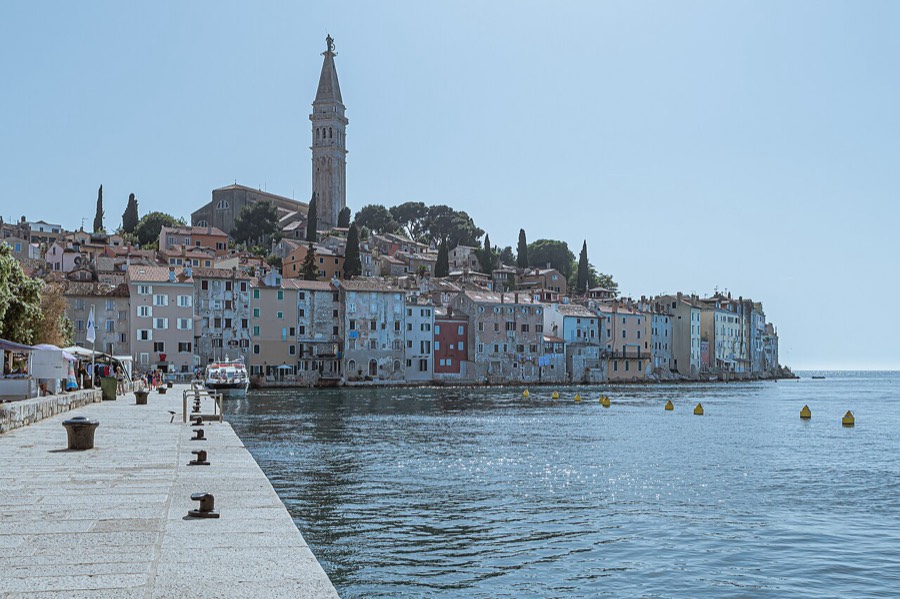
- Rovinjone night
The old town was an island until 1763, when the channel between it and the mainland was filled in. That is why the houses stand straight out of the water with no quay in front of them — there was never room for one, and the sea was the street.
- Pulastop on the way
The Roman amphitheatre here is one of only six in the world with its complete outer wall still standing. In 1583 the Venetian senate voted to take it apart stone by stone and rebuild it in Venice — the plan was stopped by a single senator who argued it should stay where it was built.
- Labinstop on the way
A hill town above the old coal mines of eastern Istria. Matthias Flacius Illyricus, one of the leading Lutheran theologians of the sixteenth century, was born here in 1520; and in March 1921 the miners of the valley below took over the mines and declared the short-lived Labin Republic.
- Opatijaone night
The first grand hotel on this coast opened here in 1884, and the Habsburg court came to winter in it. The seafront path that runs twelve kilometres along the shore was built for those guests, and it is still the way people here walk between towns.
- Rijekastop on the way
In September 1919 the poet Gabriele D’Annunzio marched into this city with a private militia, declared it his own state and ran it for fifteen months, with a constitution that made music the fundamental principle of the state. Italy eventually shelled him out.
- Senjone night
In the sixteenth century this was the base of the Uskoks, refugees from the Ottoman advance who fought the Turks on land and raided Venetian ships at sea. The round fortress of Nehaj above the harbour was built for them in 1558, partly from the stones of churches and monasteries outside the walls, and it still stands.
- Plitvice2 nights
The sixteen lakes are stacked in a staircase, and the barriers between them are alive: travertine, built by moss and algae depositing calcium out of the water, growing about a centimetre a year. The lakes are therefore not fixed — over centuries the dams rise, breach and reform somewhere else.
- Udbinastop on the way
On the Krbava field around Udbina, on 9 September 1493, an Ottoman army destroyed the Croatian nobility in a single battle, remembered by Croatian chroniclers as the beginning of the kingdom’s ruin. The Church of the Croatian Martyrs on the rise above the field was consecrated in 2010.
- Obrovacstop on the way
A small town on the Zrmanja, where the river has cut a deep canyon through the karst on its way to the sea. In the 1960s this canyon stood in for the American West in the German Winnetou films, made from the novels of Karl May.
- Zadarone night
On the waterfront there is an organ built into the steps: thirty-five pipes under the marble, played by the waves pushing air through them. It was finished in 2005, it never plays the same thing twice, and it is the only instrument in the world whose player is the sea.
- Krkastop on the way
The waterfalls here powered one of the first hydroelectric plants in the world, switched on in 1895 — two days after the plant at Niagara Falls, and it lit the town of Sibenik, which became one of the first cities anywhere with alternating current street lighting.
- Sibenikone night
The cathedral is built entirely of interlocking stone slabs — no brick, no wood, no mortar in the shell, a method used nowhere else in Europe. Around the outside run seventy-one carved heads, and they are not saints: they are the faces of ordinary people of the town in the fifteenth century.
- Primostenstop on the way
The hillsides above the town are covered in dry-stone walls built by hand to hold soil for vines on bare rock. A photograph of them hangs at the United Nations in New York as an image of human endurance, and the walls are still maintained by the families who own the plots.
- Trogirstop on the way
The whole old town is an island between the mainland and a larger island, and it has been continuously inhabited since the Greeks founded it in the third century BC. The west door of its cathedral was carved in 1240 and signed by the sculptor — which almost nobody did at that date.
- Split2 nights
This is not a town with a Roman palace in it. It is a Roman palace that became a town: Diocletian built his retirement residence here around the year 300, and when the coast was raided centuries later people moved inside the walls and never left. There are flats, bars and laundry lines inside an emperor’s house.
- Omisstop on the way
For two centuries this gorge mouth was a pirate base, and the pirates of Omis were good enough that Venice and the Pope both paid them off rather than fight them. The fortress above the town was theirs, and the canyon behind it was the escape route nobody could follow them into.
- Makarskaone night
The road that climbs away from here, the D512, is thirty and a half kilometres long and is rated among the best coastal drives in the world. It runs between the Biokovo wall and the sea, and the mountain behind the town rises to over seventeen hundred metres within four kilometres of the beach.
- Peljesac Bridgestop on the way
Opened in July 2022, the bridge is 2,404 metres long and carries the road over the sea to the Peljesac peninsula, so the drive south no longer passes through Bosnia at Neum. It was built by a Chinese state company and paid for largely by the European Union.
- Stonone night
A defensive wall five and a half kilometres long runs over the hills here, the longest in Europe after Hadrian’s, and it was not built to protect a city. It was built to protect salt. The pans below it have been worked by hand since the fourteenth century and they still are, and salt was what made Dubrovnik rich.
- Trsteno Arboretumstop on the way
A Renaissance garden laid out at the end of the fifteenth century by the Gučetić, a noble family of Dubrovnik, on a terrace over the sea. In the village square stand two oriental plane trees more than four hundred years old, and the garden played the palace gardens of King’s Landing in Game of Thrones.
- Dubrovnik2 nights
The Republic of Ragusa did two things long before anyone else. In 1377 it ordered arriving ships to wait in isolation before entering — first thirty days, later forty, and the Italian for forty, quaranta, is where the word quarantine comes from. And in 1416 it abolished the slave trade, four and a half centuries before most of Europe.

What it costs
Eighty dollars a night is the room. The car, the fuel and the ferries are yours, and on this coast the ferry is part of the road: the islands are reached by car ferry and in summer you queue for them. The old problem on this drive was Neum, the nine kilometres of Bosnian coast that cut Croatia in two — since the Peljesac Bridge opened in July 2022 the whole drive stays inside Croatia and there is no longer any border to cross.
What to know
Three things. One: the Adriatic Highway is a thousand kilometres of two-lane road with the sea on one side and rock on the other, and overtaking on it is what the accident statistics are about — the posted hour is never the real hour. Two: the islands. Hvar, Brac and Korcula are off this route and each one costs a ferry crossing in both directions, so decide before you book the car whether the car comes with you. Three: the deposit, six hundred to twelve hundred euros held on the card plus the insurance excess.
Roads, tolls and rules
Croatia has no vignette: the motorways are distance-based, you take a ticket on entry and pay on exit, in euros or by card. The coastal road itself is free and that is where the traffic is. Two legal points worth knowing: winter tyres or chains must be carried from the middle of November to the middle of April, which applies on the coast too; and police may issue on-the-spot fines to foreign-registered cars. A non-EU licence needs an international permit beside it. Fuel is reliable along the A1 and the coast road, and the islands have far fewer stations than you expect — fill up before a ferry. Charging on the Zagreb-Split corridor is spaced about every forty to sixty kilometres and gets thin off it. This track keeps every driving day to about 160 kilometres or less: the coast road is slow, and the nights in Opatija, Senj, Sibenik, Makarska and Ston are there so that no day is spent only behind the wheel.

Travel The Adriatic Highway
The route on our site, with a room up to $80 every night.