Georgia: From Tbilisi to Batumi
When to go
June to early October. This route climbs to Kazbegi and to Svaneti, and both are mountain country: in winter the road over the Jvari Pass can close for days, and snow reaches Mestia from November. In July and August Tbilisi and Kutaisi are hot and the mountains are at their best. Batumi is the wettest city in Georgia, so even in summer pack for a day of rain on the coast.
The stops
Interactive map of the route on our site ›
- Tbilisi2 nights
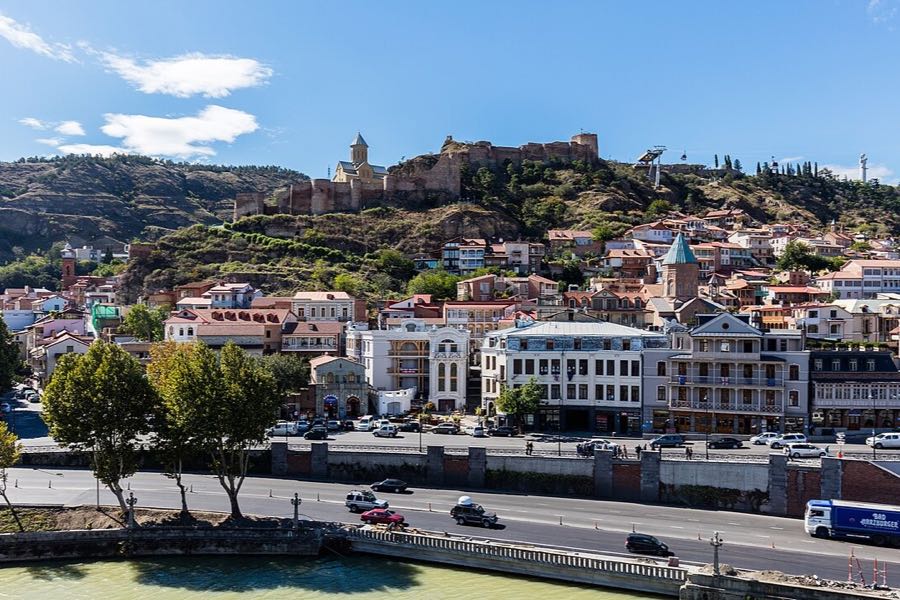
Its name comes from the Georgian word for warm, after the sulphur springs that still feed the domed bathhouses of Abanotubani. By their own tradition the Jews of Georgia arrived after the destruction of the First Temple, some twenty-six centuries ago; the Great Synagogue in the old town was built between 1895 and 1903 by Jews from Akhaltsikhe and still holds prayers.
- Bodbe Monasterystop on the way
Saint Nino, the woman who brought Christianity to Georgia in the fourth century, is buried here, two kilometres below Sighnaghi. King Mirian III built the first church over her grave, and the convent still looks out over the Alazani valley to the Caucasus.
- Sighnaghione night
A hill town over the Alazani valley and the wine country of Kakheti, ringed by walls that King Erekle II built in the 1770s, with towers you can walk between. The town museum holds a room of paintings by Niko Pirosmani, who was born in the village of Mirzaani nearby.
- Jvari Monasterystop on the way
A church built between about 586 and 605 on the hill where, by tradition, Saint Nino raised a wooden cross; jvari means cross. It looks down on the meeting of the Mtkvari and the Aragvi and on Mtskheta below, and is part of the World Heritage site listed in 1994.
- Mtskhetaone night
The capital of the ancient kingdom of Iberia, where Georgia became Christian. Georgian tradition tells of Elioz, a Jew of Mtskheta who was in Jerusalem at the crucifixion and brought back the robe of Jesus; his sister Sidonia died holding it and was buried with it, and Svetitskhoveli Cathedral, built in 1010–1029, stands over the spot.
- Ananuristop on the way
The castle of the dukes of Aragvi, of the seventeenth century, standing over the turquoise Zhinvali reservoir, which holds the drinking water of Tbilisi. The larger church, of 1689, has a great cross carved on its façade among vines.
- Friendship Monumentstop on the way
A Soviet arc of painted tiles on the edge of a sheer drop above Gudauri, built in 1983 for the two hundredth anniversary of the Treaty of Georgievsk, which put Georgia under Russian protection. It is windy and cold here even in August.
- Kazbegi2 nights
The town’s real name is Stepantsminda; for eighty years it was called Kazbegi after the writer Alexander Kazbegi, who was born here, and the old name stuck. Above it rises Mount Kazbek, a dormant volcano over five thousand metres high, and the Russian border is a short drive up the Dariali gorge.
- Gergeti Trinity Churchstop on the way
A fourteenth-century church alone on a ridge at about 2,170 metres, with Kazbek behind it; a road now climbs to it, or it is an hour and a half on foot from town. Shoulders and knees covered, and women need a headscarf, lent at the door.
- Pasanaurione night
A small town on the Georgian Military Road where the White Aragvi and the Black Aragvi meet. Pasanauri is known all over Georgia for its khinkali, the dumplings eaten by hand, holding the twisted top and drinking the broth first.
- Uplistsikhestop on the way
A town carved into the sandstone above the Mtkvari river from the first millennium before the common era, with halls, streets and a pagan temple cut in the rock. It lived on as a trading town into the Middle Ages and was emptied after the Mongols came in the thirteenth century.
- Gorione night
Stalin was born here in 1878 as Ioseb Jughashvili, and the small house of his childhood stands under a stone pavilion in front of the museum built in his name, with his armoured railway carriage beside it. The fortress on the hill above the town is medieval; in August 2008 Gori was bombed and held for days by Russian forces.
- Gelati Monasterystop on the way
Founded in 1106 by King David the Builder as a monastery and an academy of learning. The king asked to be buried under the gate, so that everyone who entered would step on him; the gold mosaic of the Virgin in the apse is of the twelfth century.
- Kutaisione night
The capital of ancient Colchis, the land of the Golden Fleece. Kutaisi was long a centre of Georgian Jewry, and its synagogue on Gaponov Street, named after Boris Gaponov, who translated The Knight in the Panther’s Skin into Hebrew, is still open; most of the community made aliyah, many of them in the 1970s. Bagrati Cathedral, of 1003, was rebuilt so thoroughly that UNESCO took it off the World Heritage list in 2017.
- Martvili Canyonstop on the way
A narrow limestone gorge of the Abasha river, with waterfalls and green water that you ride in a small boat and look down on from walkways. By local tradition only the Dadiani princes, the rulers of Mingrelia, were allowed to bathe here.
- Martvilione night
The town was long called Chkondidi, which means great oak in Mingrelian, after the sacred oak that, by tradition, stood on the hill before Christianity. The monastery on that hill, with its tenth-century church, was the seat of the bishops of Chkondidi.
- Enguri Damstop on the way
A concrete arch dam 271 metres high, among the tallest in the world, finished in 1987. The dam stands in Georgia but its power station lies downstream in Abkhazia, beyond the line of control, and the electricity is shared between the two sides.
- Mestia2 nights
The capital of Svaneti, a valley so cut off that the churches kept their icons and manuscripts through every invasion. Every family built a stone defence tower beside its house, most of them between the ninth and the thirteenth centuries; Upper Svaneti has been a World Heritage site since 1996.
- Ushgulistop on the way
A cluster of tower villages at about 2,100 metres, among the highest places in Europe lived in all year round, under Shkhara, the highest mountain in Georgia. The road from Mestia is about two hours each way; go with a local driver and a four-by-four.
- Zugdidione night
The town of the Dadiani princes of Mingrelia, and the last before the Enguri bridge into Abkhazia. Their palace is a museum, and among its treasures is one of the bronze death masks of Napoleon, which came here when Salome Dadiani married Achille Murat, a grandson of Napoleon’s sister Caroline.
- Batumi2 nights
The port on the Black Sea, with a seaside boulevard laid out in 1881 and, on the shore, Ali and Nino, two steel figures that move toward each other every evening and pass through one another. The synagogue of Batumi, built at the start of the twentieth century, was closed under Soviet rule and given back to the community after independence.
What it costs
Eighty dollars a night is the room. The car and the fuel are yours, and Georgia has no toll roads, so there are no tolls to add. Fuel is cheaper than in most of Europe. Parking in central Tbilisi and in Batumi is paid by zone; in the mountain towns it is mostly free. The one extra worth budgeting is a local driver with a four-by-four for the day from Mestia to Ushguli.
What to know
Three things. One: the driving. Georgians overtake on blind bends and over solid lines, a car coming at you in your lane is part of a normal day, and cows, dogs and pigs stand on the asphalt even on the main road; drive slowly and defensively, and never at night in the mountains. Two: the Georgian Military Road to Kazbegi crosses the Jvari Pass at about 2,400 metres, and in winter it is closed whenever snow or avalanches demand it, sometimes for days, with lorries for the Russian border queued along it; check before you set out. Three: the road to Mestia runs some 135 kilometres from Zugdidi up the Enguri gorge. It is paved, but rockfalls and landslides cut it after rain, and there is little fuel on the way; drive it in daylight, and beyond Mestia leave the rental car and hire a local driver.
Roads, tolls and rules
Georgia drives on the right. The main road from Tbilisi through Gori to Kutaisi is the only fast road in the country; everything else is a two-lane road through villages, and an hour on the map is often an hour and a half. The track takes it slowly: no day is longer than about 160 kilometres except the climb from Martvili to Mestia, some 180 kilometres up the Enguri gorge with one stop at the dam, and the mountain roads up and down from Kazbegi are split with a night in Mtskheta and one in Pasanauri. Fill up before the mountains.

Travel Georgia: From Tbilisi to Batumi
The route on our site, with a room up to $80 every night.