The Rhine by bike: between the castles
When to go
April to October is the season: the Rhine boats and the ferries run their full timetables, the vineyards are green and then golden, and in September and October the wine villages hold their wine festivals. July and August are warm in the gorge and the path is busy at weekends, so May, June and September are the best months to ride. On several summer evenings the Rhine in Flames fireworks light up the castles; on those nights the rooms in the valley go weeks ahead, so check the dates for your year.
The stops
Interactive map of the route on our site ›
- Koblenz2 nights
The route starts at the Deutsches Eck, the point where the Moselle flows into the Rhine; the Romans called the place Confluentes, the confluence, and the city’s name comes from it. The equestrian statue of Kaiser Wilhelm I on the point was shot down in 1945 and a copy was set up again in 1993.
- Ehrenbreitstein Fortressstop on the way
Across the Rhine from the Deutsches Eck, the Prussians rebuilt this fortress between 1817 and 1828 as one of the strongest in Europe. A cable car built for the 2011 Federal Garden Show crosses the river to it.
- Burg Thurantstop on the way
A day up the Moselle Cycle Route to the wine village of Alken and back, about 45 kilometres, flat along the river. Above the village stands Burg Thurant, besieged for two years from 1246 by the archbishops of Trier and Cologne, who then split it between them.
- Marksburgstop on the way
Riding south on the left bank you see it high on the far side above Braubach: the only hilltop castle on the Middle Rhine that was never destroyed.
- Boppardstop on the way
A town on the Rhine’s great bend, built inside the Roman fort of Bodobrica; long stretches of its fourth-century walls still stand between the houses, among the best-kept Roman fort walls in Germany.
- St. Goarstop on the way
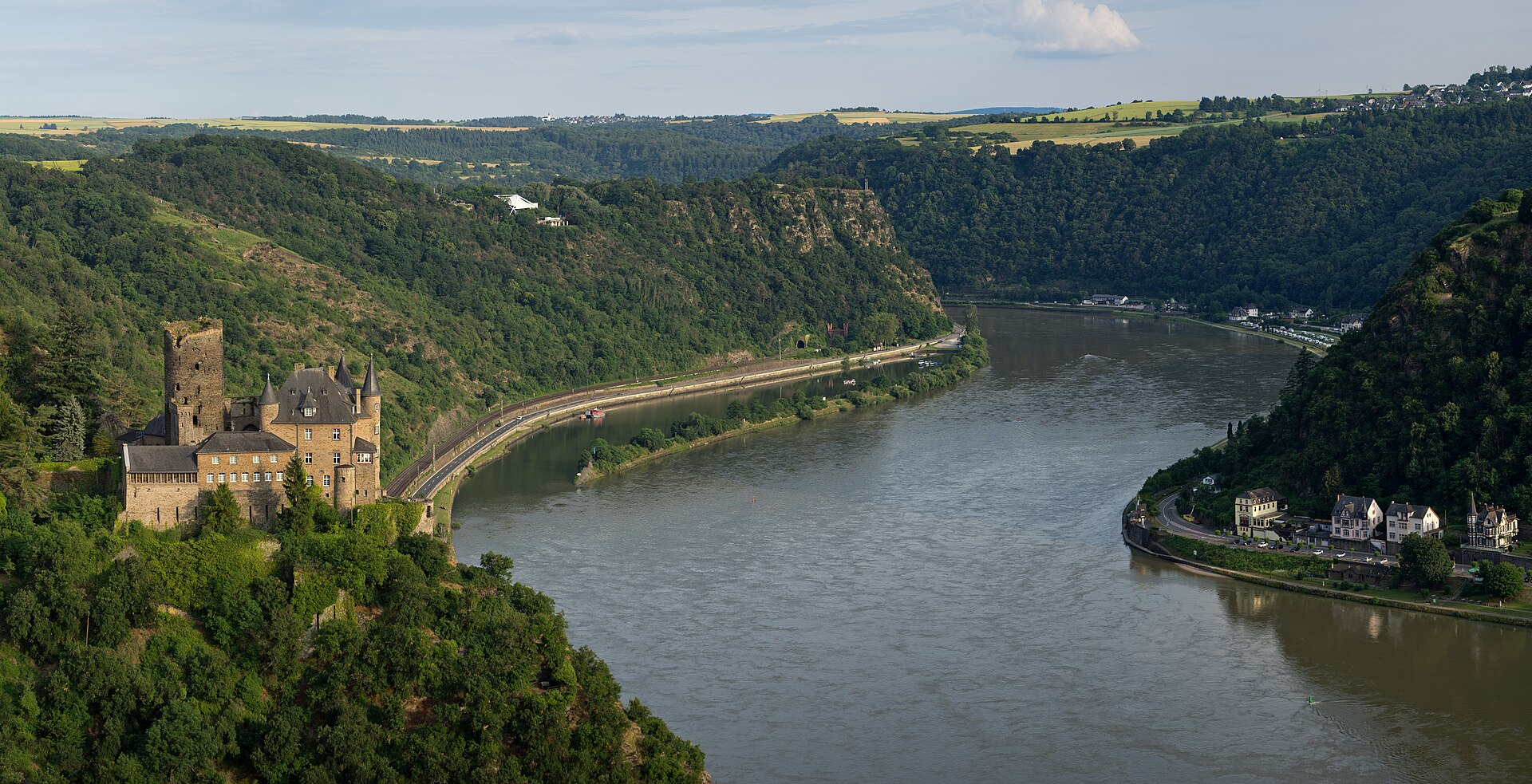
Above the town is Burg Rheinfels, once the largest castle on the Rhine; it held out against the French in 1692, and French troops blew it up in 1797. Across the river from here rises the Loreley.
- Loreleystop on the way
A slate rock about 130 metres above the narrowest bend of the river, where boats were wrecked on the reefs. Heinrich Heine, born to a Jewish family in Düsseldorf, wrote the poem of the Loreley in 1824, and Friedrich Silcher set it to the song every German knows.
- Bacharach2 nights
A walled wine town of half-timbered houses; the Altes Haus at its centre dates from 1368. Heinrich Heine set his unfinished story The Rabbi of Bacherach here, about the Jews of the town on a Passover night.
- Wernerkapellestop on the way
The roofless Gothic ruin above the town was built for Werner, a boy found dead in 1287 whose death was falsely blamed on the Jews; the libel set off the murder of Jews along the Rhine. A plaque at the ruin now remembers them.
- Burg Pfalzgrafensteinstop on the way
A rest day with a short ride north and a ferry to Kaub: a small boat takes you to this toll castle on an island in the river, built in 1327 so that no ship could pass without paying. At Kaub, on New Year’s night 1813–14, Blücher’s army crossed the Rhine after Napoleon.
- Bingenstop on the way
Where the Nahe meets the Rhine stands the Mouse Tower on its island; the legend says the cruel Archbishop Hatto was eaten here by mice. From Bingen the ferry takes the bike across to Rüdesheim.
- Ruedesheimone night
A short day — about 17 kilometres from Bacharach — ends in the wine town of the Drosselgasse, a lane of wine taverns about 144 metres long. Asbach brandy has been distilled here since 1892.
- Niederwald Monumentstop on the way
A cable car rises over the vineyards to the Germania, unveiled in 1883 to mark the founding of the German Empire in 1871; she looks out over the Rhine towards France.
- Eltvillestop on the way
On the way through the Rheingau, the Electoral Castle of the archbishops of Mainz; here in 1465 Archbishop Adolf II honoured Johannes Gutenberg, who had invented printing with movable type, and made him a courtier.
- Mainz2 nights
About 35 kilometres from Rüdesheim the route ends at the cathedral, begun in 975, in the city where Gutenberg was born. Medieval Mainz was Magenza, one of the three ShUM communities with Speyer and Worms, which UNESCO listed in 2021; its old Jewish cemetery is among the oldest in Europe.
- New Synagogue Mainzstop on the way
Opened in 2010 by the architect Manuel Herz, its folded shape is drawn from the Hebrew word kedushah, holiness. It stands on the site of the synagogue burned in 1938.

What it costs
Eighty dollars a night is the room. The bike hire, the luggage transfer, the Rhine ferries, the cable cars and any train you take with the bike are yours and are not included. The ferries charge a small fare for a rider and a bike, and the cable cars in Koblenz and Rüdesheim take bikes for an extra fee or not at all, so leave the bike at the hotel for those.
What to know
Three things. One: the ferries. Between Koblenz and Mainz no bridge crosses the Rhine, so every crossing is by ferry; they run often by day but stop in the evening, so check the last ferry before you cross. Two: the luggage. Hire shops along the Rhine Cycle Route rent bikes and e-bikes with a one-way drop at the end, and many hotels and local firms move your bags to the next hotel; ask when you book the bike, and check that it covers every night. Three: the trains. A regional train runs along each bank and takes bikes, so a tired rider or a rainy day is never a problem, but the bike may need its own ticket and the trains are full on summer weekends.
Roads, tolls and rules
This route has no car. It rides the Rhine Cycle Route, signposted as EuroVelo 15, through the Upper Middle Rhine Valley, a UNESCO World Heritage gorge of castles and vineyards, from Koblenz up the river to Mainz. The path is flat and mostly asphalt, on the river bank or beside the road and the railway; the gradient is the river’s and the only climbs are to the castles, which you can walk or skip. Riding up the Rhine means riding against the current, but it is barely felt. The days are short on purpose — between about 17 and 52 kilometres — to leave time for the castles, and two days are rest days in town; an e-bike makes them shorter still. Burg & Bike in Koblenz and Lahnstein hires bikes and many e-bikes, and takes them back at the end in Mainz for a price quoted on request. Follow the EuroVelo 15 and Rheinradweg signs the whole way. Rooms: in Bacharach and Rüdesheim a room at eighty dollars is plain but usually findable outside the festival nights; in Koblenz and Mainz there are many. When none is free the site offers two flats at that price instead.

Travel The Rhine by bike: between the castles
The route on our site, with a room up to $80 every night.