Switzerland by panoramic train: Milan to Milan
When to go
Late May to early October is the high season: the passes are green, the Gornergrat and the Muottas Muragl run long days, and the panoramic cars are full, so the seat reservations go weeks ahead. The Bernina Express runs all year, and in winter its line over the Bernina Pass is among the most beautiful snow journeys in the Alps. The Glacier Express runs in summer and in winter but not every day of the year: check the timetable for your dates before you book anything else. In July and August the rooms in Zermatt and St Moritz are at their dearest.
The stops
Interactive map of the route on our site ›
- Milanone night
The trains for this route leave from Milano Centrale, opened in 1931. Beneath it is Platform 21, from which the Jews of Milan were deported in 1943 and 1944; it is now the Shoah Memorial, open to visitors.
- Domodossolastop on the way
The last Italian station before the Simplon tunnel, which opened in 1906 and was for decades the longest railway tunnel in the world. From here the little Centovalli railway runs east to Locarno.
- Vispstop on the way
Here you change to the red narrow-gauge train of the Matterhorn Gotthard Bahn, which climbs about an hour up the valley to Zermatt.
- Zermatt2 nights
A car-free village under the Matterhorn, 4,478 metres high. Edward Whymper’s party first climbed it on 14 July 1865, and four of the seven fell to their deaths on the way down; their story is told in the Matterhorn Museum.
- Gornergratstop on the way
A rack railway from Zermatt station to a ridge at 3,089 metres, facing the Matterhorn and the Gorner Glacier. It opened in 1898 and was the first electric rack railway in Switzerland.
- Brigstop on the way
The Glacier Express passes the town of the Stockalper Palace, with its three onion-domed towers, built in the 1600s by Kaspar Stockalper, who grew rich on the trade over the Simplon Pass.
- Oberwaldstop on the way
At the top of the Rhône valley the train enters the Furka base tunnel, about fifteen kilometres long, opened in 1982. Before it, the line went over the Furka Pass and the Glacier Express could not run in winter.
- Andermattone night
A village at the crossroads of the Furka, Oberalp and Gotthard routes. Just below it, in the Schöllenen gorge, Russian troops under General Suvorov fought their way over the Devil’s Bridge in 1799, and a great cross cut in the rock remembers them.
- Oberalp Passstop on the way
At 2,033 metres, the highest point of the Glacier Express. The lighthouse on the pass marks the source of the Rhine, which rises in Lake Toma just below.
- Ruinaultastop on the way
The Swiss Grand Canyon: the Rhine cut this gorge through the debris of the Flims rockslide, the largest in the Alps, about ten thousand years ago, and the railway runs along the river at the bottom where no road goes.
- Churone night
The capital of Graubünden is often called the oldest town in Switzerland, with traces of settlement thousands of years old under its old town. H. R. Giger, who designed the creature of Alien, was born here in 1940.
- Landwasser Viaductstop on the way
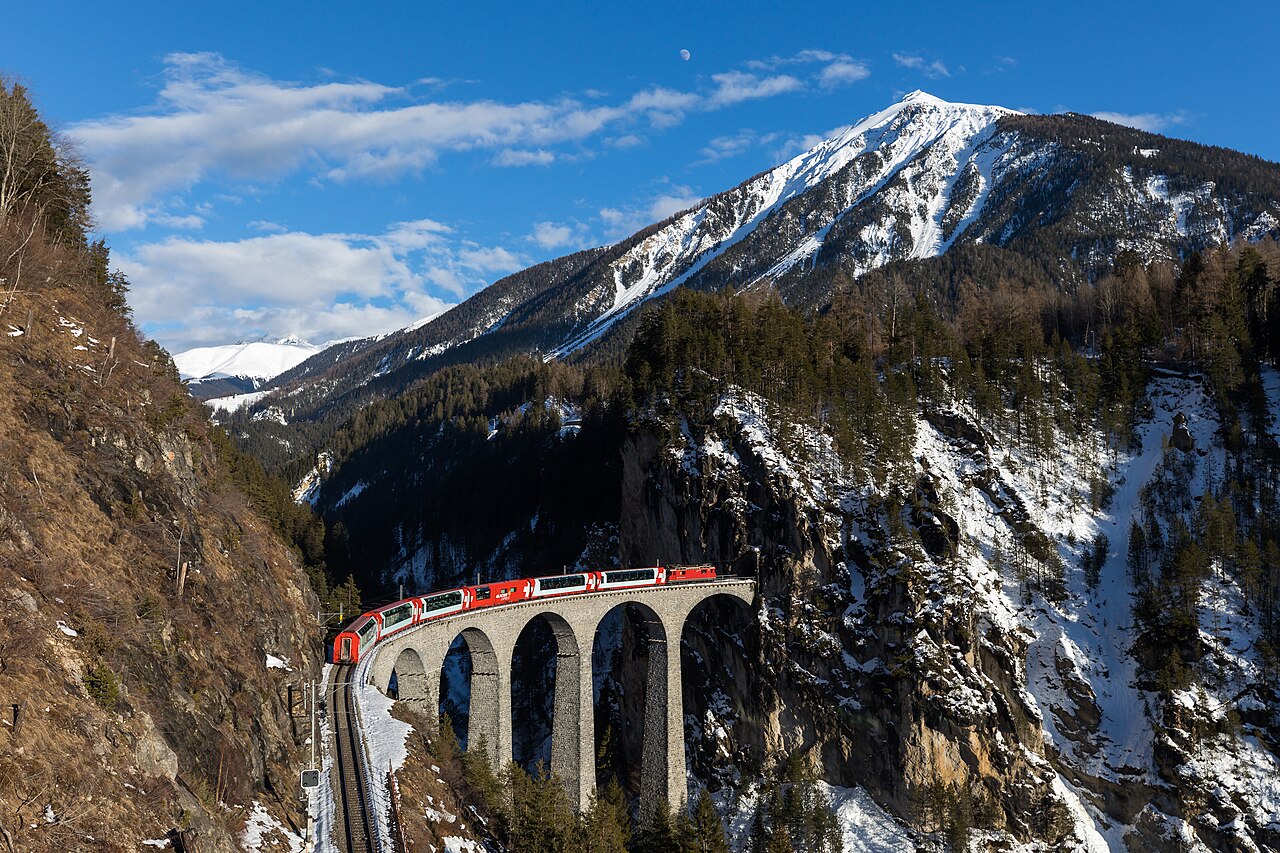
A stone viaduct of 1902, sixty-five metres high, on which the train curves straight into a tunnel in the face of the cliff. After it, between Bergün and Preda, the line climbs in spiral tunnels.
- Filisurstop on the way
The Albula line and the Bernina line beyond it have been a World Heritage site since 2008. From the station at Filisur a path leads in about half an hour to a viewpoint below the Landwasser Viaduct.
- St Moritz2 nights
Winter tourism in the Alps is said to have begun here in 1864, when the hotelier Johannes Badrutt bet English summer guests that they would enjoy a winter. The town hosted the Winter Olympics in 1928 and 1948.
- Muottas Muraglstop on the way
A funicular opened in 1907 climbs from Punt Muragl, a few minutes from St Moritz by train, to about 2,450 metres, with the whole chain of Engadine lakes below.
- Lago Biancostop on the way
The Bernina Express crosses the pass at Ospizio Bernina, 2,253 metres, without a rack, on grades of up to seven per cent. Lago Bianco beside it lies on the watershed: water to the north goes to the Black Sea, to the south to the Adriatic.
- Alp Grümstop on the way
A station at about 2,090 metres with no road to it, facing the Palü Glacier; from here the line drops in hairpin bends toward Poschiavo.
- Brusio Spiral Viaductstop on the way
Below the village the train runs a full circle on the Brusio spiral viaduct, a stone loop of 1908, to lose height without a tunnel.
- Tiranoone night
Back in Italy, the Bernina train runs down the middle of the street and past the Basilica of the Madonna di Tirano, built from 1505 on the place where the Virgin was said to have appeared in 1504.
- Milanstop on the way
The regional train from Tirano takes about two and a half hours to Milano Centrale, down the Valtellina and along the eastern shore of Lake Como.

What it costs
Eighty dollars a night is the room. The train tickets are yours and are not included: either a Swiss Travel Pass for the days in Switzerland, or point-to-point tickets bought from SBB, with the Italian legs from Milan and back from Tirano bought from Trenitalia and Trenord. On top of the ticket, the Glacier Express and the Bernina Express each need a paid seat reservation. The mountain railways — the Gornergrat, the cable car or funicular of the outing from St Moritz — charge their own fares, and with a Swiss Travel Pass some are discounted rather than free.
What to know
Three things. One: the reservations. A ticket or a pass lets you on the train, but on the Glacier Express and the Bernina Express panoramic cars you sit only in a reserved seat, and in summer they sell out; book them as soon as the dates are fixed. Two: the luggage. The panoramic cars have little room for big suitcases, and SBB will carry your bags from station to station for a fee, so they can wait for you at the next hotel; ask at the counter a day ahead. Three: the timetable. Swiss trains leave to the minute and the connections are tight, Zermatt, Andermatt and Tirano are ends of the line, and some of the mountain railways close for maintenance between seasons, so check each day before you go.
Roads, tolls and rules
This route has no car. It goes up from Milan through the Simplon tunnel into the Valais, then by the narrow-gauge mountain railways across the Alps to the Engadine and down the Bernina line to Italy, and back to Milan along Lake Como. Zermatt is car-free: petrol cars stop at Täsch, and the only way in is the train. The narrow-gauge trains are slow on purpose — the Glacier Express takes most of a day from Zermatt to St Moritz — so the days are short in kilometres and long at the window. Be honest with yourself about the rooms: in high season a room at eighty dollars in Zermatt or St Moritz is rare, and when none is free the site offers two flats at that price instead.
Travel Switzerland by panoramic train: Milan to Milan
The route on our site, with a room up to $80 every night.