Albania: From Tirana to the Riviera
When to go
May to June and September to October. In July and August Berat and Gjirokastër are hot, the beaches of Ksamil and the Riviera are packed, and rooms on the coast cost twice as much. The sea is warm enough to swim from June to mid-October. In winter many hotels on the Riviera close, and the road over the Llogara Pass can see snow.
The stops
Interactive map of the route on our site ›
- Tirana Airportstop on the way
The country’s main airport has been named after Mother Teresa since 2001; she was born to an Albanian family in Skopje in 1910. Pick up the car here and drive first north to Kruja, half an hour away, before going down to the capital.
- Krujastop on the way
The mountain fortress of Skanderbeg, the national hero, who held it against three Ottoman sieges, in 1450, 1466 and 1467; it fell only in 1478, ten years after his death. The museum inside the walls was designed by Pranvera Hoxha, the daughter of the dictator, and opened in 1982; below it runs an old covered bazaar.
- Tirana2 nights
The capital only since 1920, with Skanderbeg Square at its heart and Bunk’Art, a museum dug into a nuclear bunker built for Enver Hoxha. Albania is the only country in occupied Europe that had more Jews at the end of the Second World War than at the start: under the code of besa, the sworn word, families hid local Jews and refugees, and Yad Vashem has recognised dozens of Albanians as Righteous Among the Nations.
- Durrësstop on the way
Founded by Greek colonists from Corinth and Corfu in 627 BCE as Epidamnos; as Roman Dyrrachium it was the start of the Via Egnatia, the road to Constantinople. Its amphitheatre, of the second century, was among the largest in the Balkans and was found only in 1966, under houses that had been built over it.
- Ardenica Monasterystop on the way
An Orthodox monastery on a wooded hill above the plain, founded in 1282 by the Byzantine emperor Andronikos II after a victory over the Angevins at Berat. By tradition Skanderbeg married Donika Arianiti in its church in 1451; the frescoes inside were painted in 1744 by the brothers Kostandin and Athanas Zografi.
- Beratone night
The town of a thousand windows, where the white Ottoman houses of Mangalem climb the slope in rows under a castle that people still live in. In the cathedral inside the walls is the museum of Onufri, the sixteenth-century icon painter famous for a red that no one has managed to copy; Berat joined Gjirokastër on the World Heritage list in 2008.
- Tepelenëstop on the way
The town of Ali Pasha, the Ottoman ruler of Epirus, who was born nearby and built the castle over the Vjosa. Lord Byron came here to meet him in October 1809 and put the visit into Childe Harold’s Pilgrimage. The Vjosa below, one of the last free-flowing rivers in Europe, became a national park in 2023.
- Gjirokasterone night
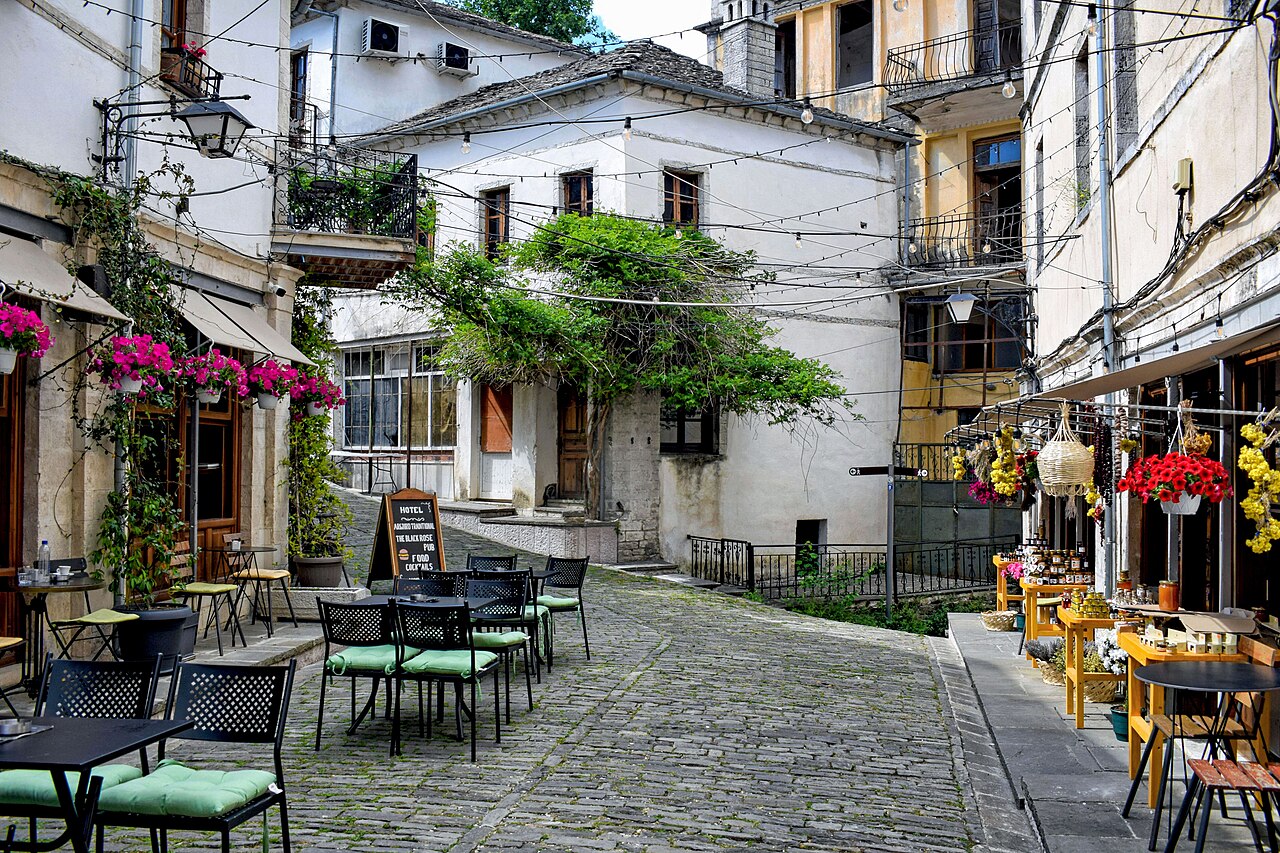
The city of stone, its houses roofed with slabs of grey stone below a huge castle; Enver Hoxha was born here in 1908 and the writer Ismail Kadare in 1936, who set Chronicle in Stone in its lanes. On the castle terrace stands an American air force jet that landed in Albania in 1957 and was displayed by the regime as a captured spy plane.
- Blue Eyestop on the way
A spring that wells up from a deep blue pool in the woods at Muzinë, on the road over the hills to the sea; divers have gone down more than fifty metres without reaching the bottom. The water stays at about ten degrees all year, and swimming in the pool is no longer allowed.
- Sarande2 nights
A seaside town facing Corfu across the strait, named after an old monastery of the Forty Saints. In the middle of town, beside the promenade, are the remains of a synagogue of the fifth and sixth centuries, found in 1983, with a floor mosaic that shows a menorah, a shofar and a citron.
- Butrintstop on the way
A city lived in for some three thousand years, on a wooded peninsula in a lagoon twenty kilometres south of Sarandë; Virgil wrote that Trojan exiles founded it. A Greek theatre, a sixth-century baptistery with a mosaic floor and a Venetian castle stand among the trees, and it has been a World Heritage site since 1992.
- Ksamilstop on the way
On the way back from Butrint, a village of white beaches facing a cluster of small wooded islands, a short swim or a pedal boat away. In August every metre of sand is rented out to sunbeds; come early, or late in the afternoon.
- Porto Palermostop on the way
A triangular fortress on a tiny peninsula in a closed bay, built or rebuilt by Ali Pasha in the early nineteenth century. Across the bay is the tunnel of a communist-era submarine base, cut into the hillside.
- Himare2 nights
A small town of the Riviera, with an old village inside castle walls on the hill and a new town on the bay below, and many of its people speak Greek as well as Albanian. It is a cheaper base than the resorts, with beaches in walking distance; a day here is a day off from the car.
- Dhërmistop on the way
A stone village high on the mountainside, its old houses and churches above a long white beach. On the coast between Dhërmi and Himarë, Julius Caesar landed his army in January 48 BCE in the civil war against Pompey, and wrote that the place was called Palaeste.
- Llogara Passstop on the way
The road climbs from the Riviera in hairpins to a saddle at about a thousand metres, with the whole coast and the island of Sazan below. On the north side is a national park of black pines, many bent flat by the wind into the shape of flags.
- Vloreone night
The city where Ismail Qemali declared the independence of Albania on 28 November 1912; the monument on Flag Square marks it. From here the motorway runs north to Tirana airport, about 150 kilometres and two hours away.

What it costs
Eighty dollars a night is the room. The car and the fuel are yours, and none of the roads on this route is tolled. The money is the lek; cards work in hotels and larger restaurants, but cafés, parking attendants and small guesthouses want cash, and euros are often accepted at a poor rate. Butrint, the castles of Berat and Gjirokastër and the museums each charge a small entry. The route ends in Vlorë, two hours from Tirana airport, so either drive back or ask the rental company in advance about a one-way fee.
What to know
Three things. One: the driving. Albanian drivers overtake where they like, roundabouts are a matter of nerve, and on the country roads there are sheep, goats, cyclists and pedestrians on the asphalt; the police run speed checks on the main roads, with hand-held radar. Drive slowly, and not at night outside the towns. Two: the old towns. Gjirokastër and the castle hill of Berat are steep lanes of polished stone, some too narrow and too slippery for a car; park below and walk up, or ask the hotel where to leave the car. Three: the Riviera road. From Vlorë over the Llogara Pass and down to Himarë and Sarandë the road climbs to about a thousand metres in hairpins with steep drops and buses on the bends; it is paved and good, but slow, so give it daylight and fill up before you set out.
Roads, tolls and rules
Albania drives on the right. The motorway from Tirana to Durrës and on south to Fier is the fast part of this route; from there the roads to Berat, Gjirokastër and the coast are two-lane roads through villages and river valleys, and an hour on the map is often an hour and a half. No day on this route is longer than about 160 kilometres, and the days on the coast are short on purpose, because the coast road is slow and the sea is the reason to come.

Travel Albania: From Tirana to the Riviera
The route on our site, with a room up to $80 every night.