Taiwan: The east coast
When to go
October to December and March to April. Typhoons reach the east coast from July to October, and each one can close the coast road and the mountain roads for days; May and June bring the plum rains. In winter the north-east monsoon keeps Yilan and the north of the coast grey and wet while Taitung and the south stay mild. Around the lunar new year, in January or February, the whole island travels and the hotels and trains fill.
The stops
Interactive map of the route on our site ›
- Taipei2 nights
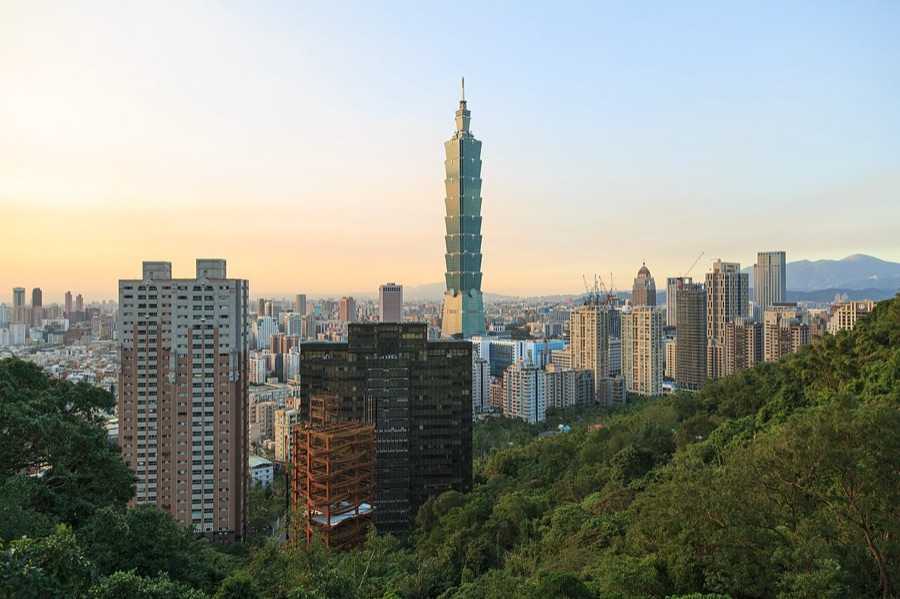
Taipei 101, 508 metres high, was the tallest building in the world from 2004 to 2010. Near the top hangs a steel ball of some 660 tonnes, a damper that sways against the building in typhoons and earthquakes, and it can be seen from the observatory.
- Jiufenstop on the way
A mining town on the mountainside over the sea that boomed after gold was found nearby in the 1890s and emptied when the mines closed. Hou Hsiao-hsien’s film A City of Sadness, which won the Golden Lion in Venice in 1989, was shot here and brought it back to life; its steep lanes of tea houses are now among the most visited in Taiwan.
- Lanyang Museumstop on the way
The museum of the Yilan plain, opened in 2010, stands at the water’s edge at Wushi harbour in Toucheng. The architect Kris Yao shaped the building as a tilted block that echoes the angled sandstone rocks of this coast.
- Jiaoxione night
A hot-spring town at the foot of the mountains on the Yilan plain, and one of the few in Taiwan where the springs rise in the flat land rather than up in the hills. In the Tangweigou park in the centre the foot baths are free, and the hotels pipe the spring water into the rooms.
- Nanfangaostop on the way
A fishing harbour south of Su’ao, busy with mackerel boats and fish restaurants on the quay. On 1 October 2019 the arched bridge over the harbour mouth collapsed onto the fishing boats moored below it.
- Qingshui Cliffsstop on the way
Here the mountains of the Central Range drop straight into the Pacific for kilometres, and the old road was cut into the face of the cliffs. Since 2020 the new tunnels of the Suhua Highway carry most of the traffic inside the mountain, and the cliffs are seen from viewpoints along the way.
- Hualien2 nights
The town between the mountains and the sea at the mouth of Taroko Gorge. Hualien and the coast south of it are the home of the Amis, the largest of Taiwan’s indigenous peoples, whose villages hold their harvest festivals in July and August.
- Taroko Gorgestop on the way
The Liwu river has cut a gorge through marble, hundreds of metres deep, and at Swallow Grotto the walls nearly meet overhead. The Central Cross-Island Highway was blasted through it from 1956 to 1960, and the Eternal Spring Shrine at the mouth of the gorge honours the 212 workers who died building it.
- Shitipingstop on the way
Stone Ladder Flat, a coast of terraces of grey volcanic rock and raised coral cut by the sea into steps and full of tide pools. It lies among the villages of the Amis, and the coast road here is among the most beautiful on the island.
- Tropic of Cancer Markerstop on the way
A white monument at Jingpu on the coast road marks the line of the Tropic of Cancer. It stands at the mouth of the Xiuguluan, the only river that cuts right through the Coastal Mountain Range to the sea.
- Ruisuione night
A town of the East Rift Valley with hot springs whose iron-rich water runs a rusty yellow, opened as a bathhouse in the Japanese era. The rafting trips down the Xiuguluan, through the coastal mountains toward the sea, start just outside town.
- Chishangstop on the way
A rice town in the East Rift Valley, between the Central Range and the coastal mountains, whose rice is among the most prized in Taiwan. The Chishang lunchbox, rice with toppings sold to train passengers at the station, became so famous that shops selling Chishang lunchboxes now stand all over the island.
- Luye Highlandstop on the way
A grassy terrace high over the rift valley, where paragliders launch over the tea fields. Every summer since 2011 it has hosted Taiwan’s hot-air balloon festival, and at dawn the balloons rise over the valley.
- Taitung2 nights
When the new station of Taitung was being dug in 1980, the workers came on the Beinan site, a village of the stone age with more than a thousand slate coffins, the largest such cemetery found in the western Pacific. The National Museum of Prehistory tells its story.
- Sanxiantaistop on the way
The Terrace of the Three Immortals, a rocky islet off the coast named for the legend that three of the Eight Immortals rested on it. A footbridge of eight arches, like the back of a dragon, crosses to it over the sea.
- Duoliang Stationstop on the way
A small station on the South Link railway, perched over the Pacific, often called the most beautiful station in Taiwan. Trains stopped calling here in 2006, but the platform is kept as a viewpoint, and the trains still pass along the cliff.
- Eluanbi Lighthousestop on the way
The lighthouse at the southern tip of Taiwan, built by the Qing in 1883 after foreign ships were wrecked on the reefs here, among them the American Rover in 1867, whose crew were killed ashore. It was built with gun ports and a moat, as a lighthouse that could defend itself.
- Kentingone night
The beach town at the southern tip of the island, at the heart of Kenting National Park, Taiwan’s first, founded in 1984. The main street turns into a night market every evening, and the coral coast on both sides is Taiwan’s tropical south.
- Hengchun Old Townstop on the way
The walls of Hengchun were built in 1875 and its four gates still stand, the best preserved Qing town wall in Taiwan. The town is the setting of Cape No. 7, the 2008 film that became one of the biggest box-office hits in Taiwan’s history.
- Donggangstop on the way
The fishing port of the bluefin tuna, landed here in spring and sold at the Huaqiao fish market, where the stalls cook what was caught that morning. Every three years the Donglong temple holds a festival that ends by burning a great wooden ship for the Wang Ye gods.
- Kaohsiung2 nights
Taiwan’s great port, where the old warehouses of Pier-2 became an arts district. Under the Formosa Boulevard metro station spreads the Dome of Light, a ceiling of coloured glass thirty metres across by the Italian-American artist Narcissus Quagliata.
- Fo Guang Shanstop on the way
The monastery founded in 1967 by the monk Hsing Yun, at the head of one of the largest Buddhist orders in the world. Its Buddha Museum, opened in 2011, was built to hold a tooth relic of the Buddha, and a huge seated bronze Buddha looks over it.
What it costs
Eighty dollars a night is the room. The car, the fuel and the tolls are yours: the freeways charge by distance through the eTag sticker on the windscreen, and the rental company bills you afterwards, while the coast road and the mountain roads are free. Renting in Taipei and returning in Kaohsiung adds a one-way fee, and the high-speed train back to Taipei is a ticket of its own, about an hour and a half to two hours. Parking in the cities is paid; in the east it is mostly cheap or free.
What to know
Three things. One: the papers. Taiwan requires an International Driving Permit together with your own licence, and only from countries whose permits it recognises, so check before you fly; without it the rental desk will not give you the car. Two: scooters. They come in swarms at every light, pass on both sides and wait in their own boxes in front of the cars; check the mirror before every right turn, and never open a door without looking. Three: the mountains and the Suhua road. The earthquake of April 2024 brought down rock across Taroko Gorge and along the Suhua Highway between Yilan and Hualien; parts of the gorge stayed closed for a long time, and the highway has at times been opened only in set time windows. Check the national park and the highway bureau the day before, and after every typhoon or strong quake.
Roads, tolls and rules
Taiwan drives on the right. This route keeps to short days: no day drives more than about 145 kilometres, with two or three stops on the way, and the nights between the cities are in small towns — the hot springs of Jiaoxi and Ruisui and the beach of Kenting. From Taipei the road goes over the hills by Jiufen to the coast and the Yilan plain; the Suhua road then follows the cliffs to Hualien. South of Hualien the route drives the coast road, Highway 11, to Shitiping, crosses the coastal mountains to Ruisui and goes down the East Rift Valley on Highway 9 to Taitung. From Taitung the South Link Highway crosses the southern tip of the Central Range, and the route goes round by Kenting before turning north to Kaohsiung. The roads on the east are slow and winding, and a day of a hundred kilometres takes most of the daylight with the stops.

Travel Taiwan: The east coast
The route on our site, with a room up to $80 every night.