Turkey classic: From Istanbul to Cappadocia
When to go
April to early June and September to October. In July and August Izmir, Ephesus and Pamukkale pass thirty-five degrees, and the white terraces burn underfoot at midday. Konya and Cappadocia lie on the central plateau at about a thousand metres, so their nights are cold in spring and autumn and their winters bring snow and ice on the roads. The balloons over Cappadocia fly at dawn all year, but wind cancels them often, so keep a spare morning.
The stops
Interactive map of the route on our site ›
- Istanbul3 nights
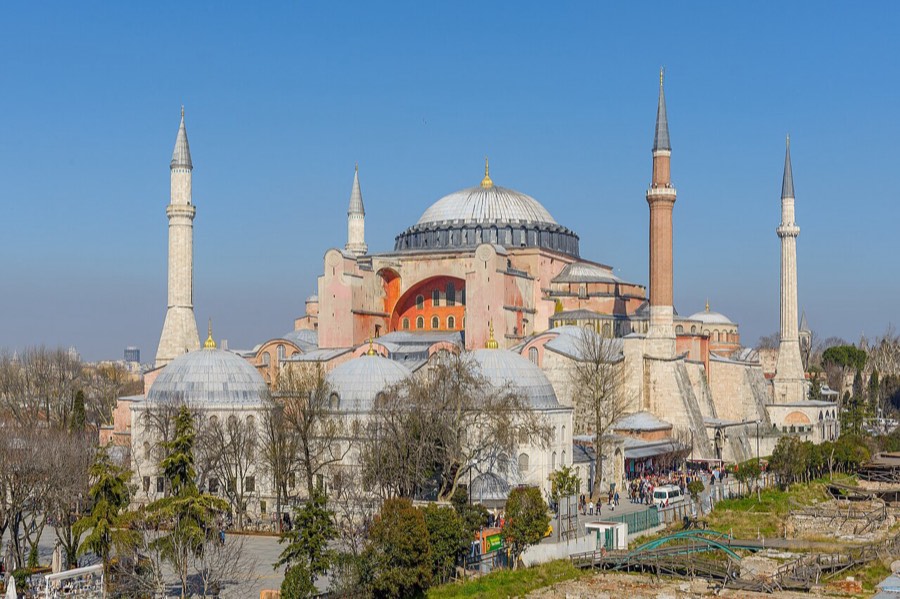
Hagia Sophia was built by Justinian and finished in 537, and for nearly a thousand years it was the largest church in the world. In 1492 Sultan Bayezid II took in the Jews expelled from Spain; in Balat the Ahrida synagogue, founded in the fifteenth century by Jews from Ohrid, keeps a reading platform shaped like the prow of a ship, which tradition links to Noah’s Ark.
- Iznikone night
Ancient Nicaea, where in 325 the emperor Constantine gathered the bishops of the Church for its first council, which wrote the Nicene Creed. The seventh council met in 787 in its Hagia Sophia, now a mosque again, and in the sixteenth century the kilns of İznik made the blue and red tiles of the great Ottoman mosques of Istanbul.
- Bursaone night
The first capital of the Ottomans, taken in 1326, where the early sultans are buried. The Grand Mosque, finished in 1399, has twenty domes; the story is that Bayezid I vowed twenty mosques for his victory at Nicopolis and built one with twenty domes instead. İskender kebab was first served here in the nineteenth century, and his family still runs the restaurant.
- Gölyazıstop on the way
A fishing village on a near-island in Lake Uluabat, joined to the shore by a narrow neck of land, on the site of ancient Apollonia ad Rhyndacum. Its old Greek houses, emptied in the population exchange of 1923, stand among Hellenistic walls, and the fishermen still go out on the lake in wooden boats.
- Balikesirone night
A market town of the plain between the Marmara and the Aegean, and a road city on this track. In its centre stands the Zağanos Pasha Mosque of 1461, built for one of the commanders of Mehmed the Conqueror at the siege of Constantinople.
- Pergamonstop on the way
The acropolis of a Hellenistic kingdom on a hill above Bergama, with one of the steepest theatres of the ancient world cut into its slope. Its great Altar of Zeus was taken to Berlin in the nineteenth century, and the city gave its name to parchment, which, the story goes, it made when Egypt cut off its supply of papyrus.
- Bergamaone night
The town at the foot of Pergamon. In its centre stands the Red Hall, a huge brick temple built in the second century for the gods of Egypt and later turned into a church; Pergamon is one of the seven churches of Asia to which the Book of Revelation is addressed.
- Izmir2 nights
Ancient Smyrna, the third city of Turkey, with its clock tower of 1901 on Konak Square and the long market of Kemeraltı behind it. Sabbatai Zevi, the false messiah, was born here in 1626, and inside the market, on a lane still called Havra Sokağı, Synagogue Street, stand several of the old Sephardi synagogues of the city.
- Ephesusstop on the way
One of the great cities of the Roman east, walked along a marble street to the Library of Celsus, built in the early second century as a library and a tomb, whose façade was raised again by archaeologists in the 1970s. In the great theatre, according to the Book of Acts, the silversmiths of Artemis rioted against Paul; of the Temple of Artemis, one of the Seven Wonders, a single column stands near Selçuk.
- Şirincestop on the way
A hill village of Greek houses above Selçuk, emptied of its Greek people in the population exchange of 1923 and resettled by Turks from Greece. Its old name meant ugly, and it was renamed Şirince, pleasant; today it lives on its fruit wines and its stone lanes.
- Selcukone night
The town below Ayasuluk hill, where Justinian built the Basilica of Saint John over the grave that tradition gives to the apostle. Storks nest on the columns of the Byzantine aqueduct that runs through the town centre.
- Nysastop on the way
A city built on both sides of a wooded ravine above the Meander valley, with a theatre on the slope and the stream running beneath it. The geographer Strabo studied here as a young man, under the grammarian Aristodemus.
- Aphrodisiasstop on the way
The city of Aphrodite, with quarries of white marble nearby that made it a centre of sculpture in the Roman empire. Its stadium, which held some thirty thousand people, is among the best preserved of the ancient world, and the whole site has been on the World Heritage list since 2017.
- Geyreone night
The village beside Aphrodisias. Its houses once stood on top of the ancient city; after an earthquake damaged them in 1956 the village was rebuilt a short walk away, and the great excavation could begin.
- Laodiceastop on the way
The church of Laodicea is the one the Book of Revelation calls lukewarm, neither cold nor hot. Its Jews were many and rich: Cicero records that in 62 before the common era the governor Flaccus seized here more than twenty pounds of gold that they had gathered for the Temple in Jerusalem.
- Pamukkale2 nights
The cotton castle: hot springs heavy with calcium have built a hillside of white terraces and pools over thousands of years. Hotels once stood on the terraces themselves and were pulled down to save them; today you walk them barefoot, and they share a World Heritage listing with Hierapolis, since 1988.
- Hierapolisstop on the way
A Roman spa town on top of the terraces, with a great theatre and one of the largest cemeteries of ancient Anatolia, its tombs lining the road for some two kilometres. In the Antique Pool you swim in warm spring water over marble columns that fell in an earthquake.
- Lake Saldastop on the way
A lake of white shores and turquoise water. NASA studied its white hydromagnesite rocks as the closest match on Earth to the deposits of Jezero crater on Mars, where the Perseverance rover landed in 2021.
- Yesilovaone night
A farming town of the lake country on the road from Denizli to Burdur, a few minutes from the shore of Salda, and a road city on this track. The lake and its shores are protected by law as a Special Environmental Protection Area, so no hotels stand on the beach.
- Burdurstop on the way
A lake-country town whose museum shows the statues and finds from Sagalassos, the Pisidian city in the mountains nearby. In winter Lake Burdur, just west of the town, is home to a large share of the world’s white-headed ducks.
- Egirdirone night
A town on a spit of land in Lake Eğirdir, the second largest freshwater lake in Turkey, under the Taurus. A causeway runs on from the town to Yeşilada, a small island of old stone houses and fish restaurants, where Greeks lived until 1923.
- Beysehirone night
A town on the shore of Lake Beyşehir, the largest freshwater lake in Turkey. Its Eşrefoğlu Mosque, finished in 1299, has a flat painted ceiling held up by rows of carved wooden columns, and in 2023 it became a World Heritage site with the other wooden-columned mosques of medieval Anatolia.
- Konyaone night
The Seljuk capital, and the city of Jalal al-Din Rumi, the poet who died here on 17 December 1273. His tomb under the green-tiled tower is now the Mevlana Museum, and every December, on the anniversary, the whirling dervishes of his order turn in the ceremony of Şeb-i Arus, his wedding night with God.
- Sultanhanı Caravanseraistop on the way
Built in 1229 by the Seljuk sultan Kayqubad I on the road between Konya and Aksaray, and one of the largest caravanserais in Anatolia. Behind its carved marble gate are a courtyard with a small mosque on columns in its middle and a great vaulted hall where the caravans spent the winter.
- Aksarayone night
A city on the old caravan road under the volcano Hasan Dağı. Its symbol is the Eğri Minare, the crooked minaret, a brick tower of the thirteenth century that leans like the tower of Pisa.
- Ihlara Valleystop on the way
A canyon some fourteen kilometres long, cut a hundred metres deep by the Melendiz river into the volcanic rock. Monks carved dozens of churches into its walls, many of them painted between the ninth and the thirteenth centuries; a path follows the river along the bottom.
- Derinkuyu Underground Citystop on the way
A city cut down into the rock some eighty-five metres deep, on many levels, with stables, wine presses, wells and air shafts, where thousands of people and their animals could hide from raiders, sealed in behind round stone doors. It was found again in 1963, when a resident knocked through a wall of his house and found a passage behind it.
- Cappadocia3 nights
Volcanoes covered this land in soft tuff, and wind and water carved it into the cones called fairy chimneys, into which people cut houses, dovecotes and churches. In the Göreme Open Air Museum the rock-cut churches of the tenth to the twelfth centuries still hold their frescoes; at dawn a hundred and more balloons rise over the valleys.

What it costs
Eighty dollars a night is the room. The car, the fuel and the tolls are yours, and on this route the tolls are real money: the Osmangazi Bridge over the Gulf of İzmit and the motorway from Istanbul to Izmir are among the most expensive in Turkey, and fuel costs more than in most of the region. Parking in the old towns is paid. The extras worth budgeting are the entry fees, high at Ephesus, Hierapolis and Göreme, where the Museum Pass can save money, and a balloon flight at dawn in Cappadocia.
What to know
Three things. One: the HGS. Turkish motorways and bridges have no cash booths; tolls are read electronically from a sticker on the windscreen, and the rental company charges them to you later. Check the sticker is there before you leave the lot, because passing a toll without one brings a fine. Two: Istanbul. Do not drive in it; collect the car on the morning you leave the city, and the bridges over the Bosphorus and the tunnels under it are tolled through the same HGS. Three: checkpoints. The police and the jandarma stop cars on the main roads, and speed is checked by radar and by cameras that measure the average between two points; keep to the limit, and keep your passport, licence and the rental papers in the car at all times.
Roads, tolls and rules
Turkey drives on the right. From Istanbul the motorway crosses the Gulf of İzmit on the Osmangazi Bridge; from there the track goes slowly, with a night in İznik, one in Bursa and one in Balıkesir before Pergamon and Izmir. From Izmir the road climbs inland up the Meander valley to Pamukkale, then through the lake country with nights at Lake Salda, Eğirdir and Beyşehir onto the plateau at Konya, and on across it with a night in Aksaray. No day is longer than about 160 kilometres.

Travel Turkey classic: From Istanbul to Cappadocia
The route on our site, with a room up to $80 every night.