The Balkan coast: From Dubrovnik to Tirana
When to go
May, June, September and October. In July and August the queue at the Croatian–Montenegrin border can take hours, the one road around the Bay of Kotor is jammed, and Shkoder and Tirana pass thirty-five degrees. In winter the coast is quiet and mild, but many seaside hotels close and it rains often.
The stops
Interactive map of the route on our site ›
- Dubrovnik2 nights
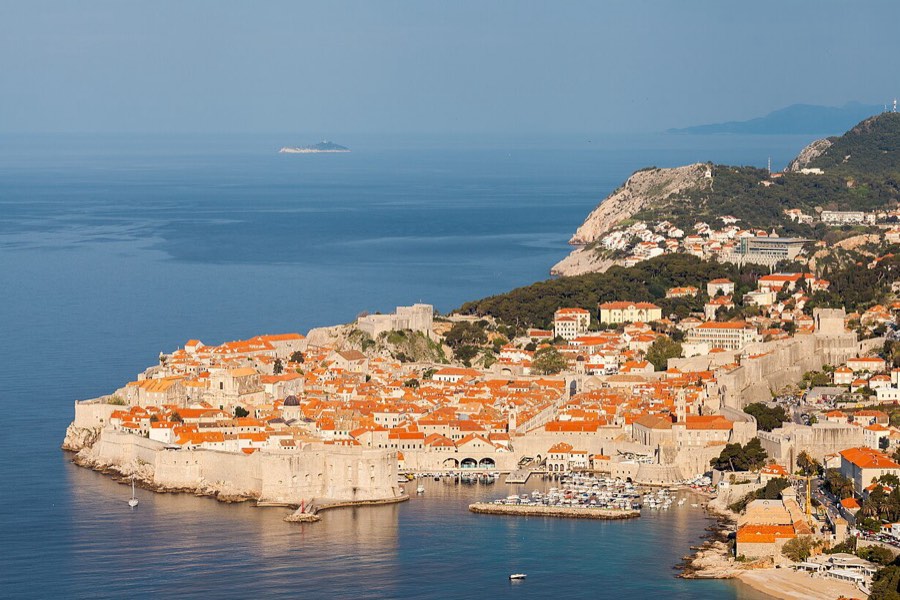
The old town is closed in by walls nearly two kilometres round that you can walk on; it was shelled in the siege of 1991 and 1992, and the new orange roofs show where. On Zudioska street, in the ghetto set up in 1546, stands a synagogue that is among the oldest Sephardic synagogues in Europe still in use.
- Herceg Novistop on the way
Founded in 1382 by the Bosnian king Tvrtko I as a fortress and salt market at the mouth of the Bay of Kotor. In 1539 an Ottoman army and fleet besieged the Spanish garrison that had taken the town the year before, and almost none of the defenders survived.
- Peraststop on the way
A small town of sea captains on the Bay of Kotor; in 1698 Peter the Great sent young Russian nobles here to learn navigation from the Perast captain Marko Martinovic. Offshore lies Our Lady of the Rocks, an island built by hand from stones and sunken ships, and every 22 July the townspeople still row out to throw more stones around it.
- Kotor2 nights
A walled Venetian town at the far end of the bay, a World Heritage site since 1979. The walls climb the mountain behind it to the fortress of St John, some thirteen hundred steps up; go at first light, before the heat and the cruise passengers.
- Budvastop on the way
One of the oldest towns on the Adriatic, with a walled old town on a point between beaches. The earthquake of April 1979 badly damaged it, and the old town was rebuilt stone by stone over the following years.
- Sveti Stefanstop on the way
A fifteenth-century fortified fishing village on an islet joined to the shore by a narrow causeway, turned whole into a luxury hotel after the Second World War. The island is closed to anyone who is not a guest; the classic view is from the road above it.
- Shkoderone night
The cultural capital of northern Albania, on the largest lake in the Balkans. The Marubi museum keeps the archive of a family of photographers who worked here from the nineteenth century, hundreds of thousands of negatives of a vanished Albania.
- Rozafa Castlestop on the way
A fortress on the rock above Shkoder where three rivers and the lake meet, which held out against the Ottoman siege until 1479. Its legend tells of Rozafa, walled into the foundations so the walls would stand, who asked that one breast, one hand and one foot be left free to nurse and rock her baby.
- Krujestop on the way
The castle town of Skanderbeg, the Albanian lord who held off the Ottomans for a quarter of a century. Kruje withstood three Ottoman sieges under him, in 1450, 1466 and 1467, and fell only in 1478, ten years after his death; the Skanderbeg Museum stands inside the walls, above an old bazaar.
- Tirana2 nights
Under Enver Hoxha Albania was sealed off from the world and covered with concrete bunkers; one of his own, under the hills outside the city, is now the museum Bunk’Art. In the Second World War Albanians hid Jews under the code of besa, the sworn promise of protection, and Albania ended the war with more Jews than it had before it.

What it costs
Eighty dollars a night is the room. The car, the fuel and the border costs are yours: there are no motorway tolls on this route, but a car registered outside Montenegro pays a small eco-tax at the border, and the rental company charges a cross-border fee for every country beyond Croatia. The big number is the one-way fee for leaving a Croatian car in Albania — many companies refuse it outright, and those that allow it charge heavily, so get it in writing before you book.
What to know
Three things. One: permission to cross. A rental car may leave Croatia only with the company’s written cross-border permission, naming each country; without it the insurance is void the moment you cross. Two: the green card. Montenegro and Albania both require proof of insurance valid in their country — the green card — and the border police ask for it; check that Montenegro and Albania are not struck off the card, or buy border insurance at the crossing. Three: the borders themselves. Croatia is in Schengen, so the crossing into Montenegro is an outer border of the European Union, with full passport control in both directions; since the EU’s Entry/Exit System began in October 2025, non-EU passports are also registered there, and the queue is longer. Montenegro requires dipped headlights by day all year.
Roads, tolls and rules
All three countries drive on the right. The coast road is one lane each way, slow in summer and full of bends around the bay; plan by the hour, not the kilometre. In Albania the main road from Shkoder to Tirana is good, but drivers cut in and pull out without warning and the roundabouts in Tirana are a free-for-all; the police set speed traps on both sides of the border. A night in Shkoder splits the drive from Kotor to Tirana in two, so no day on this route is longer than about 130 kilometres.

Travel The Balkan coast: From Dubrovnik to Tirana
The route on our site, with a room up to $80 every night.