Morocco: The Tzaddikim Route
When to go
March to May and September to November. The great dates are the hillulot: Lag BaOmer (18 Iyar, usually May) at the tomb of Rabbi Amram ben Diwan in Asjen and at Anraz, and 26 Elul (September) at the tomb of Rabbi Haim Pinto in Essaouira. On those days thousands come, the roads near the graves are closed and rooms are booked months ahead; on any other day the graves are quiet. July and August are hot inland.
The stops
Interactive map of the route on our site ›
- Casablancaone night
Most of the Jews who remain in Morocco today live here, and the city still has working synagogues, kosher butchers and a rabbinical court. On the shore the minaret of the Hassan II Mosque rises two hundred and ten metres over the Atlantic.
- Saléstop on the way
In the Jewish cemetery of Salé lies Rabbi Raphael Encaoua, who headed the High Rabbinical Court of Morocco under the French protectorate and died in 1935; his hillula falls in the month of Av. The grave itself could not be placed on the map, so the point is the old town.
- Kasbah of the Udayasstop on the way
The fortress at the mouth of the Bou Regreg, facing Salé across the river, was built by the Almohads in the twelfth century. It takes its name from the Udaya, an Arab tribe whose warriors the sultan Moulay Ismail garrisoned here.
- Rabatone night
The Hassan Tower is the stump of what was meant to be the largest mosque in the world, begun in 1195 and abandoned when its builder, the sultan Yaqub al-Mansur, died four years later.
- Kasbah of Mehdiastop on the way
A fortress on a hill over the mouth of the Sebou. The Spanish took it in 1614 and called it La Mamora, and Moulay Ismail won it back in 1681.
- Moulay Bousselhamone night
A fishing village on the Atlantic beside the Merja Zerga, a tidal lagoon protected under the Ramsar convention, where flamingos and tens of thousands of other water birds spend the winter.
- Ksar el-Kebirstop on the way
Near here, in August 1578, King Sebastian of Portugal fell in the Battle of the Three Kings. The Jews of Morocco, who had feared a Portuguese conquest, kept a day of thanksgiving for the victory, the Purim of Sebastian.
- Asjenstop on the way
Rabbi Amram ben Diwan came from Hebron as an emissary to raise money for the yeshivas of the Holy Land, and died here in 1782; his tomb stands in an olive grove beside a great tree. It is the largest Lag BaOmer hillula in Morocco.
- Ouezzane2 nights
A holy town of the Rif foothills that grew around the zawiya of the sharifs of Ouezzane. Two nights here leave a whole unhurried day at Asjen, nine kilometres away.
- Moulay Idrissstop on the way
A white town on two hills around the tomb of Idris I, who founded the first Muslim dynasty of Morocco in 789. It is the holiest town in the country, and until 2005 non-Muslims were not allowed to stay the night.
- Volubilisstop on the way
The Roman city in the plain below Moulay Idriss. Among its stones a Hebrew tombstone was found reading Matrona, daughter of Rabbi Yehuda, with lamps decorated with menorahs: Jews lived here in Roman times.
- Meknes2 nights
The imperial city of Moulay Ismail, who ruled Morocco from 1672 to 1727 and ringed it with some forty kilometres of walls. Its mellah lies beside the old medina, and Fes is seventy kilometres away by motorway.
- Fes Mellahstop on the way
The mellah of Fes, created in 1438 beside the royal palace, was the first Jewish quarter in Morocco and gave its name to all the others. The Ibn Danan synagogue here dates from the seventeenth century and has been restored.
- Jewish Cemetery of Fesstop on the way
Here lies Lalla Solica Hatchuel, a girl of seventeen who refused to convert and was beheaded in Fes in 1834; Jews and Muslim women alike pray at her tomb. Close by is the tomb of Rabbi Yehuda ben Attar, the rabbi of Fes, who died in 1733.
- Jewish Cemetery of Meknesstop on the way
The old cemetery beside the mellah holds Rabbi David Boussidan, an eighteenth-century sage who came to Meknes from Tamlilt in the south, and Rabbi Haim Messas, who died here in 1904. It was restored and reopened in 2022.
- Chellahstop on the way
Inside the walls lie the ruins of Sala, a Roman town, and above them the necropolis of the Marinid sultans of the fourteenth century. Storks nest on every tower.
- Rabatone night
The capital, and since 2012 a World Heritage site for the way its old medina and the French new town were planned side by side. The second night here is the bridge back to the south.
- Ben M’sik Cemeterystop on the way
Here lies Rabbi Eliyahu HaCohen, called the lamp of the land, the tzaddik of Casablanca. He was first buried in the old medina, and in the 1960s his remains were moved here, where a mausoleum was built over them.
- Temple Beth-Elstop on the way
The best known synagogue of Casablanca, in the city centre, still holding prayers, with its stained glass windows and great chandeliers.
- Casablancaone night
Back in the city of the community: the evening is the time to eat kosher and, if the night is Friday, to find a minyan.
- Museum of Moroccan Judaismstop on the way
Opened in 1997, and for many years the only Jewish museum in the Arab world: Torah scrolls, hanukkiot, wedding dresses and the rooms of a synagogue brought from the villages. It is closed on Shabbat and on Jewish holidays.
- Azemmourstop on the way
In the old mellah of this walled town on the Oum Er-Rbia, held by the Portuguese from 1513 to 1541, is the mausoleum of Rabbi Abraham Moul Niss, revered by Jews and Muslims alike; his hillula is on Lag BaOmer. The tomb could not be placed exactly, so the point is the town.
- El Jadidaone night
The Portuguese built Mazagan here in 1514 and held it until 1769; its walled town has been a World Heritage site since 2004. In the vaulted cistern under it Orson Welles filmed scenes of his Othello; it has been closed for restoration, so check before going.
- Oualidiastop on the way
A calm lagoon behind a line of rocks, named after the Saadian sultan al-Walid, who built a kasbah over it in the 1630s. Morocco’s first oyster farm opened here in 1957, and the oysters are eaten on the shore.
- Beddouzastop on the way
The cape the old charts called Cap Cantin, some thirty-five kilometres north of Safi, with a lighthouse over the cliffs and the coast road running along their edge.
- Safione night
The pottery town of Morocco, with its kilns on the hill above the medina and the Portuguese sea fortress on the shore. Its Jews revered the Ouled Ben Zmirro, the seven saints of the city.
- Ouled Ben Zmirrostop on the way
By tradition Rabbi Abraham ben Zmirro came to Safi after the expulsion from Spain and lies here with his brothers and sons. The hillula is held in summer, and women come above all to pray for children and for a match.
- Souira Qdimastop on the way
A beach village at the mouth of the Tensift, once Aguz, a Portuguese outpost of the early sixteenth century. The river mouth was known for its shad fishing.
- Kasbah Hamidouchstop on the way
The ruined walls of a great fortress on the left bank of the Tensift, near its mouth, attributed to the sultan Moulay Ismail.
- Essaouira2 nights
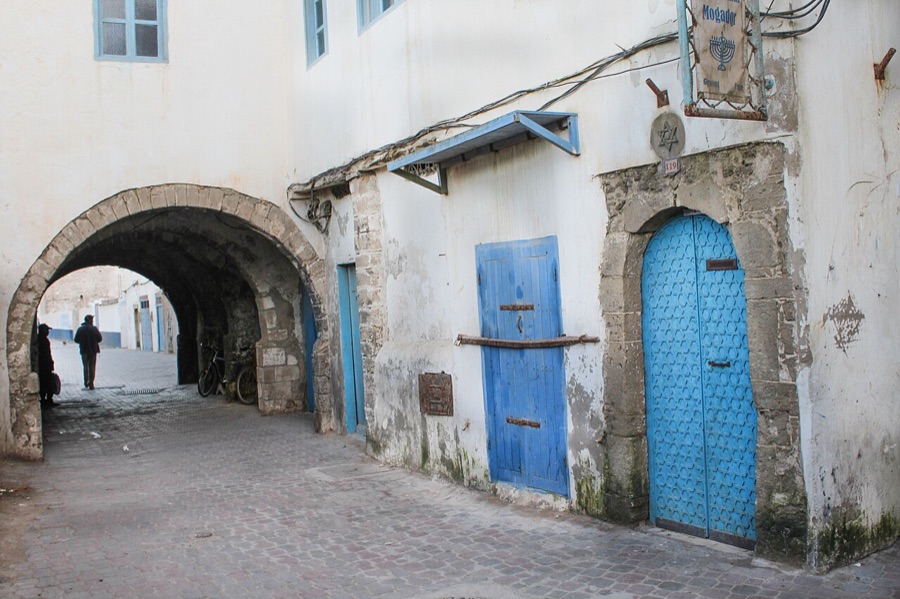
In the Jewish cemetery by Bab Doukkala lies Rabbi Haim Pinto, the rabbi of Mogador, who died on 26 Elul 1845; every year on that date thousands come for his hillula. His house and synagogue still stand in the mellah, and in 2020 the king opened Bayt Dakira, the house of memory of the town’s Jews.
- Ounaghastop on the way
The heart of argan country. The argan tree grows wild almost nowhere but south-western Morocco, and along this road the women’s cooperatives crack the nuts by hand for oil.
- Marrakesh3 nights
The Miara, the Jewish cemetery beside the mellah, is one of the largest in Morocco; along its walls stand the mausoleums of rabbis, among them Rabbi Pinhas HaCohen, who died in 1952 and whose grave still draws pilgrims. In the mellah the Lazama synagogue still opens to visitors.
- Aghbaloustop on the way
In the Ourika valley lies Rabbi Shlomo ben Lahans, by tradition an emissary from the Land of Israel who stayed in Morocco; the Muslims of the valley call him Moul Asguine and visit him too. The tomb could not be placed exactly, so the point is the village.
- Anrazstop on the way
In the hamlet of Anraz near Ouirgane, in a gated compound under the mountains, lies Rabbi Haim ben Diwan, the son of Rabbi Amram of Asjen; pilgrims come at Lag BaOmer. The compound holds three tombs, and the point is the hamlet.

What it costs
Eighty dollars a night is the room. The car, the fuel and the motorway tolls are yours, and so are the entry tickets and what you give at the graves: the guardian who opens the gate, the candles and the charity box. Kosher food is easy in Casablanca; elsewhere arrange it ahead or carry it.
What to know
Four things. One: the graves. Dress modestly, cover your head, and many graves are locked behind a gate whose key is held by a guardian, often from a family that has kept it for generations; ask your hotel or the local Jewish community to call ahead. Two: Shabbat. Plan the days so that Shabbat falls at a two-night stop, best Essaouira or Marrakesh, or shift a day so it falls in Casablanca, where the community is largest; keep Friday for a short drive. Three: security. Morocco guards its Jewish sites, police stand at the big hillulot, and a calm, discreet manner is all that is asked; for Israeli passport holders the entry rules and the travel advisory change, so check them before booking. Four: the driving. Police checkpoints at the entrance to almost every town with radar and on-the-spot fines, so carry cash, passport, the rental contract and an international permit; never drive after dark outside the cities, when carts and donkeys without lights share the road.
Roads, tolls and rules
Morocco drives on the right. The motorways from Casablanca to Rabat and on to Meknes and Fes, and south to El Jadida, are modern and tolled; the coast road from El Jadida to Essaouira is a narrow two-lane road through villages. Speed limits are 120 on motorways, 100 on main roads and 60 in towns, and they are enforced. The roads to Ourika and to Anraz climb into the High Atlas, narrow and winding, and the last stretch to Anraz is a dirt track. No car enters the old medinas: park outside the walls.

Travel Morocco: The Tzaddikim Route
The route on our site, with a room up to $80 every night.