Tuscany: Florence, Siena and Lucca
When to go
April to June and September to October. In July and August Florence passes thirty-five degrees, the queues at the Uffizi and the Duomo run for hours, and around the middle of August many family restaurants close for the Ferragosto holiday. On 2 July and 16 August Siena runs the Palio, and the city is packed. In late autumn the hills of the Val d’Orcia turn gold and the hotels are quiet.
The stops
Interactive map of the route on our site ›
- Florence3 nights
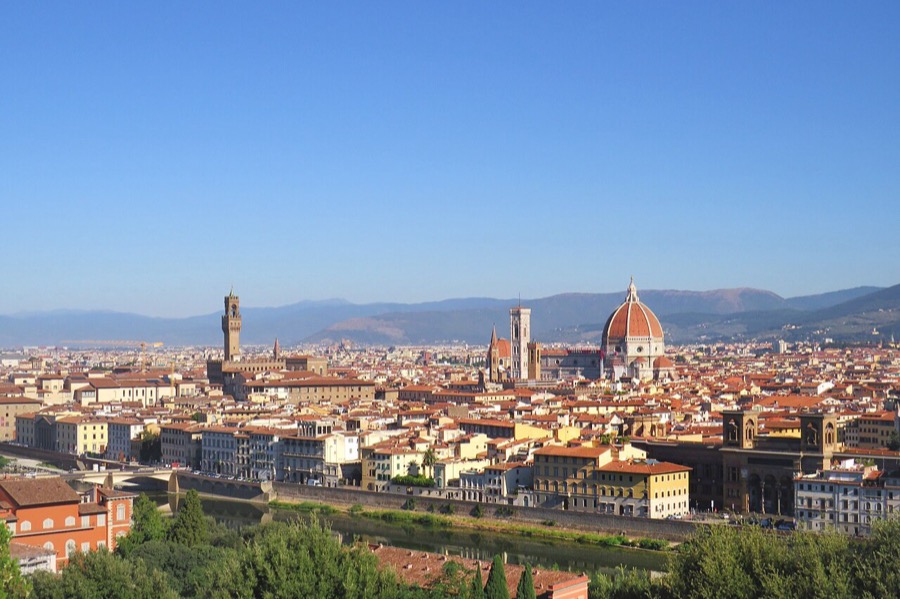
Brunelleschi’s dome over the cathedral, finished in 1436, is still the largest brick dome ever built. The Great Synagogue, inaugurated in 1882 with a green copper dome that rises over the eastern quarter, was mined by the retreating Germans in 1944 and flooded in 1966, and still holds services, with the Jewish museum upstairs.
- San Gimignanostop on the way
The town of towers: rival families of the Middle Ages raised tower houses against each other, and fourteen still stand over the walls, a World Heritage site since 1990. The local white wine, Vernaccia di San Gimignano, is among the oldest named wines of Italy.
- Monteriggionistop on the way
A walled village on a hilltop, built by Siena from 1213 as a fortress against Florence, its ring of walls crowned with towers. Dante, in the Inferno, compared the giants standing in the pit of hell to the towers of Monteriggioni.
- Siena3 nights
The Campo, the shell-shaped square in front of the town hall, becomes a racetrack twice a year for the Palio, a bareback horse race between the city’s neighbourhoods that lasts about ninety seconds. The synagogue in the old ghetto, inaugurated in 1786, is hidden behind an ordinary façade on Vicolo delle Scotte and still holds services.
- Pienzastop on the way
The village of Corsignano was rebuilt from 1459 by its native son, Pope Pius II, as an ideal Renaissance town, and renamed Pienza after him; it is a World Heritage site, and so is the Val d’Orcia below it, the landscape of cypress roads and bare hills of the postcards. The town is known for its pecorino, the sheep’s cheese.
- Pisastop on the way
The bell tower began to lean while it was being built, from 1173, on soft ground, and building stopped and restarted over two centuries. It was closed from 1990 to 2001 while engineers pulled it back by some forty centimetres. Galileo was born in Pisa in 1564.
- Lucca2 nights
The Renaissance walls, more than four kilometres round, were never attacked; their top is now a tree-lined path where the town walks and cycles. The houses of the Piazza dell’Anfiteatro follow the oval of the Roman amphitheatre they were built into, and Giacomo Puccini was born here in 1858.

What it costs
Eighty dollars a night is the room. The car, the fuel and the tolls are yours: the autostrada from Florence to Lucca and Pisa is tolled, paid at the exit by card or cash, while the dual carriageways from Florence to Siena and from Florence toward Pisa are free. Parking outside the walls of every town on this route is paid, and the car parks nearest the gates fill early. A fine from a ZTL camera, if you get one, comes months later with the rental company’s own fee added.
What to know
Three things. One, and above all: the ZTL. Every historic centre on this route — Florence, Siena, Lucca inside its walls, Pisa, San Gimignano — is a zona a traffico limitato, a limited-traffic zone, and a camera at each entrance photographs the plate of every car that drives in without a permit. There is no barrier and no warning beyond a sign with a red circle, and each pass under a camera is a separate fine. Park outside the walls and walk in; if your hotel is inside the zone, ask it before you arrive to register your plate. Two: the tolls. Take a ticket at the entrance to the autostrada and pay at the exit; stay out of the lanes marked Telepass, which are for electronic tags only. Three: speed. Average-speed cameras, the Tutor, measure the time between two points on the autostrada, and fixed cameras stand at the edges of villages; and outside towns dipped headlights must be on by day.
Roads, tolls and rules
Italy drives on the right. The distances in Tuscany are short, but the country roads through the Chianti and the Val d’Orcia climb and curve between cypresses, and an hour on the map is often more. Rental cars are mostly small and manual; automatics must be booked ahead, and a small car is easier in the narrow lanes outside the walls.

Travel Tuscany: Florence, Siena and Lucca
The route on our site, with a room up to $80 every night.