Sicily: From Palermo to Catania
When to go
April to June and September to October. In spring the island is green; from June the inland passes thirty-five degrees, and in July and August the Valley of the Temples and Piazza Armerina are best seen at opening time. Around the middle of August, Ferragosto, all of Italy is on holiday and the coast is full. On Etna it is cold and windy above two thousand metres in every season, so bring a warm layer even in summer.
The stops
Interactive map of the route on our site ›
- Palermo Airportstop on the way
The airport is named after Giovanni Falcone and Paolo Borsellino, the two judges who led the war on the Mafia and were murdered by it in 1992. Falcone was killed on 23 May of that year by a bomb under the motorway from this airport into the city, at Capaci; a memorial stands beside the road.
- Monrealestop on the way
The cathedral on the hill above Palermo, begun in 1174 by the Norman king William II, whose walls are covered with gold mosaics, with a huge Christ Pantocrator in the apse. The cloister beside it has 228 paired columns, no two carved alike.
- Palermo3 nights
A city of Arabs and Normans, whose palaces and domed churches, with the cathedrals of Monreale and Cefalù, have been a World Heritage site since 2015; the markets of Ballarò and the Vucciria still sell in the old way. The Jews of Sicily were expelled in 1492 under Spanish rule; in 2017 the archbishop of Palermo gave the community the oratory of Santa Maria del Sabato, in the old Jewish quarter, to become a synagogue again.
- Bagheriastop on the way
The town of the summer villas of the Palermo nobility, a quarter of an hour east of the city. Villa Palagonia is famous for the stone monsters on its walls, added in the eighteenth century by an eccentric prince; Goethe saw them in 1787 and wrote of them with horror.
- Cefalùstop on the way
A fishing town on a beach under a great rock, an hour east of Palermo. Its cathedral was begun in 1131 by Roger II, the first Norman king of Sicily, and in the apse is a mosaic Christ Pantocrator that many think the finest in the island; scenes of Cinema Paradiso were filmed on the beach.
- Valley of the Templesstop on the way
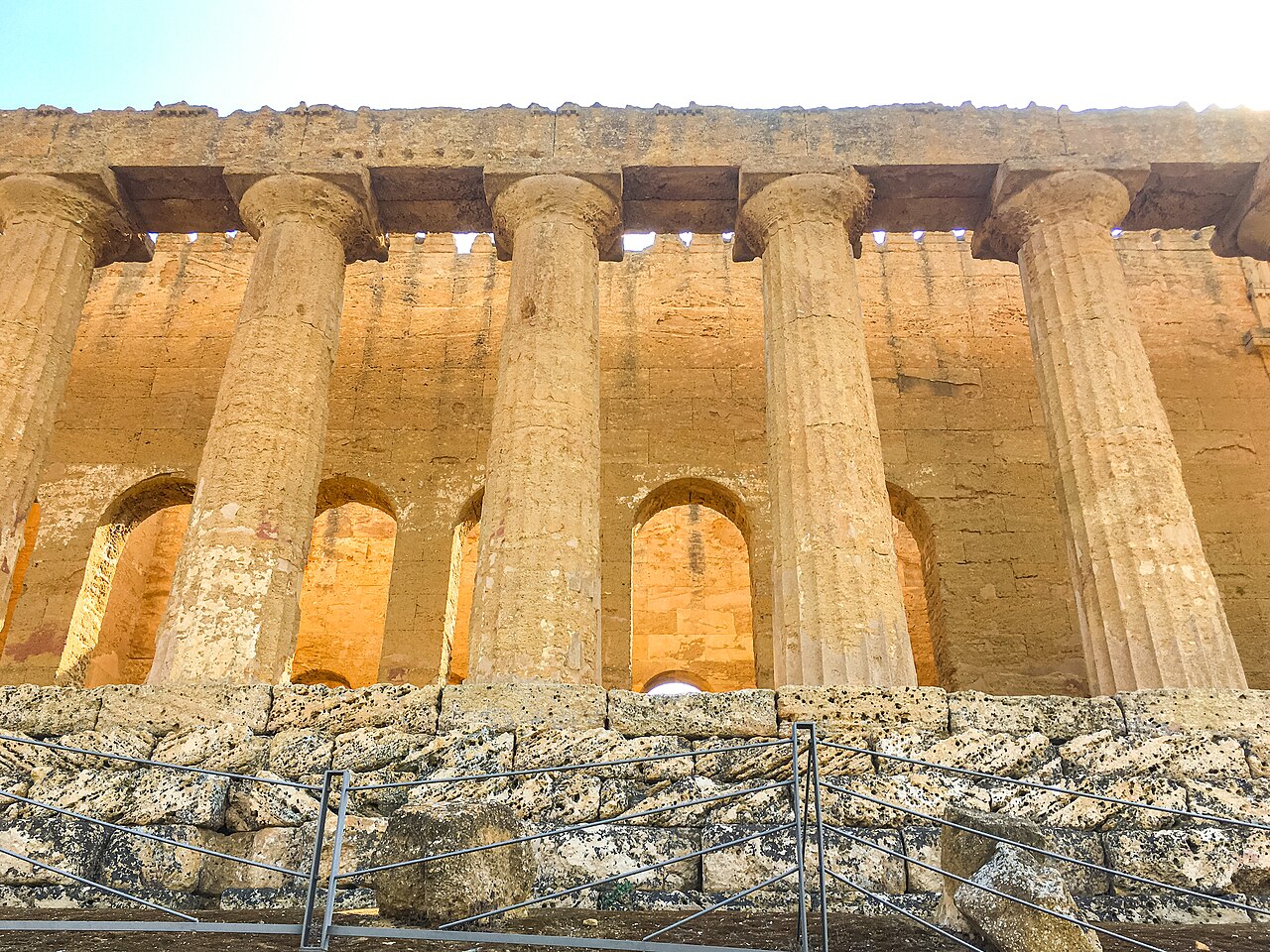
The ridge of temples of Akragas, a Greek city founded about 580 BCE, a World Heritage site since 1997. The Temple of Concordia, of the fifth century BCE, is one of the best-preserved Greek temples anywhere, because it was turned into a church at the end of the sixth century.
- Scala dei Turchistop on the way
A cliff of white marl that falls to the sea in steps, a quarter of an hour west of Agrigento, named the Stair of the Turks after the pirates who landed here. The cliff itself is closed to walkers to protect it; see it from the beach below, best at sunset.
- Agrigentoone night
The town on the hill above the temples, whose main street, Via Atenea, runs along the ridge. Luigi Pirandello was born just outside it in 1867, in a house called Caos, and won the Nobel Prize in 1934; his ashes lie under a pine beside the house.
- Villa Romana del Casalestop on the way
A Roman country palace of the fourth century, buried by a landslide in the twelfth and dug out in the twentieth, with the richest floor mosaics left from the Roman world: hunts, chariot races and, in one room, ten young women exercising in what look like bikinis. It has been a World Heritage site since 1997.
- Piazza Armerinaone night
A hill town of the interior, five kilometres from the Roman villa, with a baroque cathedral at the top. Every August it holds the Palio dei Normanni, a pageant and joust remembering Count Roger’s entry into the town in the eleventh century.
- Caltagironestop on the way
The town of Sicilian ceramics. Its staircase of Santa Maria del Monte climbs 142 steps, and the front of every step is faced with a different pattern of painted majolica tiles; on the nights of 24 and 25 July it is lit with thousands of oil lamps.
- Ragusaone night
Rebuilt after the earthquake of 1693, which levelled the whole south-east of the island; the old town of Ibla, on its own ridge, is crowned by the Duomo of San Giorgio, designed by Rosario Gagliardi. With Modica and Noto it is one of the eight late-baroque towns of the Val di Noto, a World Heritage site since 2002.
- Modicastop on the way
A baroque town in a gorge, famous for a grainy chocolate worked cold, in a way the Spaniards brought from the Aztecs. The poet Salvatore Quasimodo was born here in 1901 and won the Nobel Prize in 1959.
- Notostop on the way
After the earthquake of 1693 the town was not rebuilt where it stood but on a new site some eight kilometres away, laid out from scratch in golden stone. The dome of its cathedral collapsed in 1996 and the church reopened only in 2007.
- Syracuse2 nights
Founded by Corinthians in 733 BCE on the island of Ortigia, and once the greatest city of the Greek west; Archimedes was born here and was killed by a Roman soldier when the city fell in 212 BCE. In the old Jewish quarter of Ortigia, the Giudecca, a mikveh cut deep into the rock was found in 1989 under a palazzo, and can be visited.
- Neapolisstop on the way
The archaeological park of Syracuse, ten minutes from Ortigia: a Greek theatre cut into the hillside, where Aeschylus staged plays, and the Ear of Dionysius, a tall cave in an old quarry that Caravaggio named in 1608 for its echo.
- Cataniastop on the way
A city built of black lava stone, rebuilt after Etna’s lava reached it in 1669 and the earthquake of 1693 destroyed it. In the cathedral square stands the Elephant Fountain, a lava elephant carrying an Egyptian obelisk, set up in 1736; the fish market beside it is loud every morning but Sunday.
- Taormina2 nights
A town on a terrace above the sea, where D. H. Lawrence lived from 1920 to 1923. Leave the car in one of the car parks at the edge of town; the Corso, the main street, is closed to traffic, and Isola Bella, the little island on the beach below, is a cable car ride down.
- Greek Theatre of Taorminastop on the way
A theatre built by the Greeks and rebuilt by the Romans, with the sea and Etna framed behind the stage. It is still used for concerts and for the Taormina Film Festival every summer.
- Mount Etnastop on the way
The highest active volcano in Europe, over 3,300 metres, a World Heritage site since 2013. The road from Taormina climbs to the Rifugio Sapienza at about 1,900 metres, beside the Silvestri craters left by the eruption of 1892; from there a cable car goes higher. A day trip, about an hour each way.
- Catania Airportstop on the way
Fontanarossa, the busiest airport of Sicily, named after the composer Vincenzo Bellini, who was born in Catania in 1801. From Taormina it is under an hour on the motorway; return the car here.

What it costs
Eighty dollars a night is the room. The car, the fuel and the tolls are yours: the motorways from Palermo to Catania and from Palermo to the airport are free, while the stretch to Cefalù and the motorway from Catania to Taormina charge a small toll at the exit. The sites charge entry each: the Valley of the Temples, the Villa Romana, the Neapolis of Syracuse, the theatre of Taormina and the cloister of Monreale. On Etna the cable car and the four-by-four buses to the upper slopes are an extra and not a cheap one. Parking in Palermo, Ortigia and Taormina is paid and scarce; the route starts at Palermo airport and ends at Catania airport, so ask about the one-way fee when you book the car.
What to know
Three things. One: the ZTL. The old centres of Palermo, Ortigia in Syracuse, Taormina, Cefalù and Noto are limited-traffic zones, and a camera at each entrance photographs every plate that drives in without a permit; each pass is a separate fine that reaches you months later through the rental company. Park outside and walk in, and if the hotel is inside a zone, ask it to register your plate. Two: the city traffic. Palermo and Catania drive fast and loose, with scooters on every side and double parking as a rule; and never leave anything on the seats of a parked car. Three: Etna. It is an active volcano, and the authorities close the upper slopes whenever it erupts or throws out ash, sometimes at an hour’s notice; above the cable car the summit area may be walked only with an authorised guide. Check the day’s status before you drive up.
Roads, tolls and rules
Italy drives on the right. The A19 across the middle of the island, from Palermo to Catania, is the fast road, and the A29 to the airport is good; everything else on this route is a state road through hills and towns, slower than the map suggests. Rental cars are mostly small and manual, and a small car is a blessing in the lanes of the baroque towns. No day is longer than about 160 kilometres, and the last morning, from Taormina to Catania airport, is under an hour.

Travel Sicily: From Palermo to Catania
The route on our site, with a room up to $80 every night.