Rajasthan: From Delhi to Udaipur
When to go
October to March. From April to June the desert passes forty-five degrees, and from July to September the monsoon brings heavy rain. In December and January the days are mild but the desert nights are cold, and thick morning fog around Delhi and Agra can delay the road and hide the Taj Mahal until late morning. The Pushkar camel fair falls in October or November, around the full moon of the month of Kartik, and the town fills completely.
The stops
Interactive map of the route on our site ›
- Delhi2 nights
Humayun’s Tomb, built in the 1560s and 1570s by order of his widow, was the first great garden tomb of the subcontinent and the model the Taj Mahal followed. Near it, on Humayun Road, the Judah Hyam Synagogue, built in 1956, is the only synagogue in the city.
- Vrindavanone night
By Hindu tradition Krishna spent his boyhood here among the cowherds of the forest, and the town is said to hold some five thousand temples. The Krishna-Balaram temple of the Hare Krishna movement was opened in 1975 by its founder, A. C. Bhaktivedanta Swami Prabhupada, who is buried in its grounds.
- Krishna Janmasthan, Mathurastop on the way
The temple over the prison cell where, by tradition, Krishna was born. It stands wall to wall with the Shahi Idgah mosque, which the emperor Aurangzeb built in 1670 on the site of the great Keshava Deva temple he had torn down; security is tight, and phones and bags are left outside.
- Akbar’s Tomb, Sikandrastop on the way
The tomb of the emperor Akbar, on the edge of Agra, begun by Akbar himself and finished by his son Jahangir in 1613, in red sandstone and white marble set in a garden where deer and langur monkeys roam.
- Agra2 nights
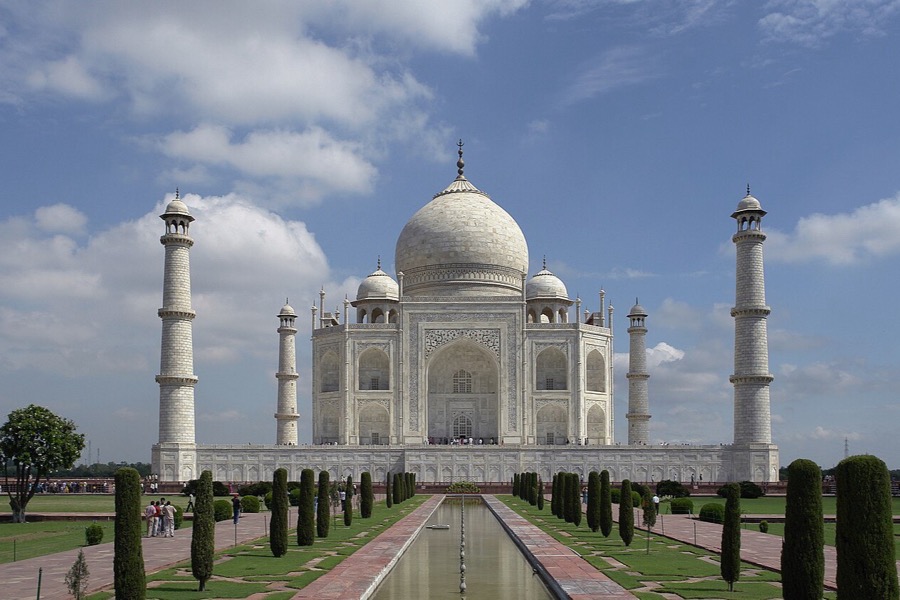
Shah Jahan built the Taj Mahal for his wife Mumtaz Mahal, who died in 1631 giving birth to their fourteenth child, and the work went on for some twenty years. His son Aurangzeb deposed him in 1658 and kept him in the Agra Fort until his death, where, as the story goes, he could see the Taj across the river.
- Fatehpur Sikristop on the way
The emperor Akbar built a whole capital of red sandstone here from 1571, in honour of the Sufi saint Salim Chishti, who had foretold the birth of his son; it was left some fourteen years later. The Buland Darwaza, the Gate of Magnificence, rises about fifty-four metres over the mosque courtyard, where the saint’s white marble tomb still draws pilgrims.
- Bharatpurone night
Lohagarh, the iron fort of the Jat kings, held out in 1805 against four assaults by the British army under Lord Lake. On the edge of town, Keoladeo, once the duck-shooting marsh of the maharajas, became a national park in 1982 and a World Heritage site in 1985; in winter it fills with migrating birds, and it is seen at dawn by bicycle rickshaw.
- Chand Baori, Abhaneristop on the way
A stepwell of the ninth century, cut some thirty metres down into the ground, with about 3,500 narrow steps in a zigzag pattern on thirteen levels down to the water. Stepwells held the rainwater of the monsoon through the dry months, and the air at the bottom stays several degrees cooler than at the top.
- Dausaone night
The first seat of the Kachhwaha Rajputs, the clan that later ruled from Amber and founded Jaipur; they took it in the tenth or eleventh century and moved on to Amber after it. Today it is a quiet district town on the road to Jaipur, an hour from the city.
- Galtajistop on the way
A temple complex of the eighteenth century in a narrow gorge in the hills east of Jaipur, where a spring fills a chain of stone tanks in which pilgrims bathe. Troops of macaques live among the temples, so it is known as the Monkey Temple; keep food out of sight.
- Jaipur3 nights
Founded in 1727 by Maharaja Sawai Jai Singh II on a grid of wide streets, and painted pink, the colour of welcome, for the visit of the Prince of Wales in 1876; the city has kept the colour ever since. The Hawa Mahal of 1799, a honeycomb façade of 953 small windows, let the women of the court watch the street without being seen.
- Ajmer Sharif Dargahstop on the way
The shrine of the Sufi saint Moinuddin Chishti, who died here in 1236, one of the holiest places of Islam in India, visited by Hindus as well. After his son was born in 1569, blessed by Salim Chishti of Fatehpur Sikri, of the same Sufi order, the emperor Akbar walked here on foot from Agra to give thanks.
- Pushkarone night
A holy town around a small lake ringed by 52 ghats, the stone steps where pilgrims bathe, with one of the very few temples in the world dedicated to Brahma. Meat, eggs and alcohol are forbidden in the town; take off your shoes on the ghats and ask before photographing the bathers.
- Merta Citystop on the way
A town founded in the fifteenth century by Rao Duda, a son of Rao Jodha of Jodhpur, and the home of his granddaughter Meera Bai, the sixteenth-century princess and poet-saint who gave up the court for her devotion to Krishna; her songs are still sung all over India, and her temple stands in the middle of town.
- Khimsarone night
A desert fort of the sixteenth century, built by Rao Karamsi, a son of Rao Jodha, at the edge of the Thar, and now a heritage hotel. Around it are sand dunes, and this is the country of the Bishnoi, a community that has protected the blackbuck and the trees of the desert since the fifteenth century.
- Mandorestop on the way
The capital of Marwar before Rao Jodha moved to his new fort at Jodhpur in 1459. In its gardens stand the cenotaphs of the rulers of Jodhpur, temple-shaped memorials of red sandstone built where they were cremated.
- Jodhpur2 nights
Rao Jodha founded the city and its fort, Mehrangarh, in 1459, on a cliff high over the plain, and the old town below is painted in so many shades of blue that it is called the Blue City. Umaid Bhawan, built from 1929 to 1943, is one of the largest private homes in the world; part is a hotel, and the royal family still lives in the rest.
- Ghaneraoone night
A village of the Rathore thakurs at the foot of the Aravalli hills, whose castle is now a heritage hotel. It lies on the edge of the Kumbhalgarh wildlife sanctuary, and a walking path climbs from here through the forest to the fort of Kumbhalgarh on the ridge above.
- Ranakpurstop on the way
A Jain temple of white marble in a wooded valley of the Aravallis, built in the fifteenth century under Rana Kumbha and dedicated to Adinath, the first of the Jain teachers. Its 1,444 carved pillars hold up the domes, and it is said that no two are alike. Shoes and anything of leather stay outside.
- Kumbhalgarhstop on the way
The mountain fortress of Rana Kumbha, of the fifteenth century, whose wall runs some thirty-six kilometres over the ridges, among the longest walls in the world. Maharana Pratap, the hero of Mewar who fought the Mughals, was born here in 1540; with other hill forts of Rajasthan it has been a World Heritage site since 2013.
- Udaipur3 nights
Maharana Udai Singh II founded the city in 1559 on the shore of Lake Pichola, and the City Palace grew along it for some three centuries. In the middle of the lake the Lake Palace, built in the 1740s as a summer palace, is now a hotel; it appeared in the James Bond film Octopussy in 1983.

What it costs
Eighty dollars a night is the room. The car and the driver are yours: on this route almost every visitor hires a car with a driver for the whole journey, priced by the day or by the kilometre, with a daily allowance for the driver’s food and lodging; tolls, parking and the state border taxes are usually added on top, so agree in writing before you start what is included. Most hotels in Rajasthan keep rooms for drivers. The large extra is the entrance fees: the Taj Mahal, the Agra Fort, Fatehpur Sikri and the forts of Rajasthan charge foreigners many times what Indians pay.
What to know
Three things. One, and above all: take a driver. India drives on the left, and the roads mix lorries, buses, tractors, motorbikes, cows, camels and people in every lane, with lorries driving without lights after dark. A tourist car crossing from Delhi into Uttar Pradesh and Rajasthan needs a tourist permit or pays a tax at each state border, and the driver and his company handle that paperwork; he also knows the roads and the hotels. Two: tipping. The driver expects a tip at the end of the journey, commonly a few hundred rupees for each day; guides at the monuments and hotel porters expect one too. Three: the Taj Mahal is closed on Fridays, when the mosque beside it is open only for prayer. No petrol or diesel car may come within 500 metres of it, so the driver leaves you at the car park and an electric shuttle takes you to the gate; large bags are not allowed in.
Roads, tolls and rules
India drives on the left. From Delhi the Yamuna Expressway runs fast toward Agra; from there the national highways across Rajasthan are four lanes for much of the way, but with trucks, cattle and villages on them, and fifty kilometres an hour is a good average. The route is slow on purpose: no day is longer than about 160 kilometres, with nights in Vrindavan, Bharatpur and Dausa on the way to Jaipur, in Pushkar and at the desert fort of Khimsar on the way to Jodhpur, and in the village of Ghanerao at the foot of the Aravalli hills before the last day to Udaipur. Leave early, and do not drive at night.

Travel Rajasthan: From Delhi to Udaipur
The route on our site, with a room up to $80 every night.