Israel: From Dan to Eilat
When to go
March to May, and October to November. In those months the Galilee is green or golden and the desert is warm by day and cool at night. In July and August the Dead Sea, the Arava and Eilat pass forty degrees and the Kinneret is hot and humid; from December to February rain falls in the north, the Hermon can be under snow and the desert wadis flood. Around Passover and Sukkot hotels fill and the national parks are crowded, so book early.
The stops
Interactive map of the route on our site ›
- Tel Aviv2 nights
The city was founded in 1909, when sixty-six families drew lots for plots in the dunes north of Jaffa using seashells. On Rothschild Boulevard, in the house of the first mayor, Meir Dizengoff, David Ben-Gurion declared the State of Israel on 14 May 1948; Ben Gurion airport is twenty minutes away.
- Caesareastop on the way
Herod built the city and its harbour between about 22 and 10 BCE and named it after Augustus. In its theatre archaeologists found in 1961 a stone with the name of Pontius Pilate, the first inscription with his name ever found from his own lifetime.
- Zichron Ya'akovstop on the way
Founded in 1882 by immigrants from Romania and named by Baron Edmond de Rothschild after his father, James, Yaakov in Hebrew. In Beit Aaronsohn on the main street lived the family at the heart of NILI, the Jewish spy ring that worked for the British against the Ottomans; Sarah Aaronsohn took her own life here in 1917 after days of torture.
- Atlit Detainee Campstop on the way
The British held Jewish immigrants caught at sea behind the barbed wire here. On the night of 10 October 1945 the Palmach broke in and led some two hundred of them away over the Carmel; visits are by guided tour, so book ahead.
- Haifa2 nights
For most Jews who came to the country by sea, Haifa was the gate. The city climbs Mount Carmel from the port, and the Bahá'í Gardens, nineteen terraces down to the golden Shrine of the Báb, have been a World Heritage site since 2008.
- Akkostop on the way
The old city of the Crusaders and the Ottomans has been a World Heritage site since 2001. In its citadel the British imprisoned and hanged Jewish underground fighters, and on 4 May 1947 the Irgun blew a hole in the wall and broke prisoners out; the cells are now the Underground Prisoners Museum.
- Rosh HaNikrastop on the way
A cable car drops down the white cliff on the Lebanese border to sea grottoes cut by the waves. The British railway from Haifa to Beirut ran through the cliff in tunnels, and the Palmach blew up its bridge here on the Night of the Bridges in June 1946; check before you go that the site is open.
- Beit She'arimstop on the way
Rabbi Judah HaNasi, who compiled the Mishnah, led the Sanhedrin here and asked to be buried here, and after him Jews from across the region brought their dead to the catacombs cut in the hill. The necropolis has been a World Heritage site since 2015.
- Tziporistop on the way
The Sanhedrin sat in Tzipori in the days of Rabbi Judah HaNasi, who spent his last years here. In a Roman villa on the hill lies a mosaic of a woman called the Mona Lisa of the Galilee, and the floor of the synagogue below shows the zodiac and the binding of Isaac.
- Safedstop on the way
After the expulsion from Spain, Safed became the centre of Kabbalah: the Ari taught here, Rabbi Yosef Karo wrote the Shulchan Aruch here, and Lecha Dodi, sung in every synagogue on Friday night, was written here. The first Hebrew printing press in the Land of Israel was set up in the town in 1577.
- Rosh Pina2 nights
Immigrants from Romania refounded the colony in 1882 and named it from Psalm 118: the stone the builders rejected has become the cornerstone. The old lane of stone houses climbs toward Safed, and the town looks down over the whole Hula valley.
- Agamon Hulastop on the way
The Hula swamps were drained in the 1950s and part of the valley was flooded again in the 1990s. About half a billion birds pass over it on migration each year, and tens of thousands of cranes spend the winter around the lake.
- Tel Haistop on the way
On 1 March 1920 Joseph Trumpeldor and seven others fell defending this farmyard, and Kiryat Shmona below is the town of the eight. The restored courtyard has a short film, and the stone lion over their graves stands on the hill of Kfar Giladi next door.
- Tel Danstop on the way
The largest spring of the Jordan, under plane trees, around the mound of the biblical city of Dan. A stone found here in 1993 bears the words house of David, the first mention of the king outside the Bible.
- Baniasstop on the way
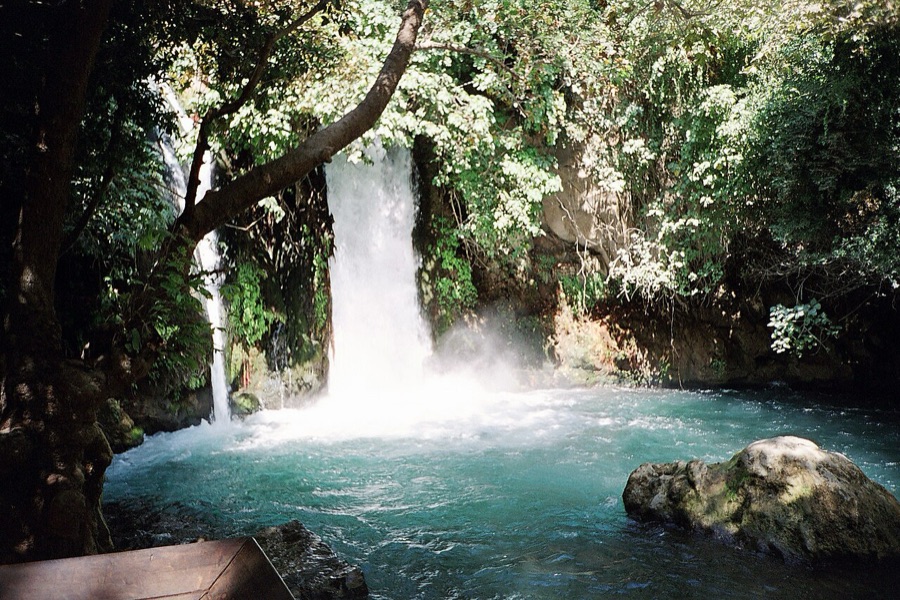
The Greeks dedicated this spring to the god Pan, and the name Banias comes from Paneas. Herod's son Philip built here the city of Caesarea Philippi, and a separate trail leads to the waterfall below.
- Ancient Katzrinstop on the way
A Jewish village of the Talmudic period on the Golan, with its basalt synagogue and houses rebuilt and furnished as they were. Next to it in the modern town is the Golan Heights Winery, founded in 1983, one of the wineries that put Israeli wine on the map.
- Korazimstop on the way
Chorazin is one of the towns the Gospel of Matthew says Jesus cursed for not believing. Its black basalt synagogue had a stone chair, the Seat of Moses, carved with an Aramaic inscription; the original is in the Israel Museum and a copy stands in its place.
- Capernaumstop on the way
The fishing town on the north shore where the Gospels set most of the ministry of Jesus. Its white limestone synagogue of the fourth or fifth century stands on the basalt foundations of an older one; shoulders and knees covered.
- Tiberiasone night
One of the four holy cities of Judaism, founded around 20 CE and named after the emperor Tiberius. The Jerusalem Talmud was completed here, and the Masoretes of Tiberias fixed the vowels of the Hebrew Bible; Maimonides is buried in the town.
- Degania Alefstop on the way
The first kibbutz, founded in 1910 where the Jordan leaves the Kinneret. On 20 May 1948 the Syrian army reached its gate, and the small Syrian tank that the defenders stopped there still stands where it halted.
- Beit She'anstop on the way
Under the Romans it was Scythopolis, a city of the Decapolis with a theatre for thousands and colonnaded streets. The earthquake of 749 brought the columns down where they still lie, all pointing the same way.
- Jerusalem3 nights
The walls of the Old City were built by Suleiman the Magnificent between 1537 and 1541. Inside them, the Western Wall is a retaining wall of the Temple Mount that Herod enlarged, and the holiest place where Jews pray today.
- Qumranstop on the way
In 1947 a Bedouin shepherd found jars with scrolls in a cave here, and the caves went on to give up about nine hundred manuscripts, among them the oldest known copies of the books of the Hebrew Bible. The scrolls are kept in the Shrine of the Book in Jerusalem.
- Ein Gedistop on the way
The oasis where, in the First Book of Samuel, David hid from Saul in a cave and spared his life. Today it is a reserve of waterfalls and ibex, and the floor of its ancient synagogue curses anyone who reveals the secret of the town.
- Ein Bokek2 nights
The hotels stand more than 430 metres below sea level, on the lowest land on earth. The water in front of them is an evaporation pond of the Dead Sea Works, since the southern basin of the sea dried up in the 1970s, and it is still salty enough to float in.
- Masadastop on the way
Herod's fortress on a table mountain, where by Josephus' account the last 960 rebels against Rome chose death over capture in 73 or 74 CE. Go up by cable car or the Snake Path at first light; it has been a World Heritage site since 2001.
- Mamshitstop on the way
The smallest and best preserved of the Nabataean towns on the Incense Route, with stone houses, two Byzantine churches and a view over the Negev. With Avdat, Haluza and Shivta it has been a World Heritage site since 2005.
- Ben-Gurion's Desert Homestop on the way
In 1953 Ben-Gurion stepped down as prime minister and came to live in this hut at Kibbutz Sde Boker, sure that the future of Israel lay in the Negev. He and his wife Paula are buried a few minutes away, on the cliff over the Zin canyon.
- Ein Avdatstop on the way
A canyon of white chalk cut by the Zin, with springs that flow all year into pools where ibex come to drink. The trail is one-way and climbs out by ladders, so walk the lower part and back if no one can pick you up at the top.
- Mitzpe Ramon2 nights
The town began in 1951 as a camp for the workers building the road to Eilat, on the rim of the Ramon crater. The crater, about forty kilometres long, was made by erosion, not by a meteor, and the Hebrew word makhtesh is now used in geology for this kind of landform.
- The Carpentrystop on the way
In the crater, sandstone baked by magma into quartzite cracked as it cooled into prisms that look like planks in a carpenter's shop. A boardwalk crosses it, and the Ammonite Wall, a cliff full of fossil shells, is a few minutes away.
- Timna Parkstop on the way
Copper was mined in this valley for thousands of years. In the 1930s the archaeologist Nelson Glueck called the mines King Solomon's; later digs found an Egyptian temple of Hathor at the foot of Solomon's Pillars, from the days of the pharaohs who worked the mines.
- Eilat2 nights
On 10 March 1949 Israeli soldiers reached the police post of Umm Rashrash on the Red Sea and raised a flag drawn in ink on a bed sheet, the Ink Flag; Eilat grew from that spot. The coral reef at its south end begins a few metres from the beach.
- Red Canyonstop on the way
A narrow canyon in the Eilat mountains, its sandstone walls coloured red, purple and white by iron and other minerals. The short loop has a few iron handholds and ladders; go in the morning, and not when rain is forecast.
What it costs
Eighty dollars a night is the room. The car, the fuel, the parking and the tolls are yours: the electronic tolls of Route 6 and of the Carmel Tunnels in Haifa are billed through the rental company. Fuel in Israel is expensive, and parking in Tel Aviv and Jerusalem is costly, so leave the car at the hotel there. The other real cost is entrance fees: Caesarea, Beit She'an, Masada, Ein Gedi, Avdat and most of the sites on the way are national parks that charge per visit, and a multi-park ticket from the Nature and Parks Authority pays for itself within a few days; the Masada cable car is charged on top.
What to know
Four things. One: tolls. Route 6, the Cross-Israel Highway, and the Carmel Tunnels in Haifa have no booths: cameras read the number plate, and the rental company charges your card later with a handling fee. This route can avoid Route 6 almost entirely, using the coast road north and Route 90 south. Two: Shabbat. From Friday afternoon to Saturday evening almost no buses or trains run, most shops and many restaurants in Jewish towns close, and some streets in the religious neighbourhoods of Jerusalem and Safed are closed to cars; the national parks are open on Saturday but close early on Friday, and a few sites, such as the Western Wall Tunnels, close for the day. Three: security. The situation in Israel can change quickly, so install the Home Front Command app, which gives alerts in English, and ask at each hotel where the protected room or shelter is. Before going north, check that the sites near the Lebanese border are open. Route 90 down the Jordan valley and along the Dead Sea passes through the West Bank: it is a normal highway open to all, with army checkpoints, but do not turn off into Palestinian towns marked by red signs, which Israelis may not enter and rental insurance does not cover. Four: the desert. Carry at least three litres of water per person per day and more in the car, start walks at dawn and finish by late morning in the hot months. In winter a storm far away can send a flash flood down a dry wadi in the Ramon crater or by the Dead Sea within minutes: when rain is forecast anywhere in the Negev or the Judean hills, do not enter a riverbed, and never drive through flowing water.
Roads, tolls and rules
Israel drives on the right, on good roads, and Route 90, the longest road in the country, runs from Metula in the north to Eilat in the south; this route drives much of it. The traffic around Tel Aviv, Haifa and Jerusalem is heavy at rush hour, and speed cameras are common. In the Negev and the Arava petrol stations are far apart, so fill up in Mitzpe Ramon, and watch for ibex and camels on the road at night. The longest day is the last one, from Mitzpe Ramon down to Eilat, about three hours of desert driving.
Travel Israel: From Dan to Eilat
The route on our site, with a room up to $80 every night.