Scotland: The Highlands
When to go
May to September. In June the Highlands get some eighteen hours of daylight, and May and September are the driest months with the fewest midges. From June to August the midges are out on every still, damp evening on the west coast, and Skye and Glencoe are at their busiest; book the rooms early. In winter many roads are fine, but the days are short, the mountain passes take snow and much of Skye closes.
The stops
Interactive map of the route on our site ›
- Edinburgh2 nights
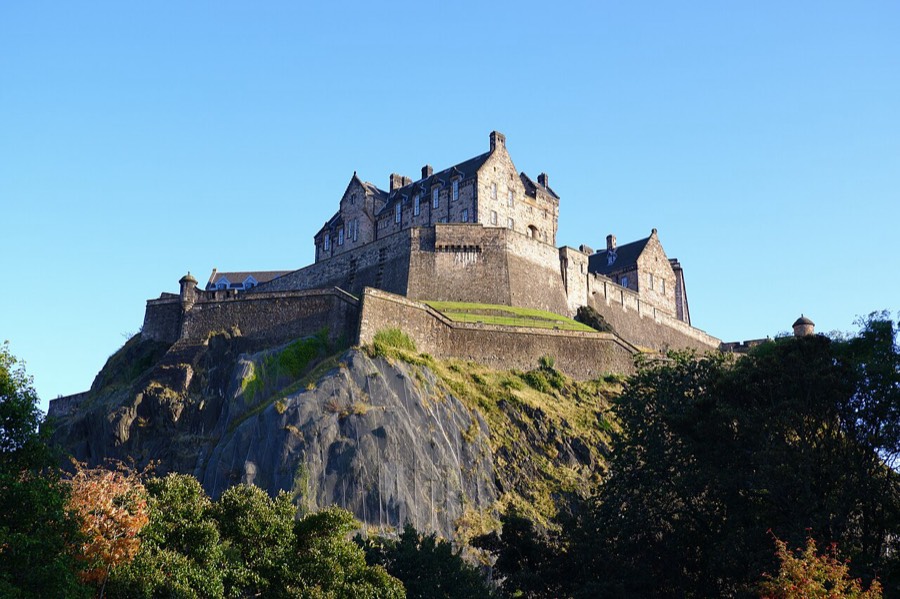
The castle stands on the plug of an extinct volcano, and the Royal Mile runs down from it to the palace of Holyroodhouse. The orderly New Town across the valley was laid out from 1767 to the plan of a young architect, James Craig, and Old Town and New Town together are a World Heritage site. The Edinburgh Hebrew Congregation still prays in the synagogue on Salisbury Road, opened in 1932.
- Stirling Castlestop on the way
The castle on the rock that guards the lowest crossing of the River Forth, and so the key to the Highlands. Below it William Wallace won the battle of Stirling Bridge in 1297, and Robert the Bruce won Bannockburn nearby in 1314; Mary, Queen of Scots, was crowned in its Chapel Royal in 1543, at nine months old.
- Killinone night
A village at the western end of Loch Tay, where the River Dochart pours over a broad staircase of rocks right under the road bridge, the Falls of Dochart. On the island of Inchbuie in the river below the bridge lies the old burial ground of the MacNab clan.
- Glencoestop on the way
The A82 runs through the bottom of this glen under the Three Sisters. On 13 February 1692 government soldiers under Robert Campbell of Glenlyon, who had been guests of the MacDonalds of Glencoe for nearly two weeks, turned on their hosts before dawn and killed some thirty-eight of them; others died fleeing in the snow. The visitor centre tells the story.
- Fort William2 nights
A town at the head of Loch Linnhe under Ben Nevis, at 1,345 metres the highest mountain in the British Isles; the path to the summit starts in Glen Nevis just outside town. Fort William is also the end of the West Highland Way, the walking trail from Glasgow.
- Glenfinnan Viaductstop on the way
A curving railway viaduct of twenty-one arches, built of mass concrete by Robert McAlpine in the late 1890s for the line to Mallaig, which opened in 1901, and the bridge the Hogwarts Express crosses in the Harry Potter films. In summer the Jacobite steam train crosses it on its way to Mallaig. At the head of the loch below stands the monument to the Jacobites, where Bonnie Prince Charlie raised his standard in August 1745.
- Eilean Donanstop on the way
A castle on a small island where three sea lochs meet, joined to the shore by a stone footbridge. Government warships shelled it in 1719, when Spanish soldiers held it for the Jacobites, and it lay in ruins for two hundred years until Lieutenant-Colonel John MacRae-Gilstrap rebuilt it between 1912 and 1932.
- Plocktonone night
A village of whitewashed cottages around a sheltered bay on Loch Carron, laid out as a planned fishing village at the end of the eighteenth century. The air is so mild here that cabbage palms from New Zealand grow along the shore, and in the 1990s the village played Lochdubh in the BBC series Hamish Macbeth.
- Portree3 nights
The main town of Skye, with a row of painted houses around the harbour. In 1746, after Culloden, Flora MacDonald said goodbye here to Bonnie Prince Charlie, whom she had smuggled across from the Outer Hebrides dressed as her Irish maid; the inn where they parted is now the Royal Hotel.
- Old Man of Storrstop on the way
A pinnacle of rock some fifty metres tall standing below the cliffs of the Trotternish ridge, left behind by an ancient landslip. The path up from the car park on the road north of Portree takes about an hour each way; drive on around the peninsula to the Quiraing and the Kilt Rock waterfall.
- Sligachan Old Bridgestop on the way
An old stone bridge under the jagged peaks of the Black Cuillin. Beside it stands a bronze statue, unveiled in 2020, of the climber Norman Collie and his Skye guide John Mackenzie, who between them opened up the Cuillin; local legend says that holding your face in the river for seven seconds gives eternal beauty.
- Glen Shielstop on the way
The glen of the A87 under the Five Sisters of Kintail. Here on 10 June 1719 government troops defeated the Jacobites and the Spanish soldiers who had landed to help them, and a peak above the battlefield is still called Sgùrr nan Spàinteach, the Peak of the Spaniards.
- Fort Augustusone night
A village at the southern end of Loch Ness, where the Caledonian Canal climbs out of the loch through a flight of five locks in the middle of the village. The fort, begun by General Wade in 1729, was named after Prince William Augustus, the Duke of Cumberland of Culloden; in 1876 it became a Benedictine abbey, whose monks left in 1998.
- Urquhart Castlestop on the way
The ruined castle on Loch Ness, blown up by government troops in 1692 so that the Jacobites could not use it. The loch is some 230 metres deep and holds more fresh water than all the lakes of England and Wales together; the monster stories took off in 1933, after a new road was opened along its north shore.
- Inverness2 nights
The capital of the Highlands, on the River Ness where it meets the Moray Firth, with its red sandstone castle over the river. Inverness is the northern end of the Caledonian Canal, built by Thomas Telford and opened in 1822, which links Loch Ness and the other lochs of the Great Glen to the sea at Fort William.
- Cullodenstop on the way
The moor where on 16 April 1746 the army of the Duke of Cumberland destroyed the Jacobites of Bonnie Prince Charlie in under an hour, in the last pitched battle fought on British soil. Flags mark the lines of the two armies, and stones mark the graves of the clans.
- Blair Castlestop on the way
The white castle of the Dukes of Atholl, at the head of the Atholl valley. In 1746 the Jacobite Lord George Murray laid siege to it, though it was his own family’s house, the last siege of a castle in Britain; the duke still keeps the Atholl Highlanders, Europe’s only legal private army.
- Pitlochryone night
A Victorian resort town on the A9 at the edge of the Cairngorms. Its hydroelectric dam on the River Tummel, built in the early 1950s, has a fish ladder of pools beside it, and from spring to autumn you can watch wild salmon climbing it through an underwater window.
- Dunkeld Cathedralstop on the way
A cathedral on the bank of the Tay, its nave roofless since the Reformation while its choir is still the parish church. Inside lies the tomb of Alexander Stewart, the Wolf of Badenoch, who burned Elgin Cathedral in 1390.
- Edinburghone night
Back in the capital for a last night. Arthur’s Seat, the hill of the old volcano in Holyrood Park, rises 251 metres right in the city, and the climb to the top takes under an hour from the palace.
What it costs
Eighty dollars a night is the room. The car and the fuel are yours, and Scotland has no road tolls at all: the Skye Bridge has been free since 2004. If you take the ferry from Mallaig to Armadale instead, the car fare is paid on top and must be booked ahead in summer. Fuel costs more in the Highlands and on Skye than in the cities, so fill up in Fort William and Inverness. Parking at Glencoe, at the Storr and at Eilean Donan is paid.
What to know
Three things. One: drive on the left, and remember it most at the start of the day, out of a car park and on an empty road. Two, and above all: the single-track roads. Much of Skye and the roads off the main routes are one lane wide with passing places every few hundred metres. Pull into a passing place on your left, or stop opposite one on your right, and let the oncoming car through; pull in too to let a faster car behind you overtake, and never park in a passing place to take a photograph. Sheep lie on these roads, and deer cross them at dusk. Three: the midges. On still evenings from June to August they come in clouds; a repellent made for them, sold in every Highland shop, and a head net make the difference. And plan the crossing to Skye: the Skye Bridge from Kyle of Lochalsh is free and always open, while the ferry from Mallaig is a short, lovely crossing that must be booked.
Roads, tolls and rules
The United Kingdom drives on the left. The route is driven slowly, with a night every hundred to a hundred and fifty kilometres: Killin on Loch Tay, Plockton on the way to Skye, Fort Augustus at the foot of Loch Ness and Pitlochry on the way home, so no day is longer than about two and a half hours at the wheel. The A9 back to Edinburgh is a fast trunk road, and the A82 through Glencoe and along Loch Ness is good but slow behind coaches. On Skye and off the main roads expect single-track lanes, and an hour on the map can be an hour and a half. Fuel stations are far apart in the west; never let the tank run below a quarter.

Travel Scotland: The Highlands
The route on our site, with a room up to $80 every night.