Northern Spain: From San Sebastián to Santiago
When to go
June and September. This is Green Spain: it rains in every month, which is why it is green, and summer is mild, in the twenties rather than the forties of the south. July and August are the Spanish holiday season, and the coast is full and dearer. San Sebastián holds its film festival in late September and the hotels fill for it. On 25 July Santiago celebrates its saint, and in a year when that day falls on a Sunday it is a Holy Year, with far more pilgrims than usual.
The stops
Interactive map of the route on our site ›
- San Sebastian2 nights
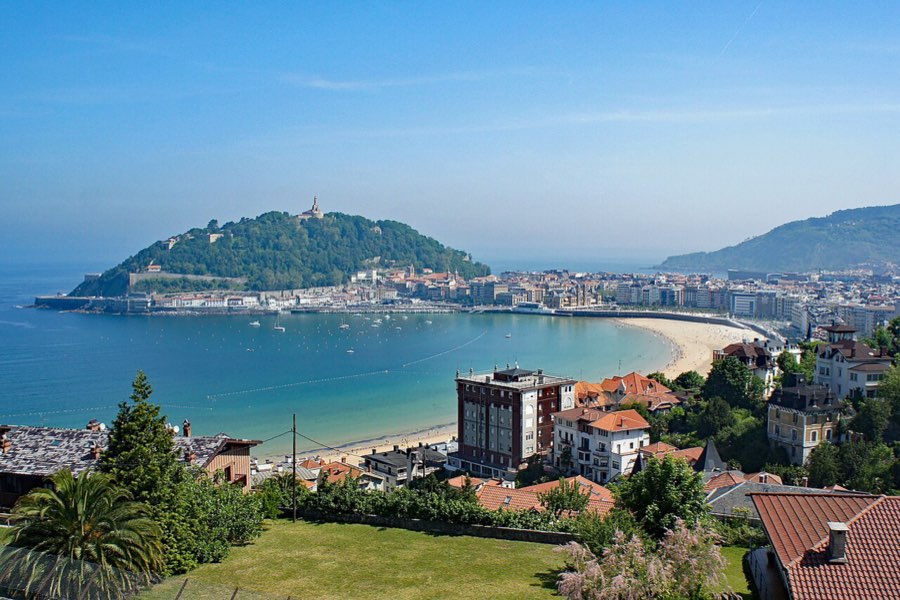
The city curves around La Concha, a shell-shaped bay with a small island at its mouth. In the bars of the Parte Vieja, the old town, the counters are covered with pintxos, small bites on bread. At the far end of Ondarreta beach the iron sculptures of Eduardo Chillida, the Comb of the Wind, grip the rocks against the waves.
- Getariastop on the way
A fishing town known for fish grilled over charcoal in the street and for txakoli, the local sharp white wine. Juan Sebastián Elcano was born here; he took over Magellan’s expedition after Magellan was killed and brought the last ship home in 1522, completing the first voyage around the world. The fashion designer Cristóbal Balenciaga was also born here, and a museum of his work stands above the town.
- Bilbao2 nights
The Guggenheim Museum by Frank Gehry, clad in titanium and opened in 1997, turned a declining port and steel city into a destination. In front of it sits Jeff Koons’s Puppy, a giant dog covered in living flowers. The old town, the Seven Streets, lies across the river.
- San Juan de Gaztelugatxestop on the way
A rocky islet joined to the coast by a stone bridge, with a hermitage on its top reached by a winding stairway of more than two hundred steps. It played Dragonstone in Game of Thrones. In the busy season entry is free but must be booked online ahead.
- Santanderstop on the way
The capital of Cantabria, on a wide bay. On the Magdalena peninsula stands the Palacio de la Magdalena, built between 1909 and 1911 with money raised by the city and given to King Alfonso XIII as a summer residence; today it houses a summer university.
- Altamirastop on the way
The cave whose painted ceiling of bison, from the Old Stone Age, was recognised in 1879 by Marcelino Sanz de Sautuola after his young daughter María looked up and saw it. The real cave is closed to protect the paintings, and the museum holds the Neocueva, an exact copy of it.
- Santillana del Marone night
A village of stone houses with coats of arms and a Romanesque collegiate church, Santa Juliana. It is called the town of three lies: it is not holy, not flat and not on the sea, though its name says all three.
- Comillasstop on the way
El Capricho, a summer villa built from 1883 by the young Antoni Gaudí, with a slim tower covered in green and sunflower tiles; it is one of his few works outside Catalonia. The town grew rich on money brought back from the Americas, and its hill is crowned by the old Pontifical University.
- Llanesstop on the way
A fishing port with a medieval core inside old walls. Its breakwater is lined with the Cubes of Memory, hundreds of concrete blocks that the Basque artist Agustín Ibarrola painted in bright colours and geometric shapes in 2001.
- Cangas de Onis2 nights
The first capital of the kingdom of Asturias, founded after the battle of Covadonga. Its tall humpbacked bridge over the Sella is called Roman but was built in the Middle Ages, and a copy of the Victory Cross, the emblem of Asturias, hangs beneath its arch.
- Covadongastop on the way
By tradition Pelayo defeated a Muslim army here around 722, and Spain counts the battle as the start of the Reconquista. His tomb lies in the Holy Cave, a chapel set in the cliff above a waterfall, and a pink stone basilica, finished in 1901, stands on the rock opposite.
- Lakes of Covadongastop on the way
Two glacial lakes, Enol and Ercina, high in the Picos de Europa, which in 1918 became the first national park in Spain. In summer and at other busy times the road up is closed to private cars during the day, and a bus runs from Cangas de Onís; check before you go.
- Ribadesellastop on the way
The town at the mouth of the Sella. The painted cave of Tito Bustillo here was found in 1968 by a group of young climbers, and was named after one of them, Celestino Bustillo, who was killed in a mountain accident days later. Every August canoeists race down the Sella from Arriondas to this harbour.
- Oviedo2 nights
Capital of the old kingdom of Asturias. On Mount Naranco above the city stand Santa María del Naranco and San Miguel de Lillo, built in the ninth century and World Heritage sites. By tradition King Alfonso II walked from here to Santiago to see the newly found tomb of the apostle, and Oviedo is the start of the Camino Primitivo, the first way. In the cider houses the waiter pours the cider from above his head to wake it up.
- Cudillerostop on the way
Coloured fishermen’s houses stacked up the slopes around a tiny harbour like the seats of a theatre. The old fishing families here speak pixueto, a dialect of their own.
- Luarcaone night
A white fishing town in a bend of the river, with its harbour below a headland. Severo Ochoa, who won the Nobel Prize in Medicine in 1959, was born here in 1905, and he is buried in the cemetery on the headland above the sea.
- Playa de las Catedralesstop on the way
The sea has cut the cliffs here into arches and caves that look like the buttresses of a cathedral, and at low tide you walk on the sand beneath them. Come at low tide, and in Easter week and summer book the free entry online ahead.
- Mondonedostop on the way
A small cathedral town in a green valley, one of the old bishoprics of Galicia. The writer Álvaro Cunqueiro was born here in 1911, and wrote much of his work about this valley and its people.
- Lugoone night
The only city whose Roman walls still run unbroken all the way round, more than two kilometres of them with dozens of towers, built in the third century; they have been a World Heritage site since 2000, and you can walk the whole circuit on top.
- Melidestop on the way
Here the Camino Primitivo, the way that began in Oviedo, joins the Camino Francés for the last stretch to Santiago. The town is known for pulpo á feira, boiled octopus cut with scissors onto wooden plates with olive oil and paprika.
- Santiago de Compostela2 nights
The end of the Camino, where pilgrims arrive at the cathedral that holds, by tradition, the tomb of the apostle James. Inside, the Pórtico da Gloria was carved by Master Mateo, finished in 1188, and on some days the Botafumeiro, a huge censer, is swung by eight men in an arc across the transept.

What it costs
Eighty dollars a night is the room. The car, the fuel and the tolls are yours: the only tolls on this route are in the Basque Country, on parts of the AP-8 between San Sebastián and Bilbao, while west of Bilbao the coastal A-8 is free across Cantabria and Asturias. Parking in San Sebastián and Bilbao is paid and dear, and the hotel car park is often an extra charge. The extras worth budgeting are the Altamira museum, the bus up to the Covadonga lakes in summer, and the online booking for Gaztelugatxe and the Cathedrals beach, which is free but must be made ahead.
What to know
Three things. One: low-emission zones. Spanish cities above fifty thousand people must have one, and Bilbao and San Sebastián read plates by camera at the edge of theirs. Cars registered in Spain carry the DGT environmental sticker on the windscreen; check the rental car has one before you drive into a city centre. Two: speed. The limit is 120 on motorways and 90 on ordinary roads, and since 2021 most single-lane town streets are limited to 30; fixed cameras and average-speed sections are common, and fines are paid on the spot by foreign drivers. Three: parking. Coloured lines on the street mean paid zones with a time limit, paid at a machine or by app; outside those hours they are free. In the old towns the lanes are narrow and often closed to traffic, so leave the car in an underground car park and walk.
Roads, tolls and rules
Spain drives on the right. The A-8 runs along the whole north coast, a fast motorway between the mountains and the sea, with exits down to the fishing villages. The pace is unhurried: no driving day is longer than about a hundred and sixty kilometres, with nights in Santillana, Cangas de Onís, Luarca and Lugo, so the coast is taken in short stretches. The road up to Covadonga and the lakes is narrow and steep, with cattle on it; from Cangas it is a short morning drive.
Travel Northern Spain: From San Sebastián to Santiago
The route on our site, with a room up to $80 every night.