Canary Islands: Tenerife and Gran Canaria by car
When to go
All year, which is the whole point of the Canaries: the coast stays at about twenty to twenty-six degrees in winter and rarely passes thirty in summer. The mountains are another climate. Teide can have snow from December to March, the road and the cable car close in snow and strong wind, and the summits of Gran Canaria are cold at dawn even in spring. The north of Tenerife is greener and cloudier than the dry south, and a few days a year the calima, dust blown from the Sahara, turns the sky yellow.
The stops
Interactive map of the route on our site ›
- La Lagunastop on the way
Tenerife North airport lies on the edge of San Cristóbal de La Laguna, so the trip begins in the old capital of the island. Founded in 1496, it was laid out as an open grid without walls, the plan UNESCO calls the model for many colonial towns in the Americas, and it has been a World Heritage site since 1999.
- Tenerife2 nights
Santa Cruz is the capital and the port of the island, and the place the ferry leaves from at the end of the Tenerife days. In July 1797 Horatio Nelson attacked the town and was beaten off, and a cannon shot here cost him his right arm.
- Anaga Rural Parkstop on the way
The mountains at the north-eastern tip of Tenerife are covered in laurisilva, a damp laurel forest of the kind that covered southern Europe millions of years ago, and since 2015 Anaga has been a UNESCO biosphere reserve. The road climbs from La Laguna to the Cruz del Carmen viewpoint and drops through tunnels of trees to the sea.
- Tagananastop on the way
One of the oldest villages on the island, its white houses on a steep slope over the Atlantic, settled soon after the conquest at the end of the fifteenth century. Below it is the black-sand beach of Roque de las Bodegas, with fish restaurants on the rocks.
- La Orotavastop on the way
A hillside town of wooden balconies above the valley of the same name. The Casa de los Balcones, of 1632, shows the carved pine balconies the town is known for, and for Corpus Christi the square before the town hall is covered with huge pictures made of coloured volcanic sand.
- Drago Milenariostop on the way
The great dragon tree of Icod de los Vinos is the emblem of Tenerife. Its name calls it a thousand years old, but the dragon tree has no annual rings and botanists put its age at several centuries; its red sap was once sold as dragon’s blood.
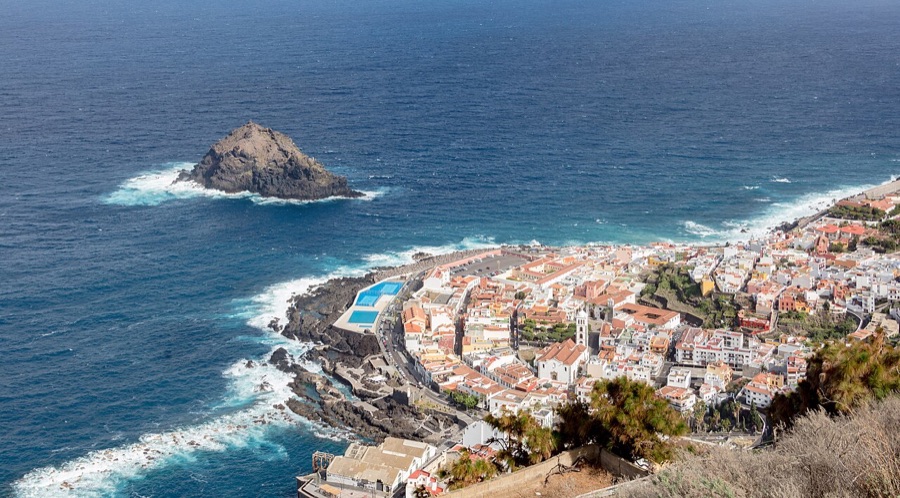
- Garachico3 nights
Until 1706 this was the richest port of Tenerife, shipping wine to Europe and the Americas. That year a volcano above the town sent lava down the cliff and filled the harbour, and the trade moved to Puerto de la Cruz; the cooled lava on the shore became El Caletón, rock pools where you swim today.
- Mascastop on the way
A hamlet on a ridge in the Teno mountains, reached by the TF-436, a road of hairpins so narrow that in places two cars cannot pass. The hike down the Masca ravine to the sea now has to be booked, and it is closed at times.
- Los Gigantesstop on the way
The cliffs of the Teno massif drop straight into the sea on the west coast; the Guanches, the people of the island before the Spanish came, called them the wall of hell. Boats from the marina sail along them, and pilot whales and dolphins live in the strait toward La Gomera.
- Teide National Parkstop on the way
At 3,715 metres Teide is the highest mountain in Spain, a volcano standing in a vast crater of lava and pumice; the park has been a World Heritage site since 2007. The cable car rises to about 3,555 metres, and the Roques de García, rock towers of old lava, stand beside the road below it.
- Santa Cruz–Agaete Ferrystop on the way
Back along the motorway to the port of Santa Cruz, and the car goes on the ferry to Gran Canaria. The crossing to Agaete takes about an hour and twenty minutes; on a clear day Teide stays in sight behind you for most of it.
- Agaetestop on the way
The ferry lands at Puerto de las Nieves, a fishing harbour under the cliffs of the north-west coast. The rock called the Finger of God stood here until a tropical storm broke it off in 2005; the stump is still pointed out from the quay.
- Cueva Pintadastop on the way
In the middle of Gáldar, the old seat of the island’s native kings, a cave painted with red, white and black geometric figures by the people who lived on Gran Canaria before the conquest. It sits in an excavated village of their houses, now a museum under one roof.
- Arucasstop on the way
A banana and sugar town whose church of San Juan Bautista, begun in 1909 in dark local stone, looks like a Gothic cathedral and is called one by everyone, though it is a parish church. The town also has a rum distillery, Arehucas, that takes visitors.
- Las Palmas2 nights
The largest city of the Canaries, founded in 1478 in the quarter of Vegueta, where the cathedral of Santa Ana and the Casa de Colón stand. Columbus stopped at Gran Canaria in 1492 on his first voyage, to repair the Pinta; the city also has Las Canteras, a long town beach sheltered by a natural reef.
- Terorstop on the way
A small town of wooden balconies in the green hills, and the religious heart of Gran Canaria: its basilica holds the Virgin of the Pine, the patron of the island, who by tradition appeared in a pine tree here in the fifteenth century. On Sundays a market fills the streets around the church.
- Roque Nublostop on the way
A tower of volcanic rock some eighty metres high on the summit plateau of the island, at about 1,800 metres, reached on foot in half an hour from the road. The landscape around it and its ancient cave sanctuaries became a World Heritage site in 2019; on a clear day Teide floats on the horizon across the sea.
- Fatagastop on the way
The road down from the summits to the south coast follows the Fataga ravine, and the village of white houses in its palms is the place to stop on the way. The valley is often called the valley of a thousand palms.
- Maspalomas3 nights
Behind the beach rise the Maspalomas dunes, a field of moving sand of some four square kilometres, protected as a nature reserve, with a lagoon of palms at its edge. The lighthouse at the point, lit in 1890, is still working.
- Puerto de Mogánstop on the way
A fishing harbour on the south-west coast rebuilt in the 1980s as a village of low white houses with flowers over the doors and canals running between them, which is why it is called the little Venice of the Canaries. The Friday market fills the quay.
What it costs
Eighty dollars a night is the room. The car, the fuel and the ferry are yours. There are no toll roads in the Canary Islands, and fuel is cheaper than on the Spanish mainland because the islands have their own, lower tax. The ferry from Santa Cruz de Tenerife to Agaete carries the car, and its fare for a car and passengers is the biggest single extra of the trip; book it ahead. Budget too for the Teide cable car, and for paid parking in Santa Cruz, La Laguna and Las Palmas.
What to know
Three things. One: the ferry. The car can cross from Tenerife to Gran Canaria on the ferry, but many rental companies forbid taking their cars between islands, or insure them only on the island where you picked them up. Rent from a company that allows it, say so when you book, and keep the permission with the contract; otherwise rent one car on each island and cross as a foot passenger. Two: the mountain roads. The road down to Masca is a single narrow ribbon of hairpins where buses and cars squeeze past each other, and the roads over the middle of Gran Canaria are much the same; go slowly, use the horn on blind bends, and do not drive them in the dark. Three: Teide. The summit path from the top of the cable car needs a free permit from the national park, booked weeks ahead, and the cable car stops in wind; the air at 3,500 metres is thin, so climb slowly.
Roads, tolls and rules
Spain drives on the right. Each island has a free motorway along its coast, the TF-1 and TF-5 on Tenerife and the GC-1 on Gran Canaria, and everything inland climbs on winding mountain roads where forty kilometres can take an hour. The ferry from Santa Cruz to Agaete takes about an hour and twenty minutes; be at the port well before sailing, because cars board first. You can fly home from Gran Canaria, half an hour from Maspalomas.

Travel Canary Islands: Tenerife and Gran Canaria by car
The route on our site, with a room up to $80 every night.