Germany: The Romantic Road
When to go
May to October. In summer the old towns of Rothenburg and Dinkelsbühl and the castle of Neuschwanstein are at their most crowded, and the coaches arrive by mid-morning; May, June and September are calmer. From the end of November the towns hold their Christmas markets, Rothenburg’s among the best known in Germany. In late September and early October Munich holds the Oktoberfest and the city is full. In winter the Allgäu around Füssen is under snow.
The stops
Interactive map of the route on our site ›
- Frankfurtone night
Goethe was born here in 1749, in a house on the Großer Hirschgraben that can be visited. Mayer Amschel Rothschild, founder of the banking family, was born in 1744 in the Judengasse, the walled Jewish street of Frankfurt, and Anne Frank was born in the city in 1929; the Jewish Museum stands in a Rothschild house on the river.
- Wurzburgone night
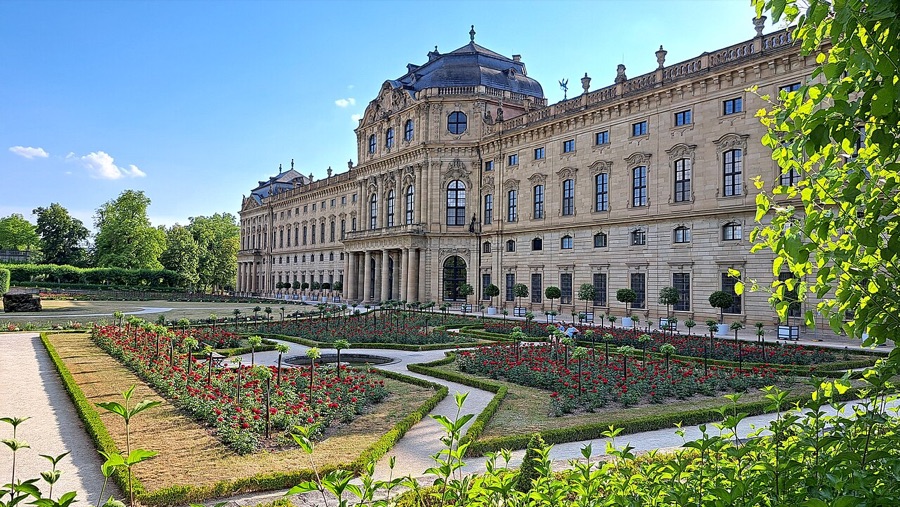
The Romantic Road begins at the Residenz, the palace of the prince-bishops, built by Balthasar Neumann, where Tiepolo painted one of the largest ceiling frescoes in the world over the staircase; it is a World Heritage site since 1981. In 1987 some fifteen hundred fragments of gravestones from the medieval Jewish cemetery were found in the city, and they are shown at Shalom Europa, the Jewish community centre and museum opened in 2006.
- Tauberbischofsheimstop on the way
A small town on the Tauber, with half-timbered houses round the market square and the castle of the archbishops of Mainz. Its fencing club has trained Olympic champions, and the town is known in Germany as a capital of fencing.
- Weikersheimstop on the way
The castle of the counts of Hohenlohe, with a Renaissance Knights’ Hall whose walls carry life-size stucco animals, and a Baroque garden of statues down to the river.
- Rothenburgone night
A walled town of the Middle Ages whose walls you can walk round. By legend, in 1631 the general Tilly agreed to spare the town if one of its councillors could empty a tankard of more than three litres of wine in one go, and the former mayor Nusch did it; the Meistertrunk is acted out every year. The great rabbi Meir of Rothenburg, the Maharam, taught here in the thirteenth century, before he was imprisoned by the emperor and died in captivity in 1293.
- Dinkelsbuhlstop on the way
A walled town of gabled houses that came through the Second World War almost untouched. Every July it holds the Kinderzeche, a festival of the legend that the town’s children saved it from the Swedish army in the Thirty Years’ War.
- Nordlingenone night
A round walled town inside the Ries, a crater some twenty-five kilometres across left by an asteroid about fifteen million years ago; Apollo astronauts trained here in 1970. The church of St George is built of suevite, a stone made by the impact, and from its tower, the Daniel, some ninety metres high, a watchman calls out every half-hour in the late evening.
- Harburg Castlestop on the way
One of the largest and best-kept medieval castles in southern Germany, on a rock over the Wörnitz, in the hands of the princes of Oettingen-Wallerstein since the thirteenth century.
- Augsburgone night
Founded by the Romans and named for Augustus. The Fuggerei, built by Jakob Fugger from 1516, is the oldest social housing in the world still in use, and its residents pay a yearly rent of 88 cents and say three prayers a day for the founder. The synagogue, finished in 1917 under a great dome, was damaged in 1938 but not burned, and holds prayers and the Jewish Museum of Augsburg and Swabia.
- Landsberg am Lechstop on the way
An old town on the Lech, with a weir across the river below the walls. Hitler was held in its prison in 1924 and wrote Mein Kampf there; after the war Landsberg had one of the largest camps for Jewish survivors in the American zone, with its own Yiddish newspaper.
- Fussen2 nights
A town at the foot of the Alps, at the end of the Romantic Road, under the High Castle of the prince-bishops of Augsburg. Füssen was a centre of lute and violin making, and in 1562 its lute makers formed the first guild of their craft in Europe.
- Neuschwansteinstop on the way
King Ludwig II of Bavaria began the castle in 1869 as a fantasy of the Middle Ages and lived in it only a short time before his death in 1886; it opened to visitors weeks later, and in 2025 it became a World Heritage site with his other palaces. The Marienbrücke, a footbridge over the gorge behind it, gives the classic view.
- Wieskirchestop on the way
A Rococo pilgrimage church alone in the meadows, built from 1745 to 1754 by the brothers Dominikus and Johann Baptist Zimmermann around a wooden statue of the scourged Christ that pilgrims said had wept. It has been a World Heritage site since 1983.
- Ettalstop on the way
A Benedictine abbey founded in 1330 by the emperor Ludwig the Bavarian, with a great domed Baroque church; the monks still brew beer and make a herbal liqueur. Oberammergau, a few minutes away, has staged its Passion Play every ten years since 1634.
- Munich2 nights
The Oktoberfest began in 1810 as the wedding celebration of Crown Prince Ludwig and Princess Therese, on the meadow still named after her. Ohel Jakob, the main synagogue, opened in 2006 on St.-Jakobs-Platz in the centre, beside the Jewish Museum; Dachau, the first concentration camp, opened in 1933, is a memorial half an hour north of the city.

What it costs
Eighty dollars a night is the room. The car and the fuel are yours, and in Germany cars pay no toll on the Autobahn or on any other road. Parking is paid in every old town on this route, in car parks outside the walls; in Munich and Frankfurt the garages are dear. At Neuschwanstein the car parks in the village of Hohenschwangau below the castle are paid, and the castle tour is its own ticket.
What to know
Three things. One: the environmental zones. Munich and Frankfurt, like many German cities, admit only cars that carry a green Umweltplakette, the emission sticker on the windscreen; a car rented in Germany normally has one, but check before you drive into the centre, since the fine is charged without one. Two: Neuschwanstein. The castle is seen only on a guided tour at a fixed time, and the tickets for the season are sold online in advance and often run out weeks ahead; book before the trip and collect them at the ticket centre in Hohenschwangau. Three: the Autobahn. Some stretches have no speed limit, but many do, signed and watched by cameras; overtake only on the left, and when traffic stops, leave a lane open between the left lane and the rest for the emergency services. If the navigation takes you over the border into Austria near Füssen, Austria’s motorways need a vignette.
Roads, tolls and rules
Germany drives on the right. The Romantic Road itself, marked by brown signs, runs on country roads from town to town; the fast way is the Autobahn, which runs alongside much of it. The distances are short, and the days are long only for the stops: the old towns are best walked, with the car left outside the walls.

Travel Germany: The Romantic Road
The route on our site, with a room up to $80 every night.