Cyprus: From Larnaca to Paphos
When to go
April to June and September to November. In July and August Limassol and Paphos pass thirty-two degrees and the inland plain is hotter still, though the Troodos villages, at a thousand metres and more, stay cool at night. The sea is warm enough to swim from May to November. In January and February snow falls on Mount Olympus, and the mountain roads can ice over.
The stops
Interactive map of the route on our site ›
- Larnacaone night
The town stands on ancient Kition, and its Church of Saint Lazarus was built in the ninth century over the tomb of Lazarus, who by tradition came here after Jesus raised him and became the first bishop of Kition. Between 1946 and 1949 the British held more than fifty thousand Jewish refugees, caught on their way to the Land of Israel, in camps on Cyprus, among them Xylotymbou and Dhekelia near Larnaca; some two thousand babies were born in the camps.
- Hala Sultan Tekkestop on the way
A mosque among palm trees on the shore of the Larnaca Salt Lake, built over the tomb of Umm Haram, a woman of the Prophet Muhammad’s circle who by tradition fell from her mule here during an Arab raid in 649. From November to March thousands of flamingos winter on the lake, and in summer it dries to a white crust of salt.
- Lefkarastop on the way
A village of stone houses in the hills, famous for its lace, Lefkaritika, embroidered by the women of the village and listed by UNESCO as intangible heritage in 2009. By local tradition Leonardo da Vinci came here in 1481 and bought a lace cloth for the altar of Milan Cathedral.
- Choirokoitiastop on the way
One of the best-kept Neolithic villages of the eastern Mediterranean, lived in from about 7000 before the common era, with round stone houses on a hillside above the Maroni river; the dead were buried under the floors of the houses. A few of the houses have been rebuilt by the entrance, and the site has been on the World Heritage list since 1998.
- Limassolone night
The second city of Cyprus and its main port, with a seafront promenade that runs for miles and a restored old harbour. By tradition Richard the Lionheart married Berengaria of Navarre in a chapel here in 1191, on his way to the Crusade, and she was crowned queen of England in Limassol; the medieval castle by the old port now holds the Cyprus Medieval Museum.
- Troodos and Mount Olympusstop on the way
The square of Troodos sits just below Mount Olympus, at 1,952 metres the highest point of Cyprus, crowned by a British radar station. The mountains are a slab of ancient ocean floor pushed up out of the sea, which is why geologists come from around the world to study them; in winter there is skiing on the north face.
- Agios Nikolaos tis Stegisstop on the way
Saint Nicholas of the Roof, an eleventh-century church that was given a second, steep wooden roof over its domes to shed the mountain snow, and took its name from it. Inside, the walls are covered with frescoes from the eleventh century to the seventeenth; it is one of the ten painted churches of Troodos on the World Heritage list.
- Kakopetriaone night
A mountain village in the Solea valley on the Karkotis river, whose name means bad stone, after the great boulders around it. Its old quarter, of stone houses with wooden balconies on a narrow ridge between two streams, is protected, and old water mills still stand along the river.
- Pedoulasstop on the way
A village of steep lanes in the Marathasa valley, known across Cyprus for its cherries, which ripen in June. Its small church of the Archangel Michael, with a pitched wooden roof, was painted in 1474 and is another of the ten painted churches on the World Heritage list.
- Kykkos Monasterystop on the way
The richest monastery of Cyprus, founded at the end of the eleventh century under the Byzantine emperor Alexios Komnenos, to keep an icon of the Virgin that tradition says Saint Luke painted; it is covered in silver and no one may look at its face. Archbishop Makarios, the first president of Cyprus, was a novice here and is buried on the hill of Throni above it.
- Omodosone night
A wine village on the southern slopes of Troodos, with a cobbled square in front of the Monastery of the Holy Cross, which by tradition keeps a piece of the rope that bound Jesus, brought from Jerusalem by Saint Helena. In the lanes around it stands a medieval wooden wine press, the Linos, and the bakers sell arkatena, a bread of chickpeas.
- Kolossi Castlestop on the way
A square keep of the Knights of Saint John, rebuilt in 1454, in the middle of what was their richest estate on the island, with a sugar mill beside it. The sweet wine made on these lands took its name from the Grand Commandery of Kolossi: Commandaria, said to be the oldest named wine still made in the world.
- Kourionstop on the way
A Greco-Roman city on a cliff above the sea, with a theatre that has been restored and still holds performances on summer nights, and floor mosaics in the villa of Eustolios. An earthquake in 365 brought it down. The site lies inside the Akrotiri base, one of the two areas Britain kept as sovereign territory when Cyprus became independent in 1960.
- Petra tou Romioustop on the way
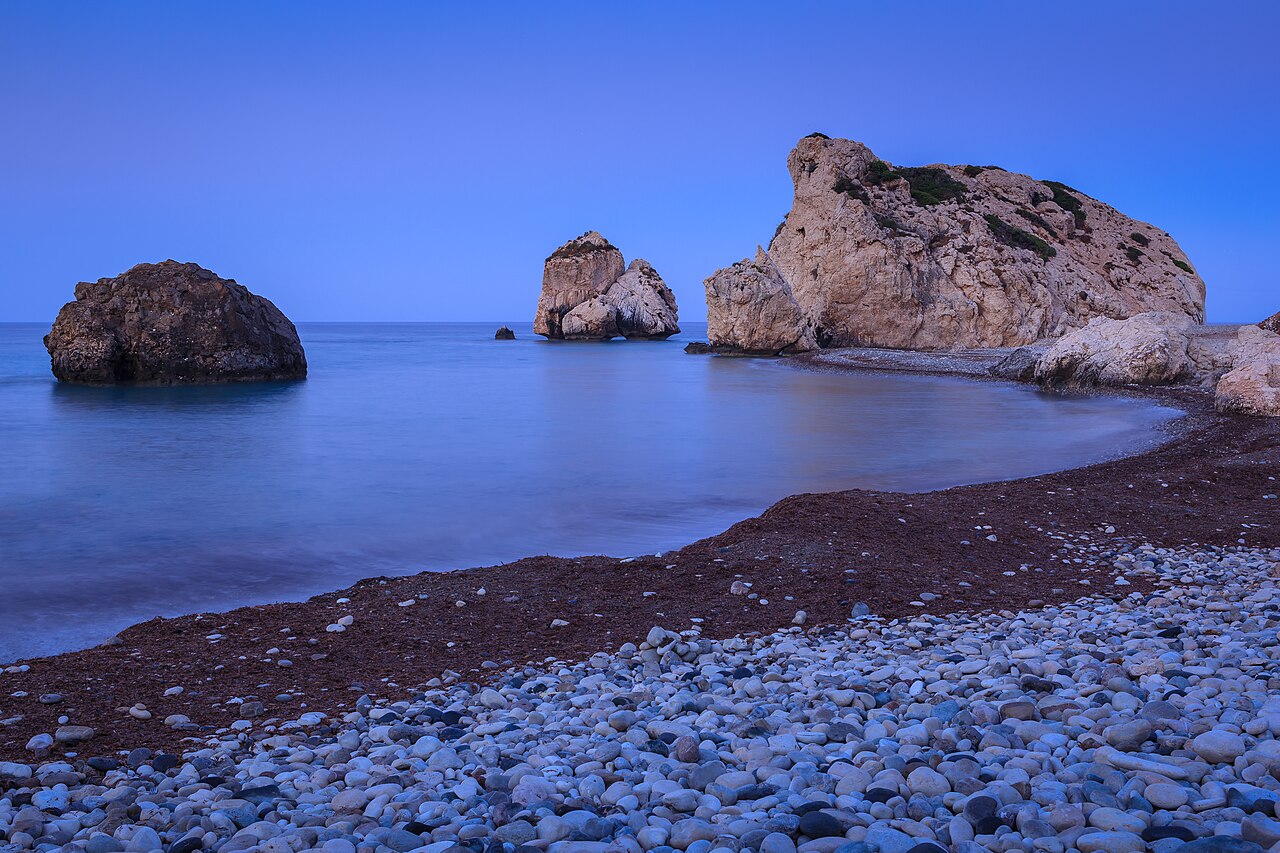
The rock in the sea where, in the Greek myth, Aphrodite rose from the foam of the waves. Its name means the Rock of the Greek, after the Byzantine hero Digenis Akritas, who by legend hurled it at Saracen pirates; the beach is of pebbles and the sea here is rough.
- Paphos2 nights
Kato Paphos, the lower town by the harbour, was the Roman capital of Cyprus, and the whole of it has been on the World Heritage list since 1980. Here, according to the Book of Acts, the apostle Paul struck the sorcerer Elymas blind before the Roman governor Sergius Paulus; a small Ottoman fort guards the harbour mouth.
- Paphos mosaicsstop on the way
In 1962 a farmer ploughing his field struck the floor of a Roman villa, and it turned out to be the House of Dionysos, its rooms paved with mosaics of the third century. The Houses of Theseus, Aion and Orpheus lie beside it in the same archaeological park, among the finest Roman floors in the Mediterranean.
- Tombs of the Kingsstop on the way
Underground tombs cut into the rock by the sea from the fourth century before the common era, some built around open courtyards lined with Doric columns, like the houses of the living. No kings were buried here; the name comes from their grandeur, and they held the high officials of Ptolemaic Paphos.
- Agios Neophytos Monasterystop on the way
In 1159 the hermit Neophytos carved himself a cave in the cliff here, the Enkleistra, and had it painted with frescoes in 1183 and 1196; it is still open to visitors beside the monastery that grew up around him. He also wrote an account of Richard the Lionheart’s conquest of Cyprus in 1191.
- Polis Chrysochous2 nights
A small town on the Bay of Chrysochou, on the site of ancient Marion, a city-kingdom that Ptolemy I destroyed in 312 before the common era and that was rebuilt as Arsinoe. Two kilometres away is the fishing harbour of Latchi, where the boats leave for the Akamas coast.
- Baths of Aphroditestop on the way
A shaded grotto with a pool fed by a spring under a fig tree, at the start of the Akamas peninsula, where by legend Aphrodite bathed and first met Adonis. Bathing in it is forbidden; walking trails climb from here into the Akamas hills.
- Blue Lagoonstop on the way
A bay of clear, shallow water on the north coast of the Akamas peninsula, a protected area with no paved road into it. The boats from Latchi run along the cliffs and anchor here for swimming; on the far side of the peninsula, Lara beach is a nesting ground for green and loggerhead turtles.

What it costs
Eighty dollars a night is the room. The car and the fuel are yours, and Cyprus has no toll roads, so there are no tolls to add. Parking in central Larnaca, Limassol and Kato Paphos is paid, by meter or in municipal lots; in the mountain villages it is mostly free. The extras worth budgeting are the entry tickets to Kourion, Kolossi, the Tombs of the Kings and the mosaics of Paphos, and the boat from Latchi to the Blue Lagoon.
What to know
Three things. One: Cyprus drives on the left, a legacy of British rule, with the steering wheel on the right; rental cars carry red number plates beginning with Z, so local drivers know to give you room. Take the first roundabouts slowly, and keep left after every turn. Two: the speed limit on the motorway is 100 kilometres an hour, and on country roads 80; cameras stand along both, and the fines arrive at the rental company. Three: this route stays in the Republic of Cyprus. If you cross the Green Line into the north, the insurance of a rental car from the south does not cover you there; you buy separate insurance at the crossing, and many rental contracts forbid the crossing altogether.
Roads, tolls and rules
The motorway from Larnaca to Limassol and on to Paphos is fast and easy, but the track leaves it for the Troodos mountains, where the roads are narrow, steep and full of bends through pine forest, and forty kilometres can take an hour. The days are short, none longer than about a hundred kilometres, with a night in Kakopetria and a night in Omodos before the coast. The last morning is about fifty kilometres from Polis down to Paphos airport; flying home from Larnaca instead adds some 150 kilometres of motorway.

Travel Cyprus: From Larnaca to Paphos
The route on our site, with a room up to $80 every night.