China by high-speed train: Beijing to Shanghai
When to go
Spring and autumn are the seasons: April and May, and September into early November, are mild from Beijing to Guilin. Avoid the national holidays: the Spring Festival, the Chinese New Year in January or February, when hundreds of millions travel home and the trains sell out for weeks around it; the Labour Day holiday at the start of May; and Golden Week, 1 to 7 October, when every train and every sight is full. Summer is hot and humid, Chongqing among the hottest cities in China, and May to August is the rainy season around Guilin, when the Li River is at its fullest. Winter is cold and dry in Beijing and Xi’an and grey in Chengdu, and in the dry months the Li River can run so low that the boats start further downstream; the rooms are cheapest then.
The stops
Interactive map of the route on our site ›
- Beijing3 nights
The Forbidden City, the palace of the Ming and Qing emperors, was built from 1406 to 1420 and has been a World Heritage site since 1987. The trains south leave from Beijing West station, opened in 1996.
- Mutianyustop on the way
A stretch of the Great Wall about 70 kilometres north-east of the centre: Ming-era wall with watchtowers along a forested ridge, reached by cable car or chairlift, with a toboggan run back down.
- Xi’an2 nights
From Beijing West the G trains take about four hours ten minutes at the fastest and up to six, second class ¥515.5. Xi’an was the capital of China under the Han and the Tang and the eastern end of the Silk Road; its Ming city wall, begun in 1370, runs some 13.7 kilometres round the old centre, and you can ride a bicycle along the top.
- Terracotta Armystop on the way
In 1974 farmers digging a well near Lintong, east of the city, found the first pieces of the army of clay soldiers buried with Qin Shi Huang, the emperor who united China in 221 BC. His mausoleum, with the pits of the soldiers, has been a World Heritage site since 1987.
- Chengdu2 nights
From Xi’an North the high-speed line over the Qinling mountains, opened in December 2017, takes from about three hours ten minutes to four, second class ¥263. Chengdu, the capital of Sichuan, was named a UNESCO City of Gastronomy in 2010, the first in Asia; the numbing Sichuan pepper is in almost everything.
- Giant Panda Basestop on the way
The Chengdu Research Base of Giant Panda Breeding, north of the centre, was founded in 1987 with six pandas rescued from the wild. Come at opening time: the pandas are fed and awake in the morning and sleep through the heat of the day.
- Chongqingone night
From Chengdu East about an hour at the fastest, mostly an hour and a half to two, second class ¥175, with trains about every ten minutes through the day. A city of hills over the meeting of the Yangtze and the Jialing, and from 1937 to 1946 the wartime seat of the Chinese government. At Liziba station the Line 2 monorail runs straight through a 19-storey apartment block.
- Guilinone night
From Chongqing the G trains through Guizhou take about four to five hours, second class ¥310. Elephant Trunk Hill, a limestone arch over the Li River, is the symbol of the city; since 2014 the karst of Guilin has been part of the South China Karst World Heritage site.
- Li Riverstop on the way
The boats from Guilin take four to five hours down the Li River to Yangshuo, ¥215–360 depending on the boat and the deck, leaving at about nine or ten in the morning. Near Xingping the river passes the view printed on the back of the 20-yuan note.
- Yangshuo2 nights
The boat ends in the town. Yangshuo sits among the karst peaks, with West Street at its centre; around it are rice fields, the Yulong River with its bamboo rafts, and Moon Hill, a peak pierced by a great round arch.
- Guilinstop on the way
The way out: the bus from Yangshuo to Guilin takes an hour and a half to two hours, ¥25–50 depending on the station. From Guilin North the high-speed train to Shanghai Hongqiao takes about nine and a half hours, second class ¥662.5, with only a few trains a day; the flight is two and a half to three hours.
- Shanghai3 nights
The Bund, the river front of banks and trading houses built mostly in the first decades of the 20th century, faces the towers of Pudong across the Huangpu. The trains arrive at Hongqiao, beside Hongqiao airport, an easy metro ride from the centre.
- Ohel Moshestop on the way
Between 1938 and 1941 nearly 20,000 Jewish refugees from Europe reached Shanghai, one of the few places that asked for no visa; from 1943 the Japanese confined them to a “designated area” in Hongkou. The Ohel Moshe synagogue of 1927 is now the Shanghai Jewish Refugees Museum.
What it costs
Eighty dollars a night is the room, and on this route it buys a good one in Xi’an, Chengdu, Chongqing, Guilin and Yangshuo; in central Beijing and Shanghai it buys a smaller room, and less near the sights. The train tickets are yours and are not included. There is no rail pass for China: every leg is its own ticket, for a set train and seat. Second-class fares on the high-speed trains, as published by the timetable sites China Highlights and Travel China Guide in 2024 and 2025: Beijing–Xi’an ¥515.5, Xi’an–Chengdu ¥263, Chengdu–Chongqing ¥175, Chongqing–Guilin ¥310 and Guilin–Shanghai ¥662.5, about ¥1,930 in all; first class costs about 60% more. The Li River boat from Guilin to Yangshuo is ¥215–360, depending on the boat and the deck, and the bus from Yangshuo back to Guilin ¥25–50. Fares change with the train and the date; the price on 12306 is the one that counts.
What to know
Three things. One: the passport is the ticket. Every rail ticket in China is sold to a named passenger, and a foreigner books with a passport: on the official 12306 app or website, which has an English version and wants the passport verified first, sometimes for several days, so register early; or through Trip.com. Tickets go on sale about 15 days ahead and sell out at the holidays. At the station the passport opens the gate, after a security check like an airport’s; the gates close a few minutes before departure, and the high-speed stations are big, so leave time. Two: the visa. Check your own passport: citizens of 50 countries, most of Europe among them, may enter China without a visa for up to 30 days (the National Immigration Administration’s list of February 2026), but Israeli citizens are not on that list, nor on the 240-hour visa-free transit list, and need a visa; since 2016 an agreement between Israel and China allows Israelis visas of up to ten years. The rules change: check with the Chinese embassy before you book. Three: the long last day. From Guilin to Shanghai the high-speed train takes about nine and a half hours, with only a few trains a day; the flight takes two and a half to three hours, the shorter day even with the airport.
Roads, tolls and rules
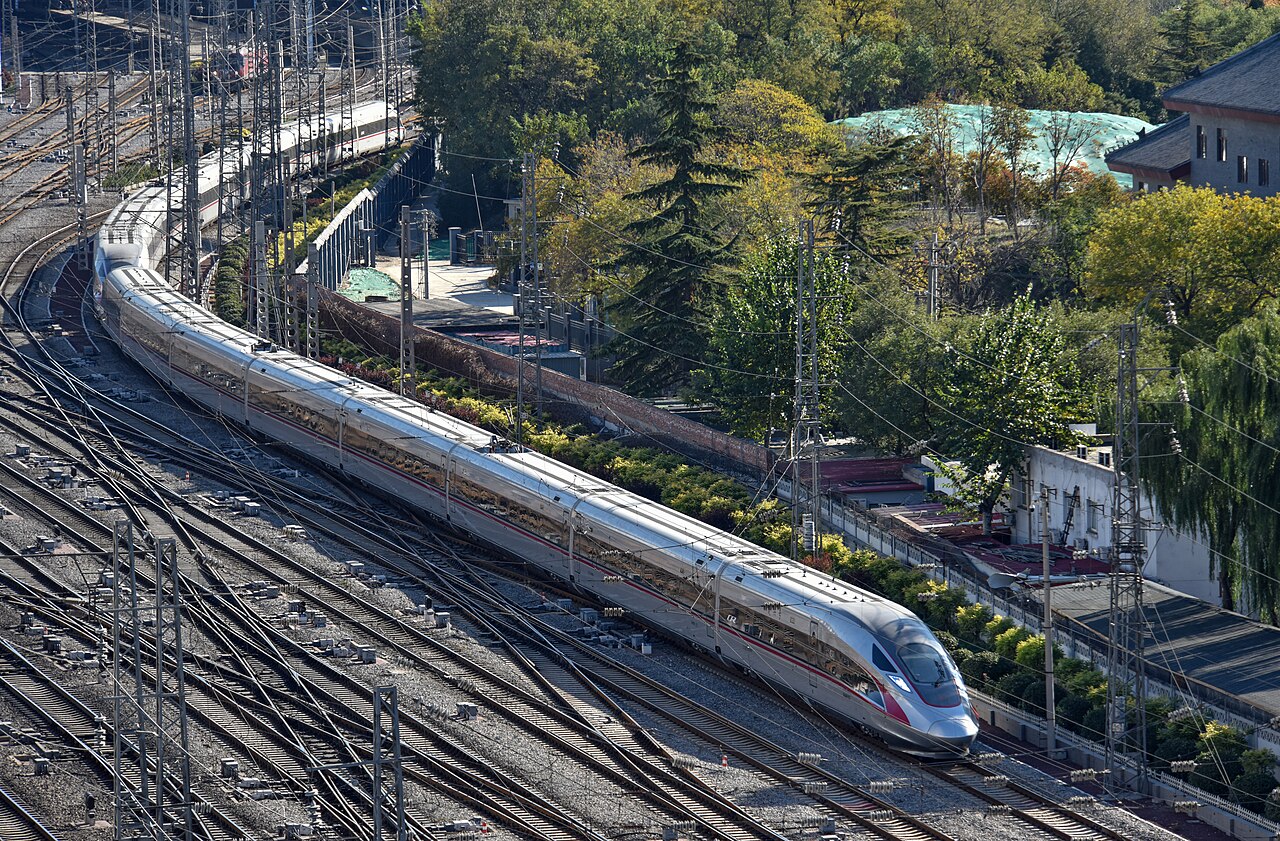
This route has no car: a foreign or international driving licence is not valid in China, and a visitor needs a Chinese licence to drive. It goes by the high-speed network instead, the largest in the world: from Beijing south-west to Xi’an, the old capital at the start of the Silk Road, over the Qinling mountains to Chengdu, an hour on to Chongqing, south through Guizhou to Guilin, by boat down the Li River to Yangshuo, and on the last day back to Guilin and east to Shanghai. The legs are long by European measure, three to five hours, but the trains run at 250 to 350 km/h, so each travel day still leaves the afternoon or the evening for the city. Be honest about the stations: the high-speed stations are mostly new ones on the edge of town, Xi’an North, Chengdu East, Guilin North, linked to the centre by metro or bus, so count half an hour to an hour at each end.
Travel China by high-speed train: Beijing to Shanghai
The route on our site, with a room up to $80 every night.