The Andes: From Santiago to Mendoza
When to go
November to April, the southern summer and autumn. The pass over the Andes climbs above three thousand metres, and from about June to September snow closes it, sometimes for days at a time, and even in spring and autumn a storm can shut it overnight. January is hot in Santiago and in Mendoza; in March Mendoza celebrates the grape harvest, the Vendimia, and the wineries are at their busiest.
The stops
Interactive map of the route on our site ›
- Santiago2 nights
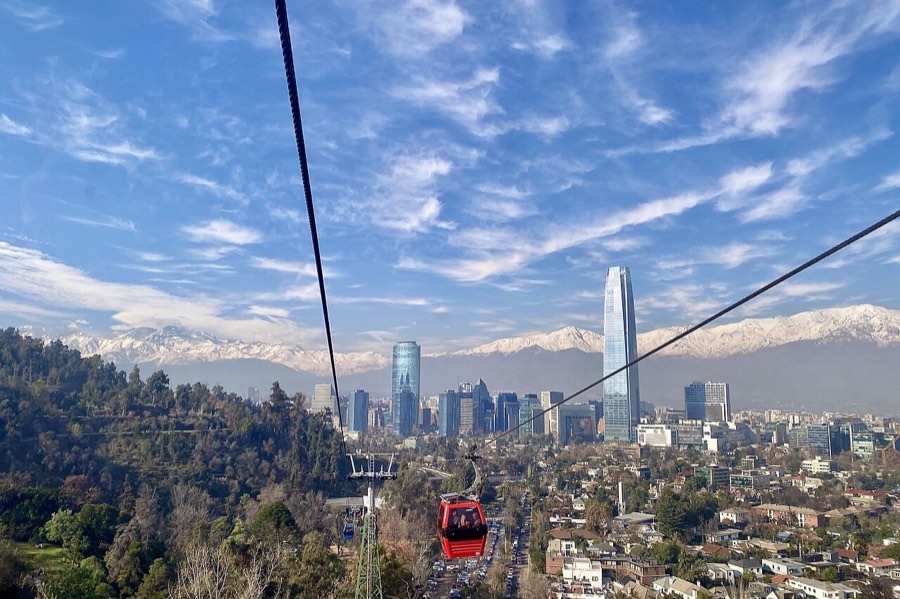
Founded by the Spanish conquistador Pedro de Valdivia on 12 February 1541, at the foot of the Santa Lucía hill, and laid out around the Plaza de Armas, where the cathedral stands. On a clear winter day after rain the snowy wall of the Andes rises straight behind the city.
- Casablanca Valleystop on the way
A wine valley between Santiago and the coast, where the first vines were planted only in the 1980s. The cool air and morning fog off the Pacific suit white wine, and the valley is known above all for its Sauvignon Blanc and Chardonnay; the wineries along Route 68 receive visitors for tastings.
- Valparaiso2 nights
A port city spilling down some forty hills to the bay, with houses painted in every colour and old funiculars, the ascensores, the first of which opened in 1883. Its historic quarter has been a World Heritage site since 2003, and Pablo Neruda’s house, La Sebastiana, looks down over the harbour.
- Los Andesone night
The last Chilean town before the pass, founded in 1791 by the governor Ambrosio O’Higgins, the father of Bernardo O’Higgins, the hero of Chile’s independence. Teresa of Los Andes, a Carmelite nun of the town’s convent who died in 1920 at nineteen, became Chile’s first saint in 1993, and her sanctuary at Auco, a short drive away, draws pilgrims from all over the country.
- Los Caracoles and Portillostop on the way
The Caracoles, the snails, are a ladder of twenty-nine hairpin bends that lift the road up the mountainside toward the border; lorries crawl up and down them all day, so keep to your lane and use a low gear on the way down. At the top lies Portillo, a ski resort beside the Laguna del Inca, which in 1966 held the World Alpine Ski Championships, the first ever held in the southern hemisphere.
- Los Libertadoresstop on the way
The border complex of the pass, where Chile and Argentina check passports and cars. The road crosses under the border in the Cristo Redentor tunnel, opened in 1980; above it, on the old road, stands the statue of Christ the Redeemer, raised in 1904 to mark the peace between the two countries, reached in summer only by a gravel track.
- Aconcagua viewpointstop on the way
At the entrance of the Aconcagua Provincial Park a short trail leads to the Horcones lagoon and the south face of Aconcagua, 6,961 metres high, the highest mountain in the world outside Asia. The park charges an entrance fee even for the short walk.
- Puente del Incaone night
A natural stone bridge over the Las Cuevas river, stained yellow and orange by the mineral springs that run over it. A spa hotel was built beside it; an avalanche destroyed it in 1965, and the ruin of its bathhouse still stands under the bridge. The hamlet beside it, at about 2,700 metres, is the base for climbers bound for Aconcagua, and its small Andinista cemetery holds the graves of climbers who died on the mountain.
- Uspallataone night
A green oasis town in a wide valley of bare coloured mountains, the last stop before the road drops to Mendoza. Its landscape stood in for Tibet in the film Seven Years in Tibet, shot here in 1997.
- Mendoza3 nights
An earthquake destroyed the city on 20 March 1861, and it was rebuilt on a new grid of wide avenues and squares, its streets lined with open irrigation channels, the acequias, that water the trees. Here General José de San Martín trained the Army of the Andes, which crossed the mountains in 1817 to free Chile.
- Maipú wineriesstop on the way
Mendoza makes most of Argentina’s wine, and Malbec is its grape. In Maipú and Luján de Cuyo, at the edge of the city, wineries open for tastings, and many visitors go round them by bicycle; with Argentina’s zero-alcohol law, that is the wiser way.

What it costs
Eighty dollars a night is the room. The car, the fuel and the tolls are yours: Santiago’s urban motorways charge by an electronic tag that the rental car carries, and the road to Valparaíso has toll plazas paid on the spot. The permission to take a Chilean rental car into Argentina, with its Argentine insurance, costs a fee on top of the rental. Few companies will let you leave a Chilean car in Argentina, and those that do charge heavily for it, so most drivers bring the car back over the pass to Santiago; plan the drive back as a day of its own. The Aconcagua park charges an entrance fee.
What to know
Four things. One: the border papers. A Chilean rental car may cross into Argentina only with a written permission from the rental company and insurance valid in Argentina. Ask for both when you book, weeks ahead, because the papers take time to issue and cost a fee; without them you will be turned back at the border. Two: the pass. The crossing at Cristo Redentor, on Chile’s side the Los Libertadores pass, closes whenever snow or wind demand it; check its status on the morning you drive, and carry chains in the cold months. Three: the border. The formalities of both countries are done at the Los Libertadores border complex, high on the pass: passports, the car papers and a search of the luggage. On summer weekends and holidays the queue can last hours. Four: food. No fresh fruit, vegetables, meat, cheese or honey across the border; Chile’s agricultural service, the SAG, is famously strict, and a forgotten apple brings a fine. Argentina has a zero-alcohol law for drivers; after a tasting, someone else drives.
Roads, tolls and rules
Chile and Argentina drive on the right. The route takes the crossing of the Andes slowly, in three short days with a night in Los Andes, at the foot of the pass, a night high up at Puente del Inca and a night in the oasis of Uspallata, so no day is longer than about two and a half hours at the wheel. From Santiago to Valparaíso is a motorway of an hour and a half. The road over the Andes leaves the coast for Los Andes, then climbs the Caracoles, a ladder of hairpins, to Portillo and the tunnel of Cristo Redentor, and on the Argentine side runs down the valley of the Mendoza river past Aconcagua, Puente del Inca and Uspallata. Fill the tank in Los Andes, drive it in daylight, and count on the border taking part of the day; the air above three thousand metres is thin, so go slowly and drink water.

Travel The Andes: From Santiago to Mendoza
The route on our site, with a room up to $80 every night.