Australia: The Great Ocean Road
When to go
November to April. The seasons are reversed: summer is December to February, the coast is warm and the evenings long, and over Christmas and the January school holidays the towns of the Great Ocean Road are full. March and April are settled and quieter. In winter, June to August, this coast is cold, wet and wild under the southern ocean; it is also the season when southern right whales come to calve off Warrnambool. In summer watch for days of total fire ban.
The stops
Interactive map of the route on our site ›
- Melbourne2 nights
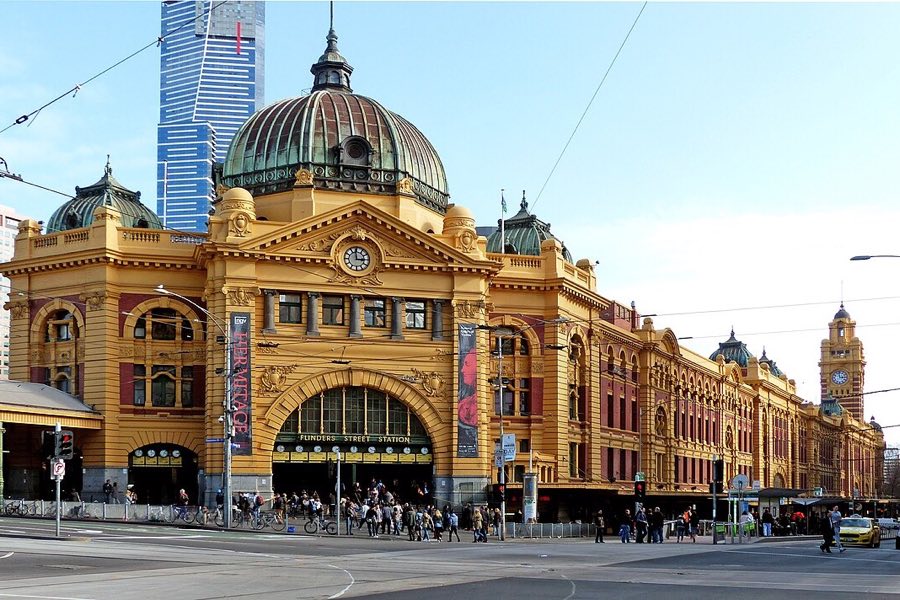
From federation in 1901 until 1927 Melbourne was the seat of the Australian parliament, while Canberra was being built. Sir John Monash, born here in 1865 to a Jewish family from Prussia, commanded the Australian Corps on the Western Front in 1918, and Monash University bears his name; the city has one of the largest Jewish communities in Australia, centred on St Kilda and Caulfield.
- Torquaystop on the way
The surf town where the Great Ocean Road begins. Rip Curl and Quiksilver were both started here around 1970 by local surfers making wetsuits and boardshorts, and the Australian National Surfing Museum is in the town’s surf-shop centre.
- Bells Beachstop on the way
A cove under the cliffs with one of the great right-hand waves of the world. Every Easter it hosts the Bells Beach surf contest, held since the early 1960s and the longest-running professional surfing event, and the winner rings a bronze bell as a trophy. Watch from the lookout above the car park.
- Memorial Archstop on the way
The wooden arch at Eastern View that marks the road as a war memorial. The Great Ocean Road was cut between 1919 and 1932 by some three thousand soldiers back from the First World War, with picks, shovels and explosives, in memory of those who did not return, and it is the largest war memorial in the world.
- Lorneone night
A seaside town at the mouth of the Erskine River, where the Otway forest comes down to the beach. Each January the Pier to Pub, a swim of about 1.2 kilometres across the bay, draws thousands and is one of the largest open-water swims in the world; Erskine Falls is a short drive up into the forest.
- Apollo Bay2 nights
A fishing town in a wide bay under the green hills of the Otway Ranges. Until the Great Ocean Road was finished in 1932 it was reached mostly by sea; the fishing boats still land crayfish at the harbour, and the rainforest walk at Maits Rest, among tree ferns and old myrtle beech, is a short drive west.
- Cape Otway Lightstationstop on the way
Lit in 1848, it is the oldest surviving lighthouse on the Australian mainland, on the cliffs where the Southern Ocean meets Bass Strait, a coast that wrecked many emigrant ships. On the road in, look up into the manna gums: koalas sleep in them.
- Twelve Apostlesstop on the way
Limestone stacks standing in the surf off the cliffs, cut from the mainland by the sea. There were never twelve of them: they were first called the Sow and Piglets and renamed to draw visitors, and one of them collapsed into the sea in 2005. Come at sunset, or early before the coaches.
- Loch Ard Gorgestop on the way
A narrow cove with a sand beach between high cliffs, named after the clipper Loch Ard, wrecked off it on 1 June 1878 near the end of her voyage from England. Of the fifty-four people aboard only two survived, both eighteen: the apprentice Tom Pearce, who was washed into the gorge and then swam back out to save Eva Carmichael.
- Port Campbellone night
The one small town on the cliffs of the Shipwreck Coast, in a narrow bay with a beach, inside the Port Campbell National Park. A night here puts the Twelve Apostles ten minutes away at sunset and again at dawn, before the coaches come from Melbourne; below them the Gibson Steps, cut into the cliff by the settler Hugh Gibson in the nineteenth century, lead down to the beach.
- London Archstop on the way
A double arch of limestone joined to the mainland, and so it was called London Bridge, after the nursery rhyme. On 15 January 1990 the span nearest the shore fell into the sea, leaving two visitors stranded on the far part until a helicopter lifted them off, and it was renamed London Arch.
- Flagstaff Hill, Warrnamboolstop on the way
A maritime village museum in Warrnambool, the largest town of this coast. It keeps the Loch Ard Peacock, a life-size porcelain peacock made by Minton for the Melbourne Exhibition of 1880, that washed ashore from the wreck in its packing case almost unharmed. From June to September southern right whales come to calve off Logans Beach, just east of the town.
- Tower Hillstop on the way
A dormant volcano whose wide crater holds a lake with islands, now a wildlife reserve where emus, koalas and kangaroos live in the open. By the 1950s the land had been cleared and grazed bare, and it was replanted using an 1855 painting of the crater by Eugene von Guérard as the guide to what had grown there.
- Port Fairyone night
A fishing port of whitewashed cottages, settled by whalers and sealers in the 1830s. On Griffiths Island, joined to the town by a causeway, short-tailed shearwaters nest in burrows from late September; they fly in at dusk from a yearly migration to the North Pacific and back.
- Halls Gap2 nights
The village in the heart of the Grampians, Gariwerd to its traditional owners, sandstone ranges that rise like breaking waves out of the plains. Most of the Aboriginal rock art sites known in Victoria are in these ranges, and the Brambuk cultural centre in the village tells their story; kangaroos graze on the village oval at dusk.
- Nhillone night
A wheat town of the Wimmera, built around a small lake, halfway between Melbourne and Adelaide. From 2010 the local duck processor, Luv-a-Duck, began hiring Karen refugees from Burma, and so many families followed that the Karen community has become part of the life of the town.
- Bordertownstop on the way
The first town over the border in South Australia, where Bob Hawke, prime minister of Australia from 1983 to 1991, was born in 1929. Beside the main road a wildlife park keeps a mob of white kangaroos.
- Keith SAone night
A farm town in what was once called the Ninety Mile Desert, scrub country where crops and sheep failed. In the 1940s scientists of the CSIRO found that the soil lacked copper and zinc; with those added, the land was cleared and settled as farms from the late 1940s, and the desert became green pasture.
- Murray Bridgeone night
The town on the lower Murray, the longest river in Australia, is named after its bridge: the iron road bridge opened here in 1879 was the first to cross the river in South Australia. Paddle steamers once carried wool and wheat along the river, and a few still take passengers.
- Hahndorfstop on the way
A village in the Adelaide Hills founded in 1839 by Lutherans from Prussia who had come out on the ship Zebra, and named after her captain, Dirk Hahn, who helped them find the land. It is the oldest surviving German settlement in Australia, with stone houses, bakeries and wurst along its main street.
- Adelaide3 nights
A planned city, laid out in 1837 by Colonel William Light on a grid of streets and squares ringed by a belt of parkland that still surrounds the centre. South Australia was founded by free settlers, without convicts, and in 1894 it became one of the first places in the world to give women the vote and the first to let them stand for parliament.

What it costs
Eighty dollars a night is the room. The car and the fuel are yours, and this route has no toll roads once you are out of Melbourne; the city’s own tollways, CityLink and EastLink, are paid online or through the rental company, which adds a fee. The real extra is the one-way fee: picking the car up in Melbourne and leaving it in Adelaide, in another state, costs a one-way charge that can be large, so compare it before you book, or plan to drive back.
What to know
Three things. One: Australia drives on the left, and the Great Ocean Road is a narrow, winding two-lane road on the edge of the cliffs; use the lay-bys to let the queue behind you pass, and never stop on the road for a photograph. Two, and above all: kangaroos. At dawn and at dusk they come out on to the roads, above all in the Otways and the Grampians, and hitting one at speed wrecks the car; do not drive in the country after sunset, and many rental contracts do not cover it. Three: the distances. Between Halls Gap and Adelaide it is about five hundred kilometres of open wheat and scrub country with long stretches between towns, split here into four short days; fill up whenever you can and carry water.
Roads, tolls and rules
Australia drives on the left. From Melbourne a fast freeway runs to Geelong and Torquay; from there the Great Ocean Road hugs the coast to Apollo Bay, cuts inland through the Otway forest and comes back to the sea at the Twelve Apostles. The coast is taken slowly, with nights in Lorne, Apollo Bay, Port Campbell and Port Fairy. From Port Fairy the route turns inland to the Grampians and then along the Western Highway to Adelaide, with nights in Nhill, Keith and Murray Bridge. South Australia is half an hour behind Victoria, so set the clock back at the border.

Travel Australia: The Great Ocean Road
The route on our site, with a room up to $80 every night.