The Alps: From Munich to Ljubljana
When to go
June to September. The Grossglockner road at the heart of this route is open only from about early May to early November, and its top can be in cloud or snow in May and October. July and August bring the crowds to Neuschwanstein, Hallstatt and Bled; June and September give the same mountains with half the people. In winter the passes close and the lakes are grey, but Salzburg and Munich have their Christmas markets.
The stops
Interactive map of the route on our site ›
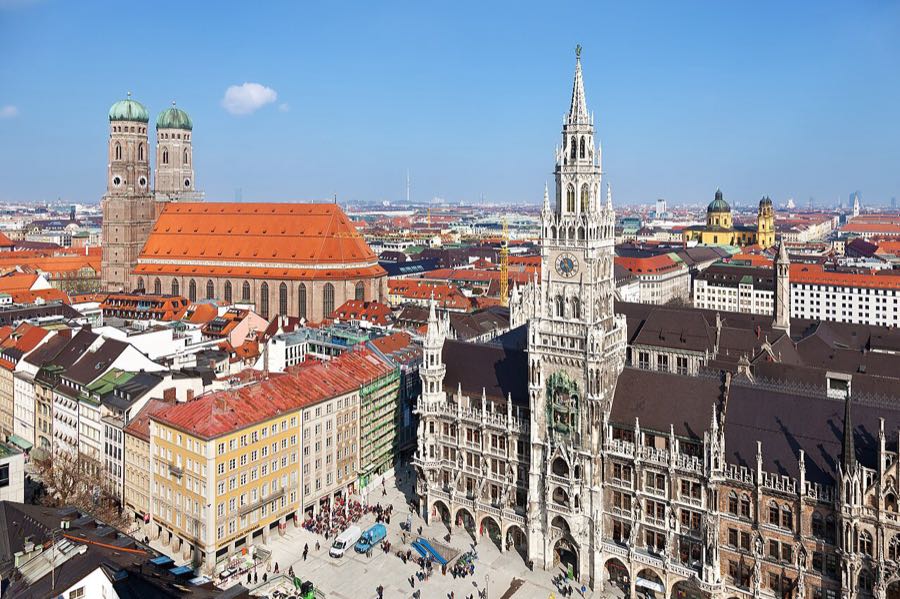
- Munich2 nights
On Sankt-Jakobs-Platz stands the Ohel Jakob synagogue, opened in 2006, the city’s Jewish community back at the heart of the city that the Nazis called the capital of their movement. Twenty kilometres north is Dachau, the first concentration camp, opened in March 1933, now a memorial site.
- Wieskirchestop on the way
A pilgrimage church in a meadow, built from 1745 to 1754 by Dominikus Zimmermann around a wooden figure of the scourged Christ that a farmer’s wife said had wept. Plain outside and a white and gold whirl of Rococo within, it has been a World Heritage site since 1983.
- Neuschwansteinstop on the way
The castle that King Ludwig II of Bavaria began in 1869 as a stage set for his own dreams of the Middle Ages. He lived in it only a few months; it was opened to visitors weeks after his mysterious death in 1886, and it is held to be the model for Disney’s Sleeping Beauty castle. Entry is by timed ticket, booked ahead in summer.
- Fussenone night
A town on the Lech under the Alps, at the southern end of the Romantic Road. In 1562 the first guild of lute makers in Europe was founded here, and the town was long a centre of lutes and violins; the courtyard walls of the High Castle are painted with windows and towers that are not there.
- Linderhof Palacestop on the way
The smallest of Ludwig II’s palaces and the only one he saw finished and lived in for long. In the park he had an artificial cave built, the Venus Grotto, with a lake for a swan boat, lit in colour from one of the first electric power plants in Bavaria.
- Oberammergaustop on the way
In 1633, as plague swept the region, the villagers vowed to stage the Passion of Christ every ten years, and they have done so since 1634, with hundreds of locals on stage. For centuries the play cast the Jews as Christ’s killers; after long protests by Jewish and Christian groups its text was rewritten in recent decades. The houses are painted with frescoes, the Lüftlmalerei.
- Garmisch-Partenkirchenone night
Two old market towns that were merged in 1935, on the orders of the Nazi government, to host the Winter Olympics of 1936. Above them rises the Zugspitze, at 2,962 metres the highest mountain in Germany, reached by a cog railway and a cable car.
- Tegernseestop on the way
A lake whose Benedictine abbey was founded in the eighth century; after it was dissolved in 1803 the kings of Bavaria made it their summer palace. The ducal brewery still brews in the old monastery and pours its beer in a beer hall beside it.
- Prien am Chiemsee2 nights
A market town on the Chiemsee, the largest lake in Bavaria, which the locals call the Bavarian Sea. From its pier at Stock the boats cross to the two islands, the Herreninsel and the Fraueninsel.
- Herrenchiemseestop on the way
On the island Ludwig II began in 1878 his own copy of Versailles, and its Hall of Mirrors is longer than the original. The money ran out, the palace was never finished, and the king spent only about ten days in it; the boat from Prien takes some fifteen minutes, and the car stays on the shore.
- Salzburg2 nights
Mozart was born in 1756 in the yellow house at Getreidegasse 9, now a museum. The baroque old town under the fortress has been a World Heritage site since 1996, and the film The Sound of Music was shot in and around the city.
- Konigsseestop on the way
A narrow lake under sheer walls, half an hour across the German border from Salzburg. Only electric boats sail it, since 1909, and halfway along the boatman stops to play a trumpet against the rock face, which throws the echo back. The red domes of St Bartholomew’s church stand on a spit reached only by boat.
- Hallstatt2 nights
Salt has been mined in the mountain above the village for some seven thousand years, and the graves found here in the nineteenth century gave their name to a whole period of European prehistory, the Hallstatt culture. With no room for a cemetery, the bones were moved to a charnel house, where hundreds of skulls are painted with names and flowers. China built a copy of the village in 2012.
- Zell am Seeone night
A town on a lake under the Schmittenhöhe, whose cable car first ran in 1927. On the square, the old heart of the town, stands the Romanesque church of Saint Hippolytus, and above Kaprun next door rises the glacier of the Kitzsteinhorn.
- Grossglockner High Alpine Roadstop on the way
A toll road built between 1930 and 1935 over the main ridge of the Alps, its highest point at the Hochtor tunnel at 2,504 metres. From the Kaiser-Franz-Josefs-Hohe you look across at the Grossglockner, the highest mountain in Austria, and down on the Pasterze, the country’s longest glacier, shrinking every year.
- Heiligenblutstop on the way
A village whose slender Gothic spire stands against the Grossglockner in one of the best-known views of the Alps. Its name, Holy Blood, comes from the legend of a knight named Briccius who in 914 was carrying a phial of Christ’s blood from Constantinople and died here in an avalanche; the phial is still kept in the church.
- Lienzone night
The capital of East Tyrol, where the Isel meets the Drava under the jagged Lienz Dolomites. Bruck Castle above the town holds the largest collection of the painter Albin Egger-Lienz, who added the town’s name to his own.
- Porcia Castle, Spittalstop on the way
A Renaissance palace around a courtyard of three storeys of arcades, begun in 1533 by Gabriel von Salamanca, the Spanish treasurer of Archduke Ferdinand, and one of the finest Italian-style palaces north of the Alps. In summer the courtyard is a theatre.
- Bled2 nights
A lake with the only island in Slovenia, reached by a flat wooden pletna boat; ninety-nine steps lead up to the church, where visitors ring the wishing bell. The castle on the cliff above was first mentioned in 1011, and the cream cake, the kremsnita, has been baked here since 1953.
- Vintgar Gorgestop on the way
A gorge of the Radovna river a few kilometres from Bled, walked on some 1.6 kilometres of wooden galleries fixed to the rock above the rapids. It was opened to visitors in 1893; today the walk runs one way only, and tickets are best booked online.
- Lake Bohinjstop on the way
The largest permanent lake in Slovenia, inside Triglav National Park, quieter and wilder than Bled. Above its western end the Savica waterfall drops into a gorge, and from Ukanc a cable car climbs to Vogel for the view over the Julian Alps.
- Ljubljana2 nights
The architect Joze Plecnik remade the city between the two world wars, from the Triple Bridge to the covered market on the river. The centre has been closed to cars since 2007, and in 2016 Ljubljana was European Green Capital.
What it costs
Eighty dollars a night is the room. The car, the fuel and the road charges are yours: German motorways are free, but Austria needs a vignette for its motorways, Slovenia an e-vignette for its own, and the Grossglockner road and the Karawanks tunnel into Slovenia each charge a separate toll at a booth. A car hired in Munich and left in Ljubljana carries a one-way fee across the border, often a large one — ask for it in writing before you book. Parking in Hallstatt, at the Konigssee and at Neuschwanstein is paid.
What to know
Three things. One: the Austrian vignette. It is needed on the Austrian motorways and expressways, and cameras and police check it; a digital vignette bought online becomes valid only on the eighteenth day after purchase, so buy it in advance or buy it at a petrol station before the border, where it is valid at once. Two: Slovenia sells its vignette only electronically, registered to the number plate, and driving on a Slovenian motorway without it brings a heavy fine on the spot. Three: Hallstatt. The village is closed to outside cars; leave the car in the paid car parks above the village by the tunnel and walk down, and if you are sleeping in the village, ask the hotel how to bring the luggage in. If the Grossglockner road is closed, the Tauern motorway with its tunnel is the way south.
Roads, tolls and rules
All three countries drive on the right, and the roads are excellent. No day of this route is longer than about a hundred and sixty kilometres: Bavaria takes four short days through Ludwig II’s castles and lakes, and the Grossglockner day, from Zell am See over the pass to Lienz, is short in distance but slow, a mountain road with thirty-odd hairpins. Austria requires winter tyres in wintry conditions from November to mid-April, and Slovenia winter equipment from mid-November to mid-March.

Travel The Alps: From Munich to Ljubljana
The route on our site, with a room up to $80 every night.